

Measurements, from May 2021 (Vol.44 No.5)
In the April 2021 issue of Stereophile, Herb Reichert wrote that he'd spent "almost 40 continuous years using first the kit, then the Rogers, then the Falcon LS3/5a's. Now, a new 5a has entered my world. It is what Falcon calls the 'Gold Badge' version ($2999/pair), and I think it might be the best LS3/5a ever produced for general consumption." The Falcon Acoustics' Gold Badge LS3/5a is a new version of the Falcon LS3/5a Herb reviewed in the July 2015 issue and which he has been using ever since.
Herb tried driving the new Falcons with a variety of amplifiers and concluded, "No matter which amp I was using, every time I put the new Falcon LS3/5a Gold Badges in the system, I did not want to take them out. I did not want to lose their beautifully balanced, let-out-my-breath, forget-about-audio just-rightness."
The LS3/5a has been in continuous production, in one form or another, for almost 46 years. I can't think of another design from the 1970s that is still competitive with modern loudspeakers. Some background is in order:
In the early 1970s, the BBC in the UK needed a small on-location monitor that would provide consistent reproduction in small, suboptimal environments such as a recording truck. A team led by T. Sommerville and D.E. Shorter, of the BBC's Research Department, based the LS3/5 on a small monitor they had designed for acoustic scaling experiments. That monitor used a B110 woofer with a doped Bextrene cone and a T27 SP1032 Mylar-dome tweeter, both sourced from British manufacturer KEF (footnote 1). The speaker showed much promise, but problems with the drive-units led to a detailed redesign, which was carried out by Dudley Harwood of the BBC's Research Department and Maurice E. Whatton and R.W. Mills of the Designs Department. The result was the LS3/5a, and the BBC licensed the design to several manufacturers, most recently Falcon, Graham, and the revitalized Rogers company (footnote 2).
I own a 1978 pair of Rogers LS3/5a's and have been using them as a reference ever since Stereophile started publishing loudspeaker measurements in 1989. Before I perform the measurements of a loudspeaker under review, I measure the on-axis response and sensitivity of one of those 1978 speakers. I do this to ensure that a systematic error has not crept into my speaker measurements. If the LS3/5a continues to measure identically, then I can be sure that nothing has gone wrong with my test gear: microphone, mike preamp, power amplifier, etc.

After HR had written his review of the Falcon LS3/5a Gold Badge, I used DRA Labs' MLSSA system and a calibrated DPA 4006 microphone to measure the loudspeaker's frequency response in the farfield and an Earthworks QTC-40 mike for the nearfield and in-room responses. (The grille was left in place for all the acoustic measurements, as recommended in the Gold Badge's manual.) I measured the speaker's impedance with Dayton Audio's DATS V2 system, checking the results with MLSSA.




Choosing at which frequency to normalize the responses in graphs like this is tricky. With loudspeakers that have "lumpy" in-room responses—and they all do—which frequency region the ear hears as the reference depends very much on the type of music being played. I decided to make the traces equal in level at 1kHz, which also makes the levels of the three speakers' mid-treble region and the peaks in the upper-bass very similar. The reflex-loaded KEFs have more mid-bass output than the two LS3/5a's, but their faster low-frequency rolloff means that they don't excite the 30Hz room resonance. While the Falcons have less presence-region energy than the KEFs and Rogers, the KEFs have less top-octave energy than the two LS3/5a versions.
Choosing 1kHz to normalize the traces makes it look as if the KEFs have considerably more output in the midrange. However, when I listened to the 1978 LS3/5a's and LS50 Metas, the KEFs had a noticeably lower high treble, which suggests that I was hearing their midrange as being correct with the music I was playing. The slight lack of midrange energy with both versions of the LS3/5a might make the treble sound a touch exaggerated, though with the elevated upper bass, this classic "smile" balance will flatter many recordings.
The Falcon LS3/5a Gold Badge's measured performance reflects the design's pedigree and confirms that 46 years after the introduction of the original, this is still a competitive loudspeaker.—John Atkinson
Footnote 1: In a recent email Martin Colloms wrote that "We should laud the late Raymond Cooke who pioneered low-coloration drivers and engineered the first examples of the B110 and the T27 in 1966—[long before] these were used in the LS3/5a! Footnote 2: You can find Stereophile's complete coverage of the LS3/5a, starting with J. Gordon Holt's March 1977 review here. A brief essay on the design that I wrote in 2005 can be found here. The late Art Dudley reviewed modern versions of the LS3/5a manufactured by Graham and Rogers in one of his final "Listening" columns, published in April 2020.
Footnote 3: EPDR is the resistive load that gives rise to the same peak dissipation in an amplifier's output devices as the loudspeaker. See "Audio Power Amplifiers for Loudspeaker Loads," JAES, Vol.42 No.9, September 1994, and stereophile.com/reference/707heavy/index.html.
Footnote 4: My thanks to the Italian Outline company, who used to manufacture the ST-2 computer-controlled turntable I have used for the past 30 years for my dispersion measurements. The 10m cable that connects the turntable to its ET-1 control box broke (again) and the 6-pole DIN connector at the turntable end had fractured and couldn't be repaired. Outline initially told me that they had no spares—the turntable had been discontinued 13 years ago—but a couple of days later they let me know they had found a replacement cable in a box in their warehouse. It arrived in time for me to use for this followup.
Footnote 6: Using FuzzMeasure 3.0 and a 96kHz sample rate, I average 20 1/6-octave–smoothed spectra, individually taken for the left and right speakers, in a rectangular grid 36" wide by 18" high and centered on the positions of my ears.
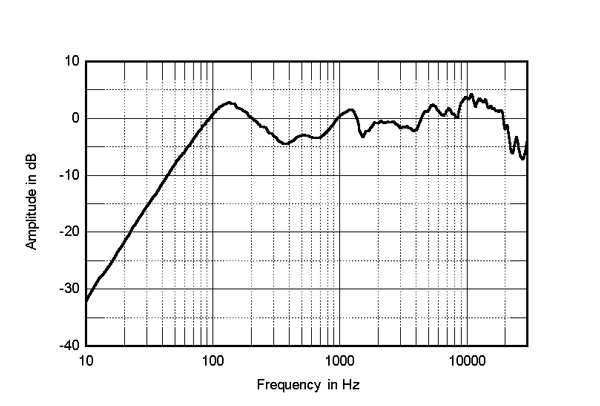
Fig.1 1978 Rogers LS3/5a, anechoic response on tweeter axis at 50", averaged across 30° horizontal window and corrected for microphone response, with the nearfield woofer response plotted below 300Hz.
The quasi-anechoic frequency response of my Rogers LS3/5a, averaged across a 30° horizontal window centered on the tweeter axis and spliced below 300Hz to the nearfield woofer response, is shown in fig.1. Small peaks in the upper bass and just above 1kHz are set against a gently rising trend in the treble; the overall response is otherwise even and smooth. While the low-frequency output is restricted—this is a small loudspeaker—the sealed-box alignment means that the bass rolls off more slowly than a typical ported design, with a 12dB/octave slope rather than 24dB/octave.
Fig.2 Falcon LS3/5a Gold Badge, electrical impedance (solid) and phase (dashed) (2 ohms/vertical div.).
Falcon specifies the LS3/5a Gold Badge's sensitivity as a low 83dB/2.83V/m. My estimate was within experimental error of that figure, at 82.7dB(B)/2.83V/m. The LS3/5a Gold Badge's impedance is specified as 15 ohms. As measured, the impedance magnitude (fig.2, solid trace) remains above 8 ohms for almost the entire audioband and lies above 12 ohms between 40Hz and 105Hz and between 300Hz and 3kHz. While the minimum impedance is a still-high 7.3 ohms at 157Hz, the electrical phase angle (dashed trace) is occasionally high. Even so, the EPDR (footnote 3) is 3.4–4.0 ohms below 60Hz and 3.3 ohms between 117Hz and 121Hz. The LS3/5a Gold Badge is a relatively easy load.
Fig.3 Falcon LS3/5a Gold Badge, cumulative spectral-decay plot calculated from output of accelerometer fastened to center of side panel (MLS driving voltage to speaker, 7.55V; measurement bandwidth, 2kHz).
The traces in fig.2 are free from the small discontinuities that would imply resonances of some kind. I investigated the enclosure's vibrational behavior with a plastic-tape accelerometer and the speaker supported on upturned cones, which allows resonances to fully develop. Other than a negligible amount of flexing at the woofer's tuning frequency, the only resonant modes I found were in the midrange on the sidewalls (fig.3). These modes have a high Q (Quality Factor) and a very low level, both of which will minimize their audibility. The Gold Badge's enclosure is significantly better-behaved than that of Falcon's 2015 LS3/5a.
Fig.4 Falcon LS3/5a Gold Badge, anechoic response on tweeter axis at 50", averaged across 30° horizontal window and corrected for microphone response, with the nearfield woofer response plotted below 300Hz.
Comparing fig.4 with fig.1, the Gold Badge LS3/5a's upper bass can be seen to be a little higher in level than that of the 1978 LS3/5a. In part, this will be due to the nearfield measurement, which assumes that the woofer is mounted in a true infinite baffle, ie, one that extends to infinity in both planes. It suggests, however, that the new speaker's alignment is less well-damped than that of the older speaker.
Fig.5 Falcon original LS3/5a, anechoic response on tweeter axis at 50", averaged across 30° horizontal window and corrected for microphone response, with the nearfield woofer response plotted below 300Hz.
Higher in frequency in fig.4, the Falcon's farfield response, averaged across a 30° horizontal window centered on the tweeter axis, is not quite as even as that of the 1978 LS3/5a. However, it is smoother than that of the 2015 Falcon LS3/5a (fig.5), and the small peak between 900Hz and 1.8kHz is slightly higher in frequency and lower in amplitude than that of the older speaker. The new speaker's output above 15kHz is also better-behaved than that of the 2015 speaker.
Fig.6 Falcon LS3/5a Gold Badge, lateral response family at 50", normalized to response on tweeter axis, from back to front: differences in response 90–5° off axis, reference response, differences in response 5–90° off axis.
Fig.7 Falcon LS3/5a Gold Badge, vertical response family at 50", normalized to response on tweeter axis, from back to front: differences in response 45–5° above axis, reference response, differences in response 5–45° below axis.
Fig.6 shows the LS3/5a Gold Badge's horizontal dispersion, normalized to the response on the tweeter axis, which thus appears as a straight line (footnote 4). The loudspeaker's radiation pattern narrows at the top of the woofer's passband, which might make the speaker sound a little polite. Small dips in the lower treble in the on-axis response fill in to the sides. In the vertical plane (fig.7), a suckout in the crossover region develops more than 10° above and 5° below the tweeter axis. Falcon recommends using 24" stands with the LS3/5a, which will place the tweeter 35.5" from the floor—just below the height of an average listener's ears. Don't listen to the Falcons in a chair that's too high or use stands that are much taller or shorter than 24".
Fig.8 Falcon LS3/5a Gold Badge, spatially averaged, 1/6-octave response in JA's listening room.
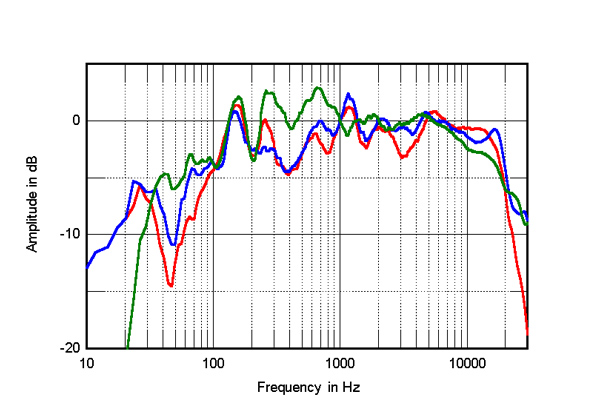
The Falcon LS3/5a Gold Badges' spatially averaged response in my room is shown in fig.8. The spatial averaging (footnote 5) tends to average out the peaks and dips below 400Hz that are due to the room's resonant modes. A loudspeaker that offers a flat on-axis response and well-controlled lateral dispersion gives a gently sloped-down treble in the spatially averaged room response, due primarily to the increased absorption of the room's furnishings at high frequencies. By that criterion, the LS3/5a Gold Badge produces a little too much energy in-room in the top two audio octaves. There is a small peak in the upper bass, but as the sealed-box rolloff is relatively gentle, the Falcons still excite the lowest-frequency room resonance around 30Hz, as do the 1978 Rogers LS3/5a's (fig.9, blue trace).
Fig.9 Falcon LS3/5a Gold Badge (red) and 1978 Rogers LS3/5a (blue), spatially averaged, 1/6-octave response in JA's listening room.
This graph also shows that the Falcons' in-room behavior (red trace) is very similar to that of the Rogers. The Falcons produce a little less midbass energy, however, which I suspect is due to the new speakers being a little farther away from the wall behind them than the older ones, which I had measured in 2017.
Fig.10 Falcon LS3/5a Gold Badge (red), 1978 Rogers LS3/5a (blue), and KEF LS50 Meta (green), spatially averaged, 1/6-octave response in JA's listening room.
Fig.10 repeats the spatially averaged responses of the LS3/5a Gold Badges (red trace) and the 1978 LS3/5a's (blue trace), but with an expanded vertical scale. It also compares those responses with that of the KEF LS50 Metas I reviewed in January 2021 (green trace). The KEFs and Falcons were in very similar positions in my room.
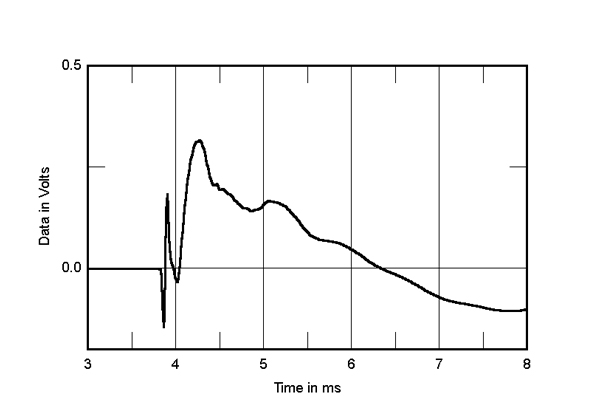
Fig.11 Falcon LS3/5a Gold Badge, step response on tweeter axis at 50" (5ms time window, 30kHz bandwidth).
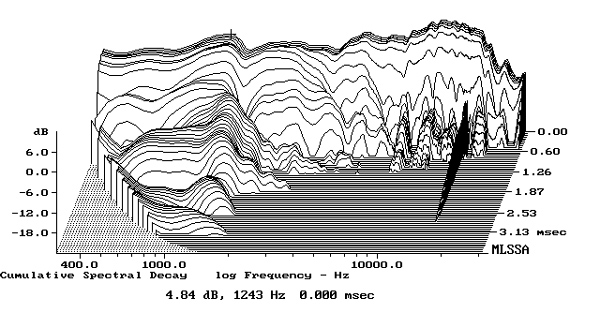
Fig.12 Falcon LS3/5a Gold Badge, cumulative spectral-decay plot on tweeter axis at 50" (0.15ms risetime).
In the time domain, the LS3/5a Gold Badge's step response on the tweeter axis (fig.11) is basically the same as that of all versions of the LS3/5a that we have reviewed. The tweeter is connected in inverted acoustic polarity, the woofer in positive polarity, and there is a ripple in the decay of the woofer's step that correlates with a ridge of resonant energy centered just above 1kHz in the loudspeaker's cumulative spectral-decay plot (fig.12). This ridge is less prominent than with the 2015 Falcon LS3/5a, and I would expect that the slightly nasal coloration that is associated with this behavior, which has been a consistent feature in the LS3/5a's sonic character, will be less audible with the Gold Badge.
Footnote 1: In a recent email Martin Colloms wrote that "We should laud the late Raymond Cooke who pioneered low-coloration drivers and engineered the first examples of the B110 and the T27 in 1966—[long before] these were used in the LS3/5a! Footnote 2: You can find Stereophile's complete coverage of the LS3/5a, starting with J. Gordon Holt's March 1977 review here. A brief essay on the design that I wrote in 2005 can be found here. The late Art Dudley reviewed modern versions of the LS3/5a manufactured by Graham and Rogers in one of his final "Listening" columns, published in April 2020.















