There are two compelling and (one not so compelling) reasons to record this way, instead of just using two actual rather than virtual angled X-Y directional microphones. First, unlike X-Y pairs, in M-S technique the Mid mike is completely on-axis to the sound source. Obviously, this would make less of a difference for an orchestra than for a point source. But for natural recordings of voice, guitar, harpsichord, piano, or any other small source, it should make a worthwhile difference.
Second, by using M-S technique, very fine adjustments of the balance of direct and ambient sounds are possible far more easily than by moving the microphones' physical locations, by merely turning the Width knob on the M-S matrix.
The not-so-compelling reason to use M-S technique is actually the reason for which Alan Blumlein's invention of it was first commercially implemented, by Holger Lauridsen of Danish State Radio. M-S allows stereo broadcasts to be auditioned in mono with little or no degradation. When the Left and Right channels are combined, the ambient information, being phase and antiphase from a common source, cancels itself out, leaving a clear mono signal.
M-S's combination of stereo image flexibility and mono compatibility make it a natural for film-sound use. Indeed, Jerry Bruck was Stereo Sound Consultant for Fame, believed to be the first use of M-S microphone technique for a motion-picture soundtrack. Since then, M-S technique has become well established in the film-sound industry.
Practical M-S
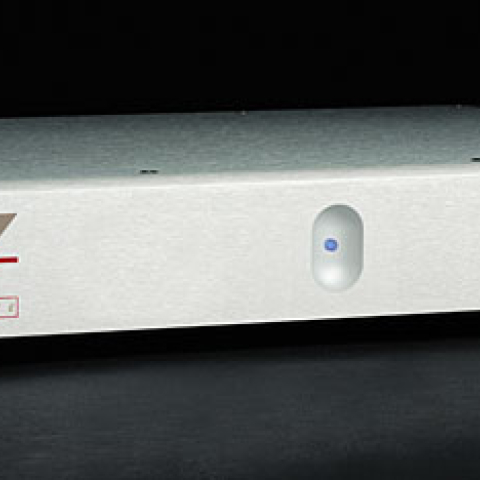
Unless you've had the experience of hearing the width of the stereo soundstage and associated room sound go from "not enough" to "too much," then back to "just right," all at the turn of a knob, you can't understand how empowering M-S technique is—or how much good clean fun it can be. So here's what I will do. I will make a recording of a point source in which the stereo width goes from all-direct sound to all-ambient sound, then back to what I think is an optimum blend . (You can download these examples, burn them to a CDR, and play it on your stereo—or even just route it or Airport it over there, if you're set up for that.) To use the True Systems P2analog in M-S mode, you connect the Mid mike to Channel 1, the Side mike to Channel 2, and engage the M-S button on the front panel. The Channel 1 gain knob controls the volume of the Mid mike, while the Channel 2 gain knob controls stereo width. The P2's analog outputs then put out conventional Left and Right stereo signals. Of course, with the M-S function not engaged, the P2 functions as a conventional 2-channel stereo microphone preamplifier.
As if M-S capability weren't enough, the P2 also boasts a stereo image (phase) indicator consisting of a row of colored lights that run, left to right, from green to yellow to red. The left, green end indicates that both channels are largely in phase, which means that you are, intentionally or not, recording in mono. The right, red end indicates that both channels are largely out of phase, which suggests that you might have something connected wrong, or that you really like the sound of an M-S array with all S and no M. Centered in the middle of yellow, with excursions into red and green on both sides, means that you're in the stereo ballpark. The stereo display is not only a confidence enhancer, it's addicting to watch. I was happiest with the image when the indicators were more green than red, but I hate the hole-in-the-middle effect.
The P2 has an aluminized front panel of a distinctive fire-engine red. Its industrial design and fit and finish are excellent, as is the owner's manual.
 Into the sanctuary
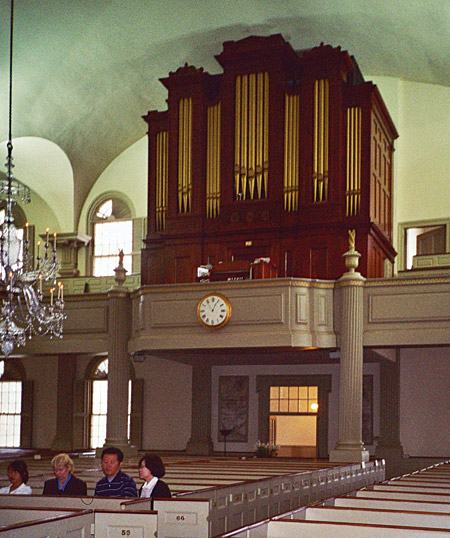
Steve Dreyfuss, an affable local recording engineer, allowed me to tag along on some of his projects so I could play with my new toys. We first made about two dozen mike-position and pattern tests in the Meeting House (1774–75) of the First Baptist Church in America, recording the 1884 Hook-Foley/Baker organ (which includes pipes from the original organ of 1834), preparatory to recording it for the Rhode Island chapter of the American Guild of Organists' planned CD documenting significant pipe organs of Rhode Island. Test-to-test repeatability was ensured by organist Steve Martorella's having recorded a one-minute soft-to-loud flourish onto the organ's hard-disk drive (a "player" system somewhat akin to Yamaha's Disklavier), so it could be replayed at the touch of a button.
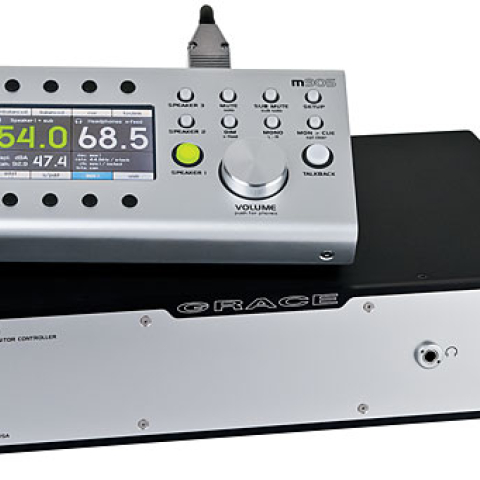
Not to take anything away from the True Systems P2analog, but if you're willing to spend about the same money and do without the P2's direct inputs, M-S matrix, and stereo indicator, there is one microphone preamplifier that I found sounded even more liquid, coherent, and involving: the Grace Design Model 201 ($1995). This is a stripped-down hot-rod of a purist mike preamp: for each channel there is a single indicator light for signal presence (green) and the approach of overload (it changes to red). The construction quality is deluxe. Thoughtful touches abound, such as small ovals made of dry-erase marker-board material for each channel, useful for making notes about settings.
 Because the Grace 201 uses stepped resistor arrays to set Gain, it also provides rotary-potentiometer Trim controls (with 10dB ranges) to set fine level adjustments. In normal practice, the Trim pots are left turned fully clockwise; fine adjustments are accomplished only by reducing the recording level, not increasing it. The Trim controls are good to have, because no matter how deft the hand that switches the Gain settings, there will be an audible discontinuity in the recorded sound as one set of resistors is switched out and another is switched in.
For both the True and the Grace, balanced analog outputs were carried to the digital recorders on Wireworld Eclipse 5 interconnects ($345/0.5m balanced pair). I found the construction quality superb; the XLR connectors were a joy to use. Their sound was sufficiently engaging that when, to break in the Eclipse 5s, I used them to run the darTZeel nhb-108 power amp, it was no letdown at all.
In two words, the True Systems P2analog is more analytical, the Grace Design 201 more lyrical. I think that both are cases of getting what you pay for. Were the final microphone choice to be an M-S array, the True Systems would get my nod; were it to be a more conventional array, I would choose the Grace Design. No tears and no hearts breakin', no remorse.
The envelope, please
Because the Grace 201 uses stepped resistor arrays to set Gain, it also provides rotary-potentiometer Trim controls (with 10dB ranges) to set fine level adjustments. In normal practice, the Trim pots are left turned fully clockwise; fine adjustments are accomplished only by reducing the recording level, not increasing it. The Trim controls are good to have, because no matter how deft the hand that switches the Gain settings, there will be an audible discontinuity in the recorded sound as one set of resistors is switched out and another is switched in.
For both the True and the Grace, balanced analog outputs were carried to the digital recorders on Wireworld Eclipse 5 interconnects ($345/0.5m balanced pair). I found the construction quality superb; the XLR connectors were a joy to use. Their sound was sufficiently engaging that when, to break in the Eclipse 5s, I used them to run the darTZeel nhb-108 power amp, it was no letdown at all.
In two words, the True Systems P2analog is more analytical, the Grace Design 201 more lyrical. I think that both are cases of getting what you pay for. Were the final microphone choice to be an M-S array, the True Systems would get my nod; were it to be a more conventional array, I would choose the Grace Design. No tears and no hearts breakin', no remorse.
The envelope, please
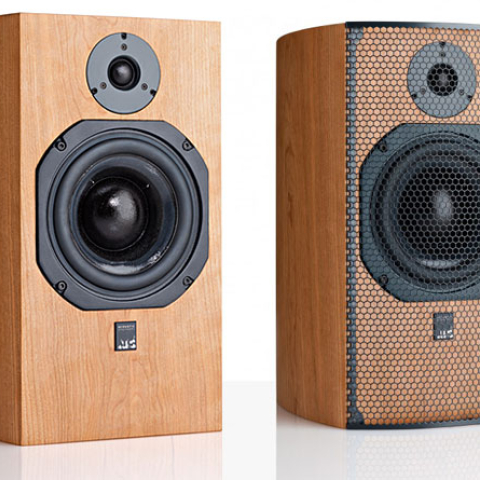
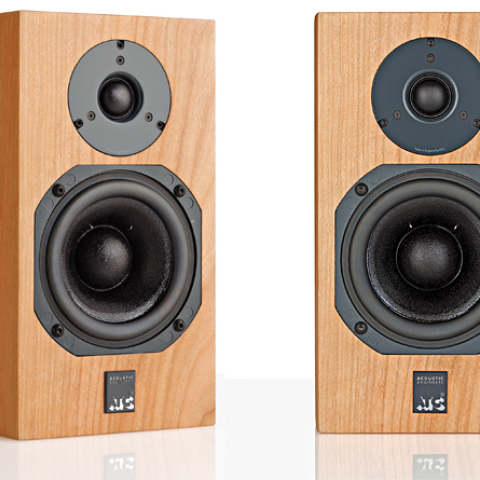
A few days after the recording tests at the Meeting House, Steve Dreyfuss, Steve Martorella, and I gathered to hear the results on the ESP Concert Grand SI loudspeakers, darTZeel amplifier, and EMM Labs source components. The differences were intriguing. My favorite array was M-S with figure-8 microphones for both Mid and Side (in this case, AKG 414 dual-capsule, variable-pattern condenser mikes).
Unless you've had the experience of hearing the width of the stereo soundstage and associated room sound go from "not enough" to "too much," then back to "just right," all at the turn of a knob, you can't understand how empowering M-S technique is—or how much good clean fun it can be. So here's what I will do. I will make a recording of a point source in which the stereo width goes from all-direct sound to all-ambient sound, then back to what I think is an optimum blend . (You can download these examples, burn them to a CDR, and play it on your stereo—or even just route it or Airport it over there, if you're set up for that.) To use the True Systems P2analog in M-S mode, you connect the Mid mike to Channel 1, the Side mike to Channel 2, and engage the M-S button on the front panel. The Channel 1 gain knob controls the volume of the Mid mike, while the Channel 2 gain knob controls stereo width. The P2's analog outputs then put out conventional Left and Right stereo signals. Of course, with the M-S function not engaged, the P2 functions as a conventional 2-channel stereo microphone preamplifier.
Into the sanctuary
Steve Dreyfuss, an affable local recording engineer, allowed me to tag along on some of his projects so I could play with my new toys. We first made about two dozen mike-position and pattern tests in the Meeting House (1774–75) of the First Baptist Church in America, recording the 1884 Hook-Foley/Baker organ (which includes pipes from the original organ of 1834), preparatory to recording it for the Rhode Island chapter of the American Guild of Organists' planned CD documenting significant pipe organs of Rhode Island. Test-to-test repeatability was ensured by organist Steve Martorella's having recorded a one-minute soft-to-loud flourish onto the organ's hard-disk drive (a "player" system somewhat akin to Yamaha's Disklavier), so it could be replayed at the touch of a button.
Because the Grace 201 uses stepped resistor arrays to set Gain, it also provides rotary-potentiometer Trim controls (with 10dB ranges) to set fine level adjustments. In normal practice, the Trim pots are left turned fully clockwise; fine adjustments are accomplished only by reducing the recording level, not increasing it. The Trim controls are good to have, because no matter how deft the hand that switches the Gain settings, there will be an audible discontinuity in the recorded sound as one set of resistors is switched out and another is switched in.
For both the True and the Grace, balanced analog outputs were carried to the digital recorders on Wireworld Eclipse 5 interconnects ($345/0.5m balanced pair). I found the construction quality superb; the XLR connectors were a joy to use. Their sound was sufficiently engaging that when, to break in the Eclipse 5s, I used them to run the darTZeel nhb-108 power amp, it was no letdown at all.
A few days after the recording tests at the Meeting House, Steve Dreyfuss, Steve Martorella, and I gathered to hear the results on the ESP Concert Grand SI loudspeakers, darTZeel amplifier, and EMM Labs source components. The differences were intriguing. My favorite array was M-S with figure-8 microphones for both Mid and Side (in this case, AKG 414 dual-capsule, variable-pattern condenser mikes).