To demonstrate the musical significance of this, we have posted an MP3 consisting of two excerpts of fast solo passagework beginning at bar 102 of the first movement (see image): first from the fast-and-sharp SACD, followed by the same snippet speed-corrected to A=440. Each excerpt is preceded by a sinewave tone: first 446.4, then 440Hz after a repeat of 446.4Hz.
At 440Hz (excerpt 2), the passagework sounds to me like exceptionally fleet-fingered playing. In the speeded-up excerpt 1, I feel there is a disconnect between the apparent speed of the arpeggios and the quantity and quality of the articulation sounds and the tone of the violin. This is especially so at the two D's in rapid succession in bar 102: the first at the bottom of the last arpeggio, the second at the bottom of the next arpeggio, with a bowing change in between.
There is a limit to how rapidly violin notes can be played with a full tone, a limit imposed by the nature of the instrument itself—specifically, the violin's acoustical "transfer function," which takes time. As the vibration of the string excites the bridge, the bridge excites the bass bar and the sound post, which in turn excite the violin's belly and back, which excite the mass of air inside the instrument—and only when all of that has happened do you have a full tone.
I think the speed-corrected example remakes the connection, which was unmade by the remix tape, of the organic congruity of the nature of the sounds of making the music with the music-making's essential pace. An unbiased listener, Laura K.T. Stokes, Music Librarian at Brown University, remarked, "FWIW, I heard two completely different performances, so to speak, in these excerpts. The second excerpt is much warmer, and oddly, to me the contour of the phrasing works better."
Perhaps a workable analogy would be to an opera singer's singing an extremely difficult passage at half the indicated tempo, then having the engineers speed up the file without changing its pitch—something easily done with a digital recording. In such a scenario, I think the same kind of artificial disconnect between the music-making and the music might happen.

I can only speculate as to how the speed/pitch error in the "Re-Mix" replacement "Master" tape arose. However, I'm certain that, at the recording session, the Brahms Concerto was played with Oistrakh and the orchestra tuned to A=440. I'm equally certain that pre-1973 US LPs were released at A=440.
Over and above the assurances from the archivist and musicians of the Cleveland Orchestra, using Amadeus Pro II, I performed spectrum analyses of more than a dozen live and studio recordings. The key findings are:
Szell/Cleveland: Schubert, Symphonies 8 & 9; March 1960 & November 1957 (CD, Sony Classical SBK 48268). Cumulate all, 439Hz.
Szell/Cleveland: Dvorák, Slavonic Dances, Opp. 46 & 72; January 1963–January 1965 (CD, Sony Classical SBK 48161). Cumulate all, 440.2Hz.
Oistrakh/Lev Oborin: Beethoven, Violin Sonata 9 in A, Op.47 ("Kreutzer"); Paris, 1962 (studio recording, Le Chant du Monde) (CD, Philips 412 570-2). Solo-piano intro only, 440Hz. C#/A double-stop in solo-violin intro, bar 3 only, 440Hz. Cumulate entire first movement, 441Hz.
Oistrakh/Otmar Nussio, Swiss Italian Radio Orchestra: Mozart, Violin Concerto 3 in G, K.216; Lugano, 1961 (CD, Dynamic CDS 389). Cumulate all, 440.6Hz.
Oistrakh/Richter: Brahms, Violin Sonata 3, third movement; TV broadcast from Alice Tully Hall, March 18, 1970 (DVD, VAI 4369). Cumulate all, 440Hz.
Oistrakh/Szell/Cleveland: Brahms, Violin Concerto, first movement, solo cadenza only; May 1969 (LP, Angel SFO 36033, pre-1973 pressing in collection of Brown University). Cumulate all, 440.3Hz.
Oistrakh/Szell/Cleveland: Brahms, Violin Concerto, first movement; May 1969 (LP, Angel SFO 36033, pressing purchased by John Marks in Nashville, Tennessee, 1977 or later; ripped by Michael Fremer, to confirm unexpected result). Cumulate all, 444.1Hz.
Oistrakh//Szell/Cleveland: Brahms, Violin Concerto, entire work; May 1969/2012 (CD layer of SACD/CD, EMI 9 55978 2). Cumulate all, 446.5Hz.


 That said, thanks to Michael Fremer, we now know that the last LP of this recording that I bought, ca 1977, was from a corrupted source. We also know that the speed-and-pitch error was not limited to the UK. Post-1972 US LPs were bad, too. It's surprising that, more than 10 years before the BOSC recording was first transferred to CD, the LPs on sale in the US were nearly 1.5% sharp and fast (footnote 1).
This unexpected finding somewhat reduces my chagrin that I didn't hear the speed and pitch discrepancies in the SACD—after all, both my Nashville LP and early-'90s CD were sharp and fast.
I tremble to think how little reason there is to hope that the Esoteric SACD of the BOSC recording from Japan, used copies of which now trade for over $250 on eBay, is from an uncorrupted source. However, I have not been able to get anyone to make a rip of that disc's CD layer for me. Unsurprisingly, Richard Lane, who invited me down this rabbit hole, reports that Testament's reissue of the recording on LP is—sharp and fast.
"The Future Lies Ahead!"
That said, thanks to Michael Fremer, we now know that the last LP of this recording that I bought, ca 1977, was from a corrupted source. We also know that the speed-and-pitch error was not limited to the UK. Post-1972 US LPs were bad, too. It's surprising that, more than 10 years before the BOSC recording was first transferred to CD, the LPs on sale in the US were nearly 1.5% sharp and fast (footnote 1).
This unexpected finding somewhat reduces my chagrin that I didn't hear the speed and pitch discrepancies in the SACD—after all, both my Nashville LP and early-'90s CD were sharp and fast.
I tremble to think how little reason there is to hope that the Esoteric SACD of the BOSC recording from Japan, used copies of which now trade for over $250 on eBay, is from an uncorrupted source. However, I have not been able to get anyone to make a rip of that disc's CD layer for me. Unsurprisingly, Richard Lane, who invited me down this rabbit hole, reports that Testament's reissue of the recording on LP is—sharp and fast.
"The Future Lies Ahead!"
I take no joy in bearing bad news, and less at eating crow in public. We do know that, at some time, an EMI engineer heard the remix replacement tape as playing sharp, and noted it in the box log. It now seems that the LP that was pulled out to check against was a post-master-tape substitution LP whose stamper had been cut from the same corrupt remix tape it was being used to check against, and so the wrong conclusion was reached. The question is, what can we do now? EMI no longer exists; its constituent parts were sold off here and there, with the Warner Music Group getting the classical department. I have so far been unable to interest anyone at Warner or Capitol Studios in looking for the BOSC session tapes. However, if those tapes could be found, I think that fixing this problem would be a perfect project for crowdfunding. Kickstart it! And with all of this, I guess I've just launched the prices of pre-1973 US pressings of the Angel LP of the BOSC recording into geosynchronous orbit.
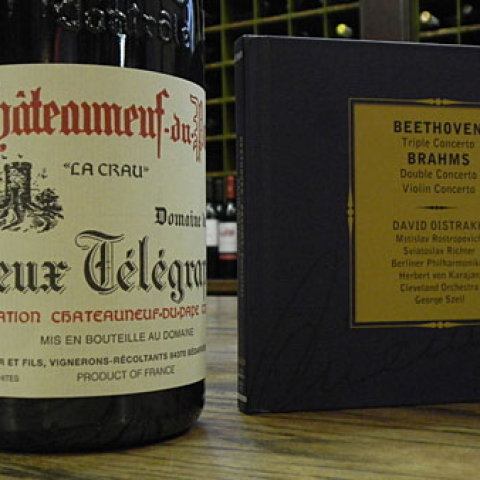
I think the ideal wine for baked-crow pie would be a legendary Rhône, such as a Vieux Télégraphe. However, given the realities, any wine that can stand up to game should suffice.
And with all of this, I guess I've just launched the prices of pre-1973 US pressings of the Angel LP of the BOSC recording into geosynchronous orbit.
I think the ideal wine for baked-crow pie would be a legendary Rhône, such as a Vieux Télégraphe. However, given the realities, any wine that can stand up to game should suffice.

Footnote 1: I recently bought on eBay, from the UK, an LP that the seller claimed was the first UK pressing. It turned out to be a Dutch pressing from the fourth stamper. But after ripping by MF and analysis by me and Amadeus Pro II, this LP, too, turned out to be sharp and fast. I informed the seller of this by e-mail but never received a response.
Brown University's much-played copy of the post-1973 LP.
Indiana Marks and the Temple of the Lost TapesI can only speculate as to how the speed/pitch error in the "Re-Mix" replacement "Master" tape arose. However, I'm certain that, at the recording session, the Brahms Concerto was played with Oistrakh and the orchestra tuned to A=440. I'm equally certain that pre-1973 US LPs were released at A=440.
Spectral analysis of the Cadenza from the pre-1973 Brown University LP.
Spectral analysis of the Concerto from the entire SACD.
Spectral analysis of the first movement of the Brahms Violin Concerto from JM's post-1972 LP.
Back in the day, if someone I liked had enjoyed an LP I'd played for him or her, I would sometimes give that person the record, and replace it with a new, unplayed one for myself. At the time, I didn't realize that the earlier pressings would almost always sound better. Ah, me. I'm sure that, before 1977, I had given away two or three BOSC LPs. I have no idea today whether the earliest one I bought had been at proper speed and pitch.
I take no joy in bearing bad news, and less at eating crow in public. We do know that, at some time, an EMI engineer heard the remix replacement tape as playing sharp, and noted it in the box log. It now seems that the LP that was pulled out to check against was a post-master-tape substitution LP whose stamper had been cut from the same corrupt remix tape it was being used to check against, and so the wrong conclusion was reached. The question is, what can we do now? EMI no longer exists; its constituent parts were sold off here and there, with the Warner Music Group getting the classical department. I have so far been unable to interest anyone at Warner or Capitol Studios in looking for the BOSC session tapes. However, if those tapes could be found, I think that fixing this problem would be a perfect project for crowdfunding. Kickstart it!
The perfect wine bottle with the imperfect, bookbound SACD.
Photo credit: John Marks w/Thanks to ENO Wines, Providence
Locating the master tapes, finding out if they're playable (see sidebar), and then going forward with remastering and repressing, would be a risky proposition for the traditional reissue-label business model. But if 1000 hardcore Oistrakh fans promised to donate x dollars for feasibility studies, and a further y dollars to make a limited-edition SACD and downloads, the proposition becomes much less flaky. One of the well-known commercial reissue firms might take a shot at it.
If you can't hear a significant pitch difference in the test tones or the music samples posted at the top of this page, consider that when the speeded-up SACD version of this recording has reached the end of the movement, the original version still has the measures above to play.—John Atkinson.
Footnote 1: I recently bought on eBay, from the UK, an LP that the seller claimed was the first UK pressing. It turned out to be a Dutch pressing from the fourth stamper. But after ripping by MF and analysis by me and Amadeus Pro II, this LP, too, turned out to be sharp and fast. I informed the seller of this by e-mail but never received a response.