

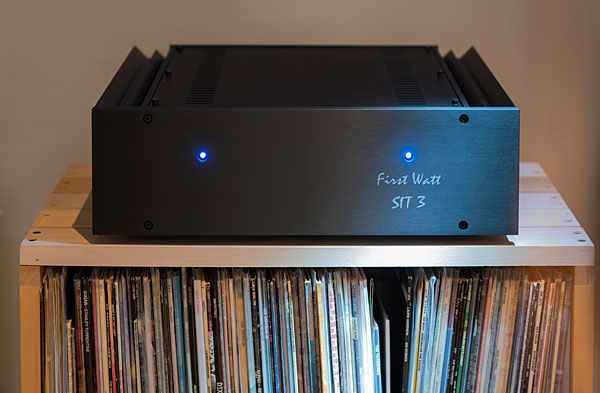
The illusion of an accordion suspended between my speakers seemed whole and believable. By that I mean that I believe the chief difference between live and reproduced music lies chiefly in the continuity of timing and phase relationships between music's fundamental tones and their expanding harmonic series. My personal observations suggest that negative feedback mutates these prime relationships while adding its own higher-order harmonic content. The First Watt SIT-3 seemed to preserve the geometry of the original harmonic relationships better than any amp I can remember, and thus made instruments sound quite real.
Listening with Harbeth Monitor 30.2 loudspeakers
Harbeth's little P3ESRs danced gingerly with the SIT-3. But the bigger Harbeth Monitor 30.2s were heavier on their feet. The piano of Hélène Grimaud, as she played the Mélodie from Gluck's Orfeo ed Euridice on her collection Perspectives (16/44.1 FLAC, Deutsche Grammophon/Tidal), had something close to perfect tone and good weight—but there was a hesitancy of timing, a slight dulling of textural detail, and a sense of distance that made me think that the First Watt was under-powering the medium-size M30.2s, which prefer Rogue's 100W Stereo 100 but also play super-superbly with Pass Labs' 25W XA25. Listening with Zu Audio Soul Supreme loudspeakers
In the vestibule of Nelson Pass's house was a pair of red Zu Audio Druid loudspeakers tht Pass had brought back from the 2018 Burning Amp Festival. Pass knows Sean Casey, Zu's founder and engineer, and at audio shows Casey makes great sounds with one or another of his speaker designs driven by Pass Labs amps. I therefore assumed that the SIT-3 would drive my Zu Soul Supremes with easy-rolling ease and super dynamics. I was wrong. The Soul Supremes, specified as having a sensitivity of 101dB/W/m and a nominal impedance of 16 ohms, sounded mushy and muffled with the First Watt. Not dynamic. My friend Sphere was with me, and we were dumbfounded. As we listened, Sphere sent Pass an e-mail. Right away came the reply: "Tell Herb to shunt a 16-ohm/10W resistor across the Souls' binding posts." Which I did.
The shunt resistors accomplished several things. Primarily, they reduced the Souls' nominal impedance to about 8 ohms, and their minimum impedance to closer to 4 ohms. They also lowered the impedance peaks and reduced the phase shift. Most important, the sound changed from mushy and muffled to vivid, clear, and crisply detailed. The simple addition of a resistor had allowed the Soul Supremes to deliver a charming, relaxed, naturally focused sound that satisfied with all types of music.
When I told JA about this experience, he told me he'd written an app that would show us what the impedance curve of the newly shunt-resistored Zus would look like. When I saw the graph he'd generated with the app, I laughed. The Zu's impedance characteristic now looked a bit like the Harbeth P3ESR's. And, surprise surprise, suddenly the Soul Supremes sounded a lot like the Harbeth P3ESRs, with basically the same texture and tone character—but, of course, the Zus could move more air and play much louder.
Listening with DeVore Fidelity Orangutan O/93 loudspeakers
The DeVore Orangutan O/93s (10 ohms, 93dB/W/m) really liked the First Watt SIT-3 and Sonny Rollins. "God Bless the Child," from The Essential Sonny Rollins: The RCA Years (16/44.1 FLAC, RCA/Tidal), sounded so simple and dreamy in its sonic essence; that essence was enhanced by the attractive burnished tones emanating from the DeVores.
"God Bless the Child" was precisely painted, with subtle but audible hesitations and pregnant, vibration-filled pauses. I immediately heard the expansive size of the soundstage produced by the O/93s. Bob Cranshaw's bass had never before sounded so big or more real. Rollins's tenor sax, Jim Hall's guitar, and Ben Riley's drums generated large, deep, perfectly toned sounds, the likes of which I'd never before heard from the DeVores. Nor had the Orangutans ever imaged so precisely. Five-foot shadow figures stood tall between the '93s' polished boxes—and those boxes "disappeared" more completely than they usually do. Together, the O/93s and SIT-3 made memorable magic. If you already own O/93s, this amp is wagging its tail for your attention.
 Listening with Falcon Acoustics LS3/5a loudspeakers
I listened closely to the SIT-3 driving Falcon's LS3/5a minimonitors. I worried that the 15-ohm Falcons might be a replay of the 16-ohm Zu Soul Supremes, and they did. My beloved LS3/5a's didn't sound mushy and muffled, just noticeably distorted through the midband. So I hauled out some 16-ohm resistors, shunted the Falcons' speaker terminals as I had the Zus', and voilà! The distortion mostly vanished. But the Falcon–First Watt pairing still wasn't singing or dancing. It sounded stiff and gray. Remembering how much I'd liked the First Watt J2 amp with the high-impedance Falcons, I removed their 16-ohm resistors and swapped in the J2. No purple prose required: The J2 plus Falcon LS3/5a's is a truly natural, breathy-voices, perfect-midrange, made-for-each-other, guaranteed-pleasurable combination. But I can't recommend that you mate the Falcons to the J2's stablemate, the First Watt SIT-3. Listening with Magnepan .7 loudspeakers
I'm always 100% happy when the Magnepan .7s ($1400/pair) are in my system, but I never imagined they could sound this beguiling. The First Watt SIT-3 forced me to appreciate the Maggies a lot more. It played Mississippi Fred McDowell's You Gotta Move (16/44.1 FLAC, Arhoolie/Tidal) and Skip James's Blues from the Delta (CD, Vanguard 79517-2) with riveting verity and full-tilt boogie via these insensitive, 4 ohm, quasi-ribbon panel speakers. Every pick or pluck of string grabbed my attention and focused it on these artists' phenomenal imaginations. James and McDowell were incomparable guitarists, and any proper hi-fi will keep the listener's mind on how and what they're doing with their strings. The SIT-3 and Maggie .7s put me in the room with the microphones, watching these masters' hands and following their grooves.
The SIT-Maggie combo generated a distinctive, liquid, ribbon-tweeter clarity that also flattered sopranos in a way not bested by any other amp-speaker combination I've tried.
Voices and instruments were no less there than they were with the Pass Labs XA25 or the Bel Canto Design e.One REF600M, and that's saying a lot—those amps make really SOLID sound with the Magnepan .7s. Wilder still, the SIT-3 generated more relaxed, natural detail and a bigger, better-mapped soundstage than I'd previously thought possible with these humble planars.
Summary 1
Three very different loudspeakers proved to be compatible with the First Watt SIT-3: the Harbeth P3ESR, the DeVore Fidelity Orangutan O/93, and the Magnepan .7. All were enjoyable, perfect, magical, 100% exciting matches for the SIT-3.
Summary 2
Did the First Watt SIT-3 sound like a single-ended-triode tube amplifier? Not really. It didn't sound like any other amp I know, either. I compared the SIT-3 directly to my Line Magnetic LM-518 IA tubed integrated amp ($4450) and found it sounded noticeably less vivid. The LM-518 IA was clearly more airy and extended in and descriptive of the top two octaves. However, the SIT-3's midrange and bass were cleaner, fuller, more textured, more rich in information. The SIT-3 produced denser, more specific images. Conclusions
Nelson Pass is that rare type of audio-engineering maverick who measures and listens with equal facility. He's not wasting his time and your money trying to cram a thousand crap watts into a marketing department's bling box. He does not believe that all measurable "distortions" are, willy-nilly, enemies of high-fidelity sound. Instead, he focuses his considerable intelligence and resources not only on reducing various types of distortion, but also on studying the essential natures of those distortions. He uses blind listening and ABX testing to understand how experienced listeners perceive distortion, and the role that distortion might play in helping our brains reconstruct the original musical event. In the SIT-3, Pass has allowed a carefully prescribed dose of negative-phase second-harmonic distortion to appear at low levels, with a tiny touch of third-harmonic distortion at higher powers. The second harmonic, he says, "fosters an illusion of expanded space and image specificity; the third appears to improve dynamics." I consider this type of thinking radical intelligence, and my experience with the First Watt SIT-3 suggests that it is among Nelson Pass's finest achievements. It's too bad that SemiSouth went south; it's too bad Pass will make only 250 SIT-3s; it's too bad that so few audiophiles will ever experience its unique, information-rich pleasures; and it's too sad that even fewer audiophiles will comprehend the 100 years of engineering wisdom distilled by Nelson Pass into this modestly priced masterpiece. Bravo, Maestro!
Harbeth's little P3ESRs danced gingerly with the SIT-3. But the bigger Harbeth Monitor 30.2s were heavier on their feet. The piano of Hélène Grimaud, as she played the Mélodie from Gluck's Orfeo ed Euridice on her collection Perspectives (16/44.1 FLAC, Deutsche Grammophon/Tidal), had something close to perfect tone and good weight—but there was a hesitancy of timing, a slight dulling of textural detail, and a sense of distance that made me think that the First Watt was under-powering the medium-size M30.2s, which prefer Rogue's 100W Stereo 100 but also play super-superbly with Pass Labs' 25W XA25. Listening with Zu Audio Soul Supreme loudspeakers
In the vestibule of Nelson Pass's house was a pair of red Zu Audio Druid loudspeakers tht Pass had brought back from the 2018 Burning Amp Festival. Pass knows Sean Casey, Zu's founder and engineer, and at audio shows Casey makes great sounds with one or another of his speaker designs driven by Pass Labs amps. I therefore assumed that the SIT-3 would drive my Zu Soul Supremes with easy-rolling ease and super dynamics. I was wrong. The Soul Supremes, specified as having a sensitivity of 101dB/W/m and a nominal impedance of 16 ohms, sounded mushy and muffled with the First Watt. Not dynamic. My friend Sphere was with me, and we were dumbfounded. As we listened, Sphere sent Pass an e-mail. Right away came the reply: "Tell Herb to shunt a 16-ohm/10W resistor across the Souls' binding posts." Which I did.
The DeVore Orangutan O/93s (10 ohms, 93dB/W/m) really liked the First Watt SIT-3 and Sonny Rollins. "God Bless the Child," from The Essential Sonny Rollins: The RCA Years (16/44.1 FLAC, RCA/Tidal), sounded so simple and dreamy in its sonic essence; that essence was enhanced by the attractive burnished tones emanating from the DeVores.
Listening with Falcon Acoustics LS3/5a loudspeakersI listened closely to the SIT-3 driving Falcon's LS3/5a minimonitors. I worried that the 15-ohm Falcons might be a replay of the 16-ohm Zu Soul Supremes, and they did. My beloved LS3/5a's didn't sound mushy and muffled, just noticeably distorted through the midband. So I hauled out some 16-ohm resistors, shunted the Falcons' speaker terminals as I had the Zus', and voilà! The distortion mostly vanished. But the Falcon–First Watt pairing still wasn't singing or dancing. It sounded stiff and gray. Remembering how much I'd liked the First Watt J2 amp with the high-impedance Falcons, I removed their 16-ohm resistors and swapped in the J2. No purple prose required: The J2 plus Falcon LS3/5a's is a truly natural, breathy-voices, perfect-midrange, made-for-each-other, guaranteed-pleasurable combination. But I can't recommend that you mate the Falcons to the J2's stablemate, the First Watt SIT-3. Listening with Magnepan .7 loudspeakers
I'm always 100% happy when the Magnepan .7s ($1400/pair) are in my system, but I never imagined they could sound this beguiling. The First Watt SIT-3 forced me to appreciate the Maggies a lot more. It played Mississippi Fred McDowell's You Gotta Move (16/44.1 FLAC, Arhoolie/Tidal) and Skip James's Blues from the Delta (CD, Vanguard 79517-2) with riveting verity and full-tilt boogie via these insensitive, 4 ohm, quasi-ribbon panel speakers. Every pick or pluck of string grabbed my attention and focused it on these artists' phenomenal imaginations. James and McDowell were incomparable guitarists, and any proper hi-fi will keep the listener's mind on how and what they're doing with their strings. The SIT-3 and Maggie .7s put me in the room with the microphones, watching these masters' hands and following their grooves.
Three very different loudspeakers proved to be compatible with the First Watt SIT-3: the Harbeth P3ESR, the DeVore Fidelity Orangutan O/93, and the Magnepan .7. All were enjoyable, perfect, magical, 100% exciting matches for the SIT-3.
Did the First Watt SIT-3 sound like a single-ended-triode tube amplifier? Not really. It didn't sound like any other amp I know, either. I compared the SIT-3 directly to my Line Magnetic LM-518 IA tubed integrated amp ($4450) and found it sounded noticeably less vivid. The LM-518 IA was clearly more airy and extended in and descriptive of the top two octaves. However, the SIT-3's midrange and bass were cleaner, fuller, more textured, more rich in information. The SIT-3 produced denser, more specific images. Conclusions
Nelson Pass is that rare type of audio-engineering maverick who measures and listens with equal facility. He's not wasting his time and your money trying to cram a thousand crap watts into a marketing department's bling box. He does not believe that all measurable "distortions" are, willy-nilly, enemies of high-fidelity sound. Instead, he focuses his considerable intelligence and resources not only on reducing various types of distortion, but also on studying the essential natures of those distortions. He uses blind listening and ABX testing to understand how experienced listeners perceive distortion, and the role that distortion might play in helping our brains reconstruct the original musical event. In the SIT-3, Pass has allowed a carefully prescribed dose of negative-phase second-harmonic distortion to appear at low levels, with a tiny touch of third-harmonic distortion at higher powers. The second harmonic, he says, "fosters an illusion of expanded space and image specificity; the third appears to improve dynamics." I consider this type of thinking radical intelligence, and my experience with the First Watt SIT-3 suggests that it is among Nelson Pass's finest achievements. It's too bad that SemiSouth went south; it's too bad Pass will make only 250 SIT-3s; it's too bad that so few audiophiles will ever experience its unique, information-rich pleasures; and it's too sad that even fewer audiophiles will comprehend the 100 years of engineering wisdom distilled by Nelson Pass into this modestly priced masterpiece. Bravo, Maestro!















