Sidebar 3: Measurements
I measured the OMA Fleetwood DeVille SQ's farfield and nearfield behavior with the DRA Labs MLSSA system, using calibrated DPA 4006 and Earthworks QTC-40 microphones and an Earthworks microphone preamplifier. I used Dayton Audio's DATS V2 system to examine the loudspeaker's impedance magnitude and electrical phase.
OMA specifies the Fleetwood DeVille's sensitivity as 94dB/W/m. My B-weighted estimate was lower, at 89dB(B)/2.83V/m, However, the DeVille's impedance, specified as a nominal 8 ohms, averages closer to 15 ohms (fig.1, solid trace). A voltage of 2.83V is therefore equivalent to just over 0.5W. Increasing the voltage to 3.87V would result in 1W into 15 ohms, which would increase the DeVille's estimated sensitivity to 91.7dB(B), closer to the specified figure (footnote 1).
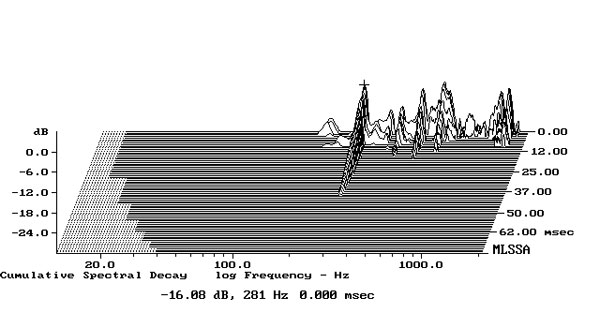
 Investigating the enclosure's vibrational behavior with a plastic-tape accelerometer revealed very few panel resonant modes. Fig.2 is a cumulative spectral-decay plot calculated from the accelerometer's output when it was fastened to the center of one of the sidewalls, level with the woofer. A resonance is visible at 281Hz, but this is low in level and has a high Q (Quality Factor). The relatively large back panel appears to be well-damped.

 The black trace above 300Hz in fig.3 shows the Fleetwood DeVille's farfield output, averaged across a 30° horizontal window centered on an axis 5° above the axis of the horn-loaded tweeter. The response is flat and even through the midrange and mid-treble regions, above which the output gently slopes down by a couple of dB before some response irregularities appear in the top audio octave. This behavior is most likely due to reflections of the tweeter's output from the mouth of the horn.
I initially measured the averaged response on the horn axis, but this has a suckout in the crossover region (fig.3, green trace). OMA's matching stand for the Fleetwood DeVille is 23.5" high on its spikes, which would place the horn axis 41.5" from the floor; the axis on which I took the response shown by the black trace in fig.3 is closer to 46". I queried KM about his preferred listening axis with the OMA speakers. He responded that his usual chair "was much too low, so I bought a new chair to review the DeVilles." In the new chair, his ears were 45" from the floor, a height at which the suckout shown by the green trace in fig.3 is much reduced.
Fig.4 shows the DeVille's horizontal dispersion with the traces normalized to the response on the tweeter axis, which thus appears as a straight line. The woofer's radiation pattern narrows significantly at the top of its passband. While the on-axis suckout in the crossover region tends to fill in to the speaker's sides, the DeVille is relatively directional in the region covered by the horn-loaded driver. The vertical dispersion, again normalized to the response on the tweeter axis, is shown in fig.5, and confirms that the flattest response will be obtained 5° above the tweeter axis.
The black trace above 300Hz in fig.3 shows the Fleetwood DeVille's farfield output, averaged across a 30° horizontal window centered on an axis 5° above the axis of the horn-loaded tweeter. The response is flat and even through the midrange and mid-treble regions, above which the output gently slopes down by a couple of dB before some response irregularities appear in the top audio octave. This behavior is most likely due to reflections of the tweeter's output from the mouth of the horn.
I initially measured the averaged response on the horn axis, but this has a suckout in the crossover region (fig.3, green trace). OMA's matching stand for the Fleetwood DeVille is 23.5" high on its spikes, which would place the horn axis 41.5" from the floor; the axis on which I took the response shown by the black trace in fig.3 is closer to 46". I queried KM about his preferred listening axis with the OMA speakers. He responded that his usual chair "was much too low, so I bought a new chair to review the DeVilles." In the new chair, his ears were 45" from the floor, a height at which the suckout shown by the green trace in fig.3 is much reduced.
Fig.4 shows the DeVille's horizontal dispersion with the traces normalized to the response on the tweeter axis, which thus appears as a straight line. The woofer's radiation pattern narrows significantly at the top of its passband. While the on-axis suckout in the crossover region tends to fill in to the speaker's sides, the DeVille is relatively directional in the region covered by the horn-loaded driver. The vertical dispersion, again normalized to the response on the tweeter axis, is shown in fig.5, and confirms that the flattest response will be obtained 5° above the tweeter axis.


Footnote 1: In his Manufacturer's Comment Fleetwood's Chief Technical Officer, Vytas Viesulas, wrote "We stand by our 94dB/W/m sensitivity rating with a clear conscience, as we do not artificially inflate our specs. Differences in measured results will naturally arise from technique and equipment deltas." Footnote 2: EPDR is the resistive load that gives rise to the same peak dissipation in an amplifier's output devices as the loudspeaker. See "Audio Power Amplifiers for Loudspeaker Loads," JAES, Vol.42 No.9, September 1994, and stereophile.com/reference/707heavy/index.html.
Fig.1 Fleetwood DeVille, electrical impedance (solid) and phase (dashed) (2 ohms/vertical div.).
The impedance remains above 12 ohms for the entire treble, the minimum magnitude was 6.33 ohms at 186Hz, and there is a discontinuity around 250Hz in the trace. The electrical phase angle (dashed trace) is high in the top audio octave as well as in the upper bass; though the resultant EPDR (footnote 2) remains above 5 ohms for almost the entire audioband, it does drop to 3.33 ohms at 55Hz and 315Hz. Its high sensitivity means that the Fleetwood DeVille will work with a tube amplifier's 8 ohm output transformer tap, but the shape of the impedance magnitude trace means that any tap with a high source impedance will boost the treble. In general, with traditional tube amplifiers, for accuracy of frequency response, the 4 ohm output taps will be preferable.
Fig.2 Fleetwood DeVille, cumulative spectral-decay plot calculated from output of accelerometer fastened to center of sidewall level with woofer (MLS driving voltage to speaker, 7.55V; measurement bandwidth, 2kHz).
The saddle centered on 48Hz in the impedance magnitude trace suggests that this is the tuning frequency of the two ports on the DeVille's base. The ports' nearfield response (fig.3, red trace) peaks sharply at this frequency, and the upper-frequency rolloff is clean. While the nearfield response of the woofer (fig.3, blue trace below 350Hz) has the expected notch at the port-tuning frequency, this is less well-developed than usual. In addition, the nearfield responses of the woofer and ports roll off faster than the expected 12dB/ octave.
Fig.3 Fleetwood DeVille, anechoic response 5° above tweeter axis at 50", averaged across 30° horizontal window and corrected for microphone response, with the nearfield responses of the port (red) and woofer (blue), and their complex sum, respectively plotted below 300Hz, 475Hz, and 350Hz.
The black trace below 300Hz in fig.4 shows the complex sum of the nearfield woofer and port responses. The boost in the loudspeaker's upper bass will be due to the nearfield measurement technique, which assumes the drive-unit is mounted in a true infinite baffle, ie, one that extends to infinity in both planes. There is a slight notch at 250Hz in the low-frequency traces in fig.3, which I suspect is connected with the discontinuity at the same frequency in the impedance traces. An antiresonance might be present in the ports' output.
Fig.4 OMA Fleetwood DeVille, lateral response family at 50", normalized to response on tweeter axis, from back to front: differences in response 90–5° off axis, reference response, differences in response 5–90° off axis.
Fig.5 Fleetwood DeVille, vertical response family at 50", normalized to response on tweeter axis, from back to front: differences in response 45–5° above axis, reference response, differences in response 5–45° below axis.
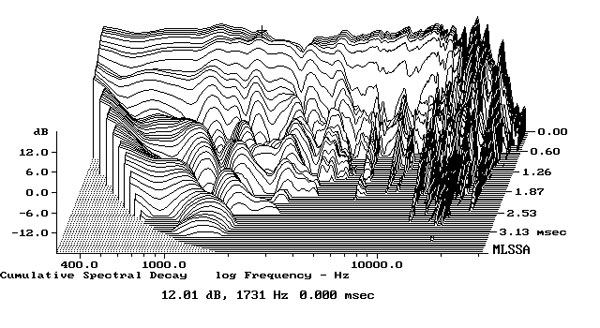
In the time domain, the Fleetwood DeVille's step response on the tweeter axis (fig.6) indicates that both drivers are connected in positive acoustic polarity and that the tweeter's output arrives first at the microphone. The drivers' steps don't blend smoothly on this axis, which correlates with the suckout on this axis shown by the green trace in fig.3. However, the step response taken 5° above the tweeter axis (not shown) indicates that the decay of the tweeter's step does blend with the start of the woofer's step, which is why there is no suckout at the crossover frequency on that higher axis, which, as previously noted, will be closer to ear level for most listeners with the custom stands. Other than some chaotic behavior in the top octave, the DeVille's cumulative spectral-decay plot (fig.7) is relatively clean.
Fig.6 Fleetwood DeVille, step response on tweeter axis at 50" (5ms time window, 30kHz bandwidth).
Fig.7 Fleetwood DeVille. cumulative spectral-decay plot on tweeter axis at 50" (0.15ms risetime).
The OMA Fleetwood DeVille's measured performance is dominated by its use of a horn-loaded tweeter. While this does result in usefully high sensitivity, the narrow radiation pattern above 1kHz will result in an overmellow balance unless the speakers are toed in to the listening position. And, as KM found, listeners should also sit with their ears sufficiently far from the floor.—John Atkinson
Footnote 1: In his Manufacturer's Comment Fleetwood's Chief Technical Officer, Vytas Viesulas, wrote "We stand by our 94dB/W/m sensitivity rating with a clear conscience, as we do not artificially inflate our specs. Differences in measured results will naturally arise from technique and equipment deltas." Footnote 2: EPDR is the resistive load that gives rise to the same peak dissipation in an amplifier's output devices as the loudspeaker. See "Audio Power Amplifiers for Loudspeaker Loads," JAES, Vol.42 No.9, September 1994, and stereophile.com/reference/707heavy/index.html.