Sidebar 4: Measurements
The first test I performed of the GeerFab D.BOB was to examine if its output was bit-perfect—ie, if the bits it outputs via S/PDIF are the same as those sent to it via HDMI. Using my Audio Precision SYS2722, I created a 24-bit S/PDIF signal representing a 1kHz tone at –120dBFS, with triangular dither applied at the LSB level. Fig.1 shows the spectrum of this signal, analyzed in the digital domain (no conversion to analog) by looping the Audio Precision's S/PDIF output to its S/PDIF input. The FFT bins lie at the –180dBFS level, and the noise floor is the spectrum of the LSB-level dither.


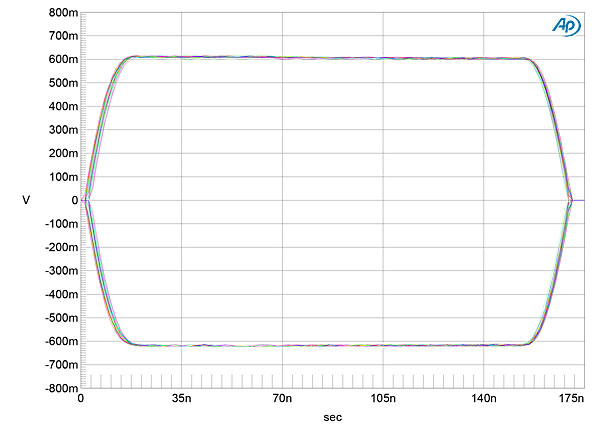
 Repeating this test with the D.BOB's coaxial output gave the eye pattern shown in fig.4. The eye is still wide open, but there is some uncertainty in the beginning and ending times of the multiple traces. The average jitter level was now 1352ps. (Unusually, the jitter was slightly lower with the optical datalink, at 1313ps.) Repeating the test with 24-bit data representing the tone at –120dBFS reduced the jitter in the D.BOB's coaxial output to around 600ps.
 The D.BOB does what it claims to do.—John Atkinson
Fig.1 Audio Precision SYS2722, digital-domain spectrum with noise and spuriae of dithered 24-bit, 1kHz tone at –120dBFS (left channel blue, right red) (20dB/vertical div.).
I then created an AIFF file from this S/PDIF signal and copied it to my music library. I connected the D.BOB to the HDMI output of my Roon Nucleus + server with a 10m HDMI cable and connected its optical and coaxial S/PDIF outputs to the Audio Precision with an Esperanto coaxial datalink. Fig.2 shows the digital-domain spectrum of the D.BOB's optical output. It is identical to the spectrum in fig.1, proving that the D.BOB's digital output data are identical to the input data.
Fig.2 GeerFab D.BOB, digital-domain spectrum with noise and spuriae of dithered 24-bit, 1kHz tone at –120dBFS (left channel blue, right red) (20dB/vertical div.).
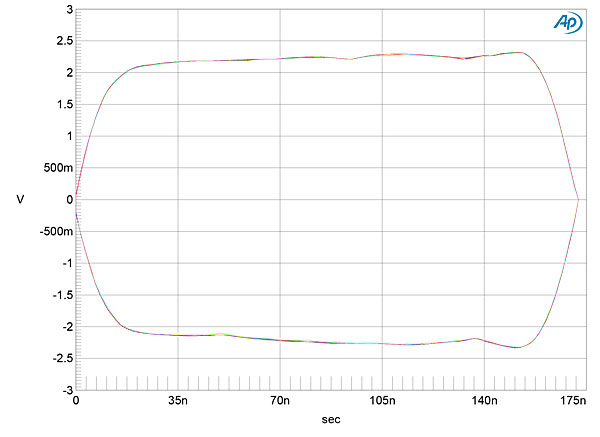
Next, I examined the amount of timing uncertainty or jitter in the D.BOB's S/PDIF output. Using the Audio Precision's digital oscilloscope function, I overlaid successive snapshots of the analyzer's AES/EBU output, sampled at 44.1kHz and taken over a 60-second time window, to show what's called an "eye pattern." The data represented a 16-bit Miller/Dunn J-Test signal, which is a worst-case signal. To make things even harder for the Audio Precision's data output, the AES/EBU link was a 45' length of Canare 110-ohm balanced interconnect. With an ideal transmission system, all the pulse transitions in the datastream will overlay one another to produce an image of a wide-open "eye," with just one trace visible. Fig.3, plotted over one "unit cycle," indicates that this was indeed the case with the SYS2722's output. The average jitter level, assessed with a 50Hz–100kHz bandwidth, was 243 picoseconds (ps).
Fig.3 Audio Precision SYS2722, eye pattern of AES/EBU data output carrying 16-bit, 44.1kHz J-Test data (±3V vertical scale, 175ns horizontal scale).
Fig.4 GeerFab D.BOB, eye pattern of coaxial S/PDIF data output carrying 16-bit, 44.1kHz J-Test data (±800mV vertical scale, 175ns horizontal scale).
The jitter I found in the D.BOB's S/PDIF output was not high in absolute terms. It will have no effect on sound quality, other than with vintage D/A processors with pathologically poor serial data inputs.