

So far, so good—really good—but let me get back to the regular process of analyzing individual performance elements. For example, I tested the low-frequency capabilities of the One.Rs with everything I had, and they did not disappoint. Organ pedals were tight, tonally defined, and extended. In fact my only criticism was that the lows were occasionally too good to be real and benefitted from turning down the bass level by 1–2 notches from the middle position. The facility to do this is very useful and, along with careful room placement and orientation, it helped the One.Rs get the bass right while maintaining good imaging.
As an aside here, I was so impressed with the bass/midrange integration, especially in view of the passively driven midranges on the one hand and the combination of actively driven woofers with undriven radiators on the other, that I didn't even try to take advantage of the speaker's Low Frequency Effects input. For home-theater use, however, one might take advantage of this input instead of adding a separate subwoofer. The One.R's bass might not sound quite as good as a real subwoofer or two (properly situated and equalized), but it is certainly an effective alternative for those with budget and/or space constraints.
The One.R's mid and treble ranges, judged from recordings of the human voice and solo instruments, were consistently clear, undistorted, and natural. If anything, there seemed to be a very slight reticence in some female voices, but that was elusive given how wide those voices range and how variably they are recorded and mixed. Recordings of female singers, from the above-referenced Marianne Beate Kielland, through Sara K. and Adele, and on to Birgit Nilsson, were all glorious. Even with Dame Emma Kirkby's recording of Mozart's "Exsultate, Jubilate" (CD, L'oiseau-Lyre 168055), the glare I heard with some amp/speaker combinations was not there even with the Benchmark AHB2 running the One.Rs. Alison Krauss's voice on Alison Krauss + Union Station Live (SACD, Rounder 11661-0515-6) was lovely and clear, as expected, but she appeared to be standing a foot or two back and her voice was more "breathy" than I had remembered. Male voices were excellent, and the low ones—like Leonard Cohen, Hans Theessink, and Gottlob Frick—benefitted from the One.R's seamless integration of bass and midrange drivers.
 Given all that, it was not a surprise that the One.Rs were up to the task of reproducing orchestral and choral recordings with appropriate dynamics, weight, size, and clarity. It doesn't come much bigger than Busoni's Piano Concerto, a juggernaut that calls for a large symphony orchestra, a pianist with big chops, and a chorus, no less. It's almost too cumbersome for its own good, but it contains some spectacular music and is a test for all involved, performers and listeners alike. I've been having a good time with a new live recording by pianist Kirill Gerstein, conductor Sakari Oramo, the Boston Symphony Orchestra, and the men of the Tanglewood Festival Chorus (CD, Myrios MYR024). Gerstein is spectacular and his piano is recorded close up with a lot of floor bounce—which, over the One.Rs, makes you feel like you are in the front row. The orchestral contributions lurch between extremes and, when it ends after 71:29, you are ready. It's like a wild ride to nowhere, and the One.Rs let you feel all the bumps and turns as if you were in Symphony Hall in March 2017. (N.B.: I can't seem to get enough of Gerstein.)
If there is anything at all that concerned me about the One.Rs, it is something that turned up only occasionally. With the aforementioned Alison Krauss and with the Gerstein/Busoni, both recorded live before an audience, I felt that the One.Rs' amply broad soundstage was a little lacking in depth, and in detail within that depth. It was hard to find other recordings to confirm this, but I can offer two more examples. The elegant terracing of the voices of the Portland State Chamber Choir in Eriks Esenvalds' The Doors of Heaven, conducted by Ethan Sperry (Naxos 8.579008), was less distinct even though the voices themselves were clear and distinct. That is an analytical assessment that did not make the music any less enjoyable. On the other hand, that little loss had a greater effect on Hugh Masekela's "Stimela (The Coal Train)," from Hope (SACD, Analogue Productions APJ 82020). Most of the frisson I get from this cut comes from the contributions of the performance-space acoustics and the audience sounds—sounds that, even in stereo, make me feel like a participant. I missed it.
Given all that, it was not a surprise that the One.Rs were up to the task of reproducing orchestral and choral recordings with appropriate dynamics, weight, size, and clarity. It doesn't come much bigger than Busoni's Piano Concerto, a juggernaut that calls for a large symphony orchestra, a pianist with big chops, and a chorus, no less. It's almost too cumbersome for its own good, but it contains some spectacular music and is a test for all involved, performers and listeners alike. I've been having a good time with a new live recording by pianist Kirill Gerstein, conductor Sakari Oramo, the Boston Symphony Orchestra, and the men of the Tanglewood Festival Chorus (CD, Myrios MYR024). Gerstein is spectacular and his piano is recorded close up with a lot of floor bounce—which, over the One.Rs, makes you feel like you are in the front row. The orchestral contributions lurch between extremes and, when it ends after 71:29, you are ready. It's like a wild ride to nowhere, and the One.Rs let you feel all the bumps and turns as if you were in Symphony Hall in March 2017. (N.B.: I can't seem to get enough of Gerstein.)
If there is anything at all that concerned me about the One.Rs, it is something that turned up only occasionally. With the aforementioned Alison Krauss and with the Gerstein/Busoni, both recorded live before an audience, I felt that the One.Rs' amply broad soundstage was a little lacking in depth, and in detail within that depth. It was hard to find other recordings to confirm this, but I can offer two more examples. The elegant terracing of the voices of the Portland State Chamber Choir in Eriks Esenvalds' The Doors of Heaven, conducted by Ethan Sperry (Naxos 8.579008), was less distinct even though the voices themselves were clear and distinct. That is an analytical assessment that did not make the music any less enjoyable. On the other hand, that little loss had a greater effect on Hugh Masekela's "Stimela (The Coal Train)," from Hope (SACD, Analogue Productions APJ 82020). Most of the frisson I get from this cut comes from the contributions of the performance-space acoustics and the audience sounds—sounds that, even in stereo, make me feel like a participant. I missed it.
 Comparisons
I tried four different power amps with the One.Rs—see "Associated Equipment sidebar—but there was little to choose among them. There was a definite electricity in the air with the Benchmark AHB-2, but any of the others might be preferred for a more relaxed balance. The Hegel C53, in particular, struck the right note with most program material by preserving the liveliness, tonally and spatially, but with a less forward presentation.
For me, speakers that retail for more than $2000/pair are not cheap and must do something special. Compared to other speakers I have reviewed recently, the GoldenEar One.Rs represent an excellent choice: They are striking in appearance, throw a big, wide soundstage, play at levels that exceed domestic needs, have good balance across the audible spectrum, and, frankly, are above reproach at low frequencies. The B&W 702 S2 ($4500/pair) are good speakers, but they cannot compete with the soundstaging and bass capabilities of the One.Rs. On the other hand, the Revel Performa F228Be ($10,000/pair) is capable of more resolution in the upper bass and midrange, while preserving soundstage depth and detail—but it cannot equal the One.R at the bottom end.
 Conclusions
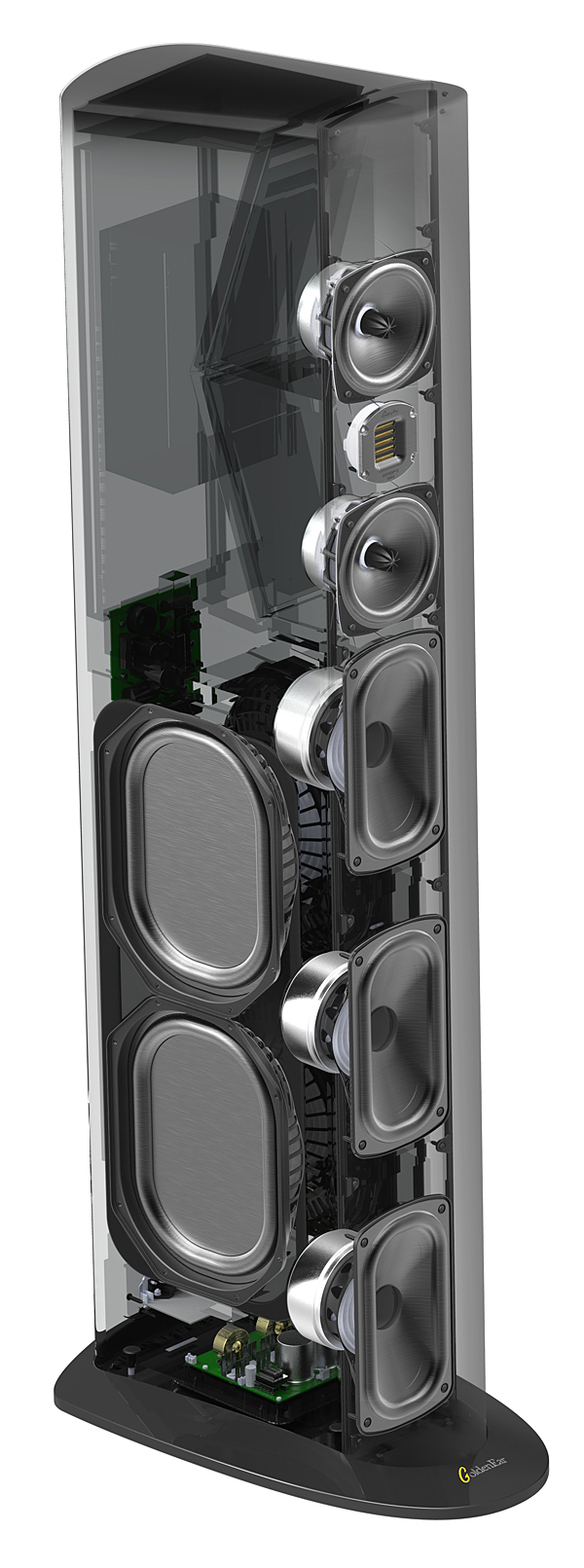
Prior to writing this review, I was familiar with GoldenEar's products from audio shows. Those demonstrations have always been impressive: When asked to guess their retail price, I usually greatly overestimated. But their use of multiple niche technologies, all assigned proprietary names and descriptions, is a bit offputting. Mind you, all those technologies—passive radiators, rectangular diaphragms, powered woofers, folded ribbon tweeters, etc.—are well proven and valid. Yet it has seemed to me that the GoldenEar speakers have too many widgets. That being said, the quip "Everything should be as simple as possible, but not simpler," generally attributed to Einstein, is an appropriate caution: Does a product's performance justify whatever goes into it?
With the Triton One.R, the answer is Yes. It throws a wide and clean soundstage and is capable of conveying the dynamics of any music program. It presents a convincing image of the instruments and preserves their tones. It has prodigious bass capabilities in a slim profile, thanks to the use of multiple powered drivers and multiple passive radiators. The One.Rs may not equal what one can get from adding one or more good subwoofers in terms of ultimate extension and body feel, but in terms of reproducing music overall, these are among the best I have heard in my room, regardless of price.
The One.R does it all, and at a fair price. Hard to beat that.
Given all that, it was not a surprise that the One.Rs were up to the task of reproducing orchestral and choral recordings with appropriate dynamics, weight, size, and clarity. It doesn't come much bigger than Busoni's Piano Concerto, a juggernaut that calls for a large symphony orchestra, a pianist with big chops, and a chorus, no less. It's almost too cumbersome for its own good, but it contains some spectacular music and is a test for all involved, performers and listeners alike. I've been having a good time with a new live recording by pianist Kirill Gerstein, conductor Sakari Oramo, the Boston Symphony Orchestra, and the men of the Tanglewood Festival Chorus (CD, Myrios MYR024). Gerstein is spectacular and his piano is recorded close up with a lot of floor bounce—which, over the One.Rs, makes you feel like you are in the front row. The orchestral contributions lurch between extremes and, when it ends after 71:29, you are ready. It's like a wild ride to nowhere, and the One.Rs let you feel all the bumps and turns as if you were in Symphony Hall in March 2017. (N.B.: I can't seem to get enough of Gerstein.)
If there is anything at all that concerned me about the One.Rs, it is something that turned up only occasionally. With the aforementioned Alison Krauss and with the Gerstein/Busoni, both recorded live before an audience, I felt that the One.Rs' amply broad soundstage was a little lacking in depth, and in detail within that depth. It was hard to find other recordings to confirm this, but I can offer two more examples. The elegant terracing of the voices of the Portland State Chamber Choir in Eriks Esenvalds' The Doors of Heaven, conducted by Ethan Sperry (Naxos 8.579008), was less distinct even though the voices themselves were clear and distinct. That is an analytical assessment that did not make the music any less enjoyable. On the other hand, that little loss had a greater effect on Hugh Masekela's "Stimela (The Coal Train)," from Hope (SACD, Analogue Productions APJ 82020). Most of the frisson I get from this cut comes from the contributions of the performance-space acoustics and the audience sounds—sounds that, even in stereo, make me feel like a participant. I missed it.
ComparisonsI tried four different power amps with the One.Rs—see "Associated Equipment sidebar—but there was little to choose among them. There was a definite electricity in the air with the Benchmark AHB-2, but any of the others might be preferred for a more relaxed balance. The Hegel C53, in particular, struck the right note with most program material by preserving the liveliness, tonally and spatially, but with a less forward presentation.
ConclusionsPrior to writing this review, I was familiar with GoldenEar's products from audio shows. Those demonstrations have always been impressive: When asked to guess their retail price, I usually greatly overestimated. But their use of multiple niche technologies, all assigned proprietary names and descriptions, is a bit offputting. Mind you, all those technologies—passive radiators, rectangular diaphragms, powered woofers, folded ribbon tweeters, etc.—are well proven and valid. Yet it has seemed to me that the GoldenEar speakers have too many widgets. That being said, the quip "Everything should be as simple as possible, but not simpler," generally attributed to Einstein, is an appropriate caution: Does a product's performance justify whatever goes into it?















