In the early to mid-1980s, I read every high-end hi-fi magazine I could get my hands on. Among the consequences was my discovery that the Grado Signature Seven phono cartridge—which was better and cheaper than the Signatures One through Six—was the cartridge that God wanted me to have. So I cut back on all manner of luxuries, saved every dollar I could save, and a few months later brought a walletful of cash to Harvey Sound in midtown Manhattan, where an unpleasant man with a bad comb-over handed me a little pill bottle of a plastic tube.
 "You mean this is my handmade phono cartridge?"
I've never been the sort who could wait until he got home to open this or that new toy. I rode the train back to White Plains, taking from its pill bottle the humble-looking, plastic-bodied cartridge—it didn't even have the words Signature Seven on it!—along with the mounting hardware, the stylus-removal tool, and the instruction sheet, and stuffing them all back in at least a half-dozen times. I remember being disappointed with the brevity and sparseness of the instructions: not a single word about alignment, vertical tracking angle, or reproducing the soundstage in all of its dimensions. Hmph.
But in time I came to admire the Grado approach to packaging: cheap, effective, unpretentious. Sooner than that—the evening of the day I bought it, in fact—I also came to admire the Grado approach to music-making: lush, textured, palpable.
A few things have changed in the quarter-century since. Company founder Joe Grado retired and let his nephew, John Grado, take the wheel. Grado Labs expanded into the headphone market—with remarkable success. Then Grado began making some cartridges with fancy wooden bodies, and began selling them in fancy wooden boxes.
But the instructions stayed the same—and so did most of the cartridges. That's the nice thing about growing up in a charming old hobby such as this: I can ask for a brand-new Grado cartridge, slice open the carton when it gets here, and bang! —instant memory lane.
Description
"You mean this is my handmade phono cartridge?"
I've never been the sort who could wait until he got home to open this or that new toy. I rode the train back to White Plains, taking from its pill bottle the humble-looking, plastic-bodied cartridge—it didn't even have the words Signature Seven on it!—along with the mounting hardware, the stylus-removal tool, and the instruction sheet, and stuffing them all back in at least a half-dozen times. I remember being disappointed with the brevity and sparseness of the instructions: not a single word about alignment, vertical tracking angle, or reproducing the soundstage in all of its dimensions. Hmph.
But in time I came to admire the Grado approach to packaging: cheap, effective, unpretentious. Sooner than that—the evening of the day I bought it, in fact—I also came to admire the Grado approach to music-making: lush, textured, palpable.
A few things have changed in the quarter-century since. Company founder Joe Grado retired and let his nephew, John Grado, take the wheel. Grado Labs expanded into the headphone market—with remarkable success. Then Grado began making some cartridges with fancy wooden bodies, and began selling them in fancy wooden boxes.
But the instructions stayed the same—and so did most of the cartridges. That's the nice thing about growing up in a charming old hobby such as this: I can ask for a brand-new Grado cartridge, slice open the carton when it gets here, and bang! —instant memory lane.
Description
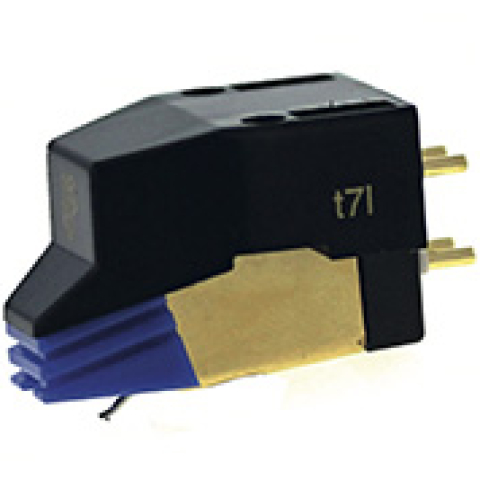
The Grado Prestige Gold1 ($220) is among the latest descendents of Joe Grado's unique and long-refined variation of the moving-iron principle: A stationary magnet and four stationary coils of copper wire are fastened inside a cartridge body, along with two magnetically permeable pole-plates, creating a 1/8" gap into which a plastic stylus housing is snugged. Along with the cantilever and its rubber suspension, that removable housing contains four very small pole-pieces, precisely arranged to correspond with the four coils of wire. A tiny piece of iron near the fulcrum moves with the cantilever and alters the flux lines within those four distinct gaps, inducing in the coils a stereo pair of signals that correspond with the movement of the stylus. (Grado uses the expression Flux-Bridger to describe their complementary pairs of coils and pole-pieces per channel: An increase in flux on one side always corresponds with a decrease on the other, for a presumably distortion-free "push-pull" operation.)
As in virtually all Grado cartridges, the careful application of various damping materials is evident in the Prestige Gold1. A black, tarry substance is sparingly applied to the stylus housing and the gap into which it's snugged—which has the additional benefit of preventing the stylus housing from snapping free of the body too abruptly during removal. And the multipiece alloy cantilever is treated with an apparently harder black coating of its own, to prevent unwanted resonances from setting up along its surface. The stylus itself is an elliptical diamond, and a tracking force of 1.5gm is recommended.
Installation and Setup
With its high compliance and low weight—20cu and 5.5gm, respectively—the Grado Prestige Gold1 is clearly intended for use in tonearms of low to medium mass. Theory trumped empiricism this time out; I didn't even consider using the Grado in my high-mass EMT 997 arm. Instead, I restricted my use of the Grado to two other tonearms: a Naim Aro (on a Linn LP12 turntable) and a Rega RB300 (on a Rega Planar 3 turntable). The Rega arm's range of cartridge adjustment was more than wide enough to permit perfect van Baerwald alignment of the Grado Prestige Gold1; RB300 owners can expect fine results with the cartridge just slightly forward of the center of the adjustment range, and its body rotated inward a few degrees more than the angle of the Rega's headshell area.
The Naim Aro tonearm posed a challenge: As with all Grado cartridges of this type, the distance between the Prestige Gold1's stylus tip and the centerline described by its mounting holes is at least 3mm greater than the "Linn standard." According to my alignment aid, a Dennessen Soundtraktor, the Grado exhibited too much overhang when installed in the nonadjustable Aro—more than enough to confirm that the pairing is far from optimal.
"You mean this is my handmade phono cartridge?"
I've never been the sort who could wait until he got home to open this or that new toy. I rode the train back to White Plains, taking from its pill bottle the humble-looking, plastic-bodied cartridge—it didn't even have the words Signature Seven on it!—along with the mounting hardware, the stylus-removal tool, and the instruction sheet, and stuffing them all back in at least a half-dozen times. I remember being disappointed with the brevity and sparseness of the instructions: not a single word about alignment, vertical tracking angle, or reproducing the soundstage in all of its dimensions. Hmph.
But in time I came to admire the Grado approach to packaging: cheap, effective, unpretentious. Sooner than that—the evening of the day I bought it, in fact—I also came to admire the Grado approach to music-making: lush, textured, palpable.
The Grado Prestige Gold1 ($220) is among the latest descendents of Joe Grado's unique and long-refined variation of the moving-iron principle: A stationary magnet and four stationary coils of copper wire are fastened inside a cartridge body, along with two magnetically permeable pole-plates, creating a 1/8" gap into which a plastic stylus housing is snugged. Along with the cantilever and its rubber suspension, that removable housing contains four very small pole-pieces, precisely arranged to correspond with the four coils of wire. A tiny piece of iron near the fulcrum moves with the cantilever and alters the flux lines within those four distinct gaps, inducing in the coils a stereo pair of signals that correspond with the movement of the stylus. (Grado uses the expression Flux-Bridger to describe their complementary pairs of coils and pole-pieces per channel: An increase in flux on one side always corresponds with a decrease on the other, for a presumably distortion-free "push-pull" operation.)
With its high compliance and low weight—20cu and 5.5gm, respectively—the Grado Prestige Gold1 is clearly intended for use in tonearms of low to medium mass. Theory trumped empiricism this time out; I didn't even consider using the Grado in my high-mass EMT 997 arm. Instead, I restricted my use of the Grado to two other tonearms: a Naim Aro (on a Linn LP12 turntable) and a Rega RB300 (on a Rega Planar 3 turntable). The Rega arm's range of cartridge adjustment was more than wide enough to permit perfect van Baerwald alignment of the Grado Prestige Gold1; RB300 owners can expect fine results with the cartridge just slightly forward of the center of the adjustment range, and its body rotated inward a few degrees more than the angle of the Rega's headshell area.