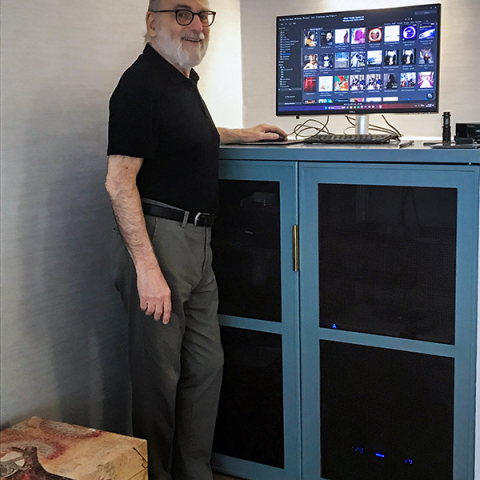
Tim Connor's USB care package also included a 0.2m length of Intona Professional Impedance Controlled USB cable ($450), which I inserted between my Mac mini and the Intona isolator. Between the isolator and the May DAC, I used a 5m Cardas Clear Serial Bus USB cable. Alternately, with my portable MacBook Air as the source, I connected the May DAC to the Intona isolator with a 1m AudioQuest Diamond USB cable.
Out of respect for Tim's opinion, I carefully examined the effects of these Intona products; however, except where noted, all critical observations about the HoloAudio May DAC made below were accomplished without Intona isolation.
Listening
Many products I review start out sounding wrong in a variety of ways and then, in a day or two, sober up and sound right. To my surprise, with the May DAC, the very first album I played, Folketoner ("folk songs"), sung by Det Norske Jentekor (the Norwegian Girls' Choir), sounded more fundamentally right than any digital reproduction I have experienced in my little bunker (24/44.1 FLAC 2L/Qobuz). The sound quality difference between it and the Spring DAC was not subtle. The May DAC made recordings sound considerably more "factual," like this is how it is supposed to sound, in a very unobtrusive way. Everything I write after this will serve only to amplify and verify that observation.
"I once was lost, but now I'm found." The spirit-soothing hymn "Amazing Grace" will outlast the planet it was formed on. Written by poet, clergyman, and reformed slave-trader John Newton (1725–1807), its simple form frames an exquisite incantation that testifies to our shared need for truth and redemption. Among a host of others, folk singer Judy Collins is admired for her many (live) renditions of this powerful song. The May DAC made Collins's 1971 recorded version (from her album Whales and Nightingales, 16/44.1 FLAC Rhino-Elektra/ Qobuz) sound sweet and unaffected. I teared up during the first verse. Judy's voice, and the highly textured reverb surrounding it, opened my heart and kept my mind on the emotional power of every syllable of lyrics.
A few days later, I played this hymn again, and it was distractingly bright with a harsh glare on the top notes of Judy's voice. The choir was muddled. Then I looked at the May's display and realized that the DAC was set for oversampling. When I switched to NOS, the choir's voices separated and became more richly toned. The top octave of Collins's voice relaxed and stopped stinging my ears.
Noticing, at CanJams and audio shows, how gray and hard some DACs sound made me wonder: Do NOS ladder DACs sound unnaturally soft? My best answer is—perhaps. Or maybe not. Who could say for certain? Clearly some R–2R DACs do play on the soft side of neutral. After years with the Holo Spring, I can say for sure that it imparted neither a soft nor hard quality to the recordings it reproduced. I will go further and declare that this hard/soft neutrality, and the Spring's preternatural quiet, are what made it disappear so completely and interfere so little with the music it plays. The May DAC takes the Spring DAC's invisibility and Mohs-scale neutrality and adds push to it. Better than any DAC I know, the May recovers the natural pressure behind musical flow. No doubt, the May's massive power supply contributes to this effect.
In overall presentation, the May DAC reminds me of Mytek's $5995 Manhattan II DAC, which I reviewed in August 2017. Both are extraordinary at recovering music's force and momentum. Until I got the May, the Manhattan II was my favorite digital locomotive. It delivered a mesmerizing sense of music's forward motions. Now I think the May DAC sounds more powerful, and more straightforward, less digital, and just more there than the Manhattan II or the $2449 Schiit Yggdrasil, another favorite.
DSD
Over the years, I've developed a fondness for more digital bits. More than 16 bits makes recordings sound more correct and natural, while artificially elevated sampling rates seem to increase only the illusion of resolution while decreasing palpability and believability. Pure, native DSD is another story. In my little world, DSD provides the most musicality today's digital has to offer. One of the chief reasons I fell in love with the HoloAudio Spring was how organically it played native DSD.
I am fortunate to have a CD, a 24/176.4 WAV file, and a native (5.6 MHz) DSD version of Argentinian music collective Puente Celeste's Nama. This masterful Todd Garfinkle recording (MA Recordings M084A) was made in a smaller hall than Todd usually uses; therefore, the voices and instruments feel more immediate than other Garfinkle recordings. Nama was captured at 5.6MHz with MA's Korg MR-2000 DSD one-bit master recorder and a pair of MA's custom mikes with 16mm DPA omnidirectional capsules. The mikes were connected to the Korg with a 3m pair of Crystal Cable Ultra XLR cables. The sound on Nama is solid and scintillating but also completely relaxed and natural. This recording is an example of what I call utopian digital.
I listened to the DSD128 version of the Nama album using the RAAL Audio SR1a and Abyss AB-1266 Phi TC headphones, both transducers driven by my reference Pass Laboratories INT-25 integrated amplifier.
I like audio that feels (at least a little) like real people playing real instruments in my room. The May DAC, playing Nama, did that real-people thing extremely well. The volume was less than live, but images were lifelike, dense, and hyper-3D. With both headphones, imaging was a 360°, out-of-body experience.
OS: Then I pushed the oversampling button on the remote, causing an increase in the sample rate compared to the original, native DSD, prior to analog conversion, and everything got thinner and more spread out. The soundstage became even wider, but it was now shallower. The harmonic spectrum of vocal and guitar tones was reduced by at least 50%. Performers sounded like imitations of themselves. The audio pleasure factor was reduced by 90%. With oversampling, vividness, brilliance, and old-fashioned transparency were reduced. I found this unsettling. On the good side, there was a sense of greater image specificity and detail.
CD: Oversampling did not enhance my esoteric DSD files. I wondered if it would help my CDs.
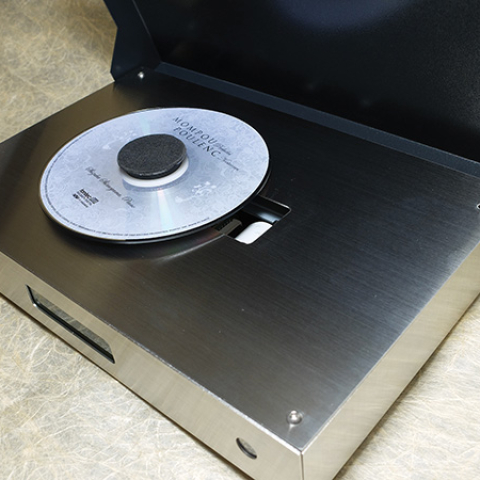
I connected the May to my Integra DPS-7.2 CD player (used as a transport) with a Kimber Kable D50 Dataflex Studio coaxial. I played some more Nama.
Played via the May DAC, the Nama CD sounded less immediate than the DSD128 file or the PCM 24/176.4 file without oversampling. The sound was clear, with a nice flow and fine musical textures, but with softer bass and less precisely drawn soundstages. The May made the Nama CD sound relaxed, natural, and consistently engaging.
Still playing Nama, I pushed that OS button again (selecting OS PCM). The first thing I noticed was a reduction in reverberant sounds. The hall of the Goethe Institute outside Buenos Aires is not enormous, but it has a distinct reverberation that oversampling reduced by half. On the positive side, the recording now sounded more tidy and well-sorted. Detail was easier to notice.
To my surprise, when I switched to OS DSD, which converts PCM bitstreams to DSD, the oversampling added a strange, music-enhancing something—I can't say exactly what, but it felt like—don't laugh—assuredness. With OS DSD, CDs seemed quieter and less digital than with the OS PCM.
The more I listened to CDs with the May's OS DSD mode, the more it seemed the DSD conversion reduced that digital homogenization I referred to earlier. Maybe I stumbled on something.
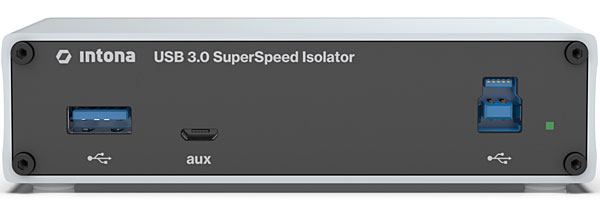 And what about that Intona isolator?
During the last week before writing this, I began examining the effects of the Intona USB 3.0 Galvanic Isolator and its associated cable. When I first put it in, I jumped back. The sound changed more than I expected it would. For a short while, I could not say I liked what it was doing, but I know myself and figured expectations were affecting my judgment, so I left it in and forgot about it. Four days later, I sat listening to Anouar Brahem's The Astounding Eyes of Rita (24/96 FLAC ECM/Qobuz) and thinking, absentmindedly, this recording sounds amazing. Am I listening to the best digital anywhere? Better than my rich friends? Then I remembered the Intona and thought, wow, is this possible? The sound coming out of the Magnepan .7 speakers was sensuous in a way that reminded me of food, strong drink, and sex. Very undigital. Then I took the Intona out. And existential melancholy set in. The soundstage was drier, flatter, and smaller. Instruments sounded plain. Reverberation on the recording was noticeably reduced. Music was less intoxicating.
Then I put the Intona back in.
With the Intona wire and isolator, music sounded more fascinating and complex, which, in my view, is what high fidelity is all about (footnote 2).
 In sum
As the digital anchor in my ever-changing audio systems, the HoloAudio May DAC (Level 3 KTE) exhibited a force and gravity that exceeded even the mighty Mytek Manhattan II. It demonstrated a natural quietness that exceeded my former reference for natural quiet, the HoloAudio Spring. It exhibited a unique type of understated liveliness that exceeded the Yggdrasil and Chord Qutest. The May's true-to-life demeanor made recorded music seem infinite and beautiful. Best of all, it made me feel good about our collective digital future. Bravo, Jeff Zhu. Thank you, Tim Connor.
In sum
As the digital anchor in my ever-changing audio systems, the HoloAudio May DAC (Level 3 KTE) exhibited a force and gravity that exceeded even the mighty Mytek Manhattan II. It demonstrated a natural quietness that exceeded my former reference for natural quiet, the HoloAudio Spring. It exhibited a unique type of understated liveliness that exceeded the Yggdrasil and Chord Qutest. The May's true-to-life demeanor made recorded music seem infinite and beautiful. Best of all, it made me feel good about our collective digital future. Bravo, Jeff Zhu. Thank you, Tim Connor.
Footnote 2: Herb asked me to see if I could find any measured reason for the Intona's improvement in sound quality. However, with data sourced from my MacBook Pro and the Intona connected to the HoloAudio May's USB input, I couldn't find any difference in the May's analog output signal than when the laptop was connected directly to the processor. This echoes my experience with the AudioQuest JitterBug and the UpTone Audio USB Regen, both of which I found improved sound quality despite my not finding any measured reason for the improvement.—John Atkinson
Many products I review start out sounding wrong in a variety of ways and then, in a day or two, sober up and sound right. To my surprise, with the May DAC, the very first album I played, Folketoner ("folk songs"), sung by Det Norske Jentekor (the Norwegian Girls' Choir), sounded more fundamentally right than any digital reproduction I have experienced in my little bunker (24/44.1 FLAC 2L/Qobuz). The sound quality difference between it and the Spring DAC was not subtle. The May DAC made recordings sound considerably more "factual," like this is how it is supposed to sound, in a very unobtrusive way. Everything I write after this will serve only to amplify and verify that observation.
Over the years, I've developed a fondness for more digital bits. More than 16 bits makes recordings sound more correct and natural, while artificially elevated sampling rates seem to increase only the illusion of resolution while decreasing palpability and believability. Pure, native DSD is another story. In my little world, DSD provides the most musicality today's digital has to offer. One of the chief reasons I fell in love with the HoloAudio Spring was how organically it played native DSD.
And what about that Intona isolator?During the last week before writing this, I began examining the effects of the Intona USB 3.0 Galvanic Isolator and its associated cable. When I first put it in, I jumped back. The sound changed more than I expected it would. For a short while, I could not say I liked what it was doing, but I know myself and figured expectations were affecting my judgment, so I left it in and forgot about it. Four days later, I sat listening to Anouar Brahem's The Astounding Eyes of Rita (24/96 FLAC ECM/Qobuz) and thinking, absentmindedly, this recording sounds amazing. Am I listening to the best digital anywhere? Better than my rich friends? Then I remembered the Intona and thought, wow, is this possible? The sound coming out of the Magnepan .7 speakers was sensuous in a way that reminded me of food, strong drink, and sex. Very undigital. Then I took the Intona out. And existential melancholy set in. The soundstage was drier, flatter, and smaller. Instruments sounded plain. Reverberation on the recording was noticeably reduced. Music was less intoxicating.
In sum
As the digital anchor in my ever-changing audio systems, the HoloAudio May DAC (Level 3 KTE) exhibited a force and gravity that exceeded even the mighty Mytek Manhattan II. It demonstrated a natural quietness that exceeded my former reference for natural quiet, the HoloAudio Spring. It exhibited a unique type of understated liveliness that exceeded the Yggdrasil and Chord Qutest. The May's true-to-life demeanor made recorded music seem infinite and beautiful. Best of all, it made me feel good about our collective digital future. Bravo, Jeff Zhu. Thank you, Tim Connor.
Footnote 2: Herb asked me to see if I could find any measured reason for the Intona's improvement in sound quality. However, with data sourced from my MacBook Pro and the Intona connected to the HoloAudio May's USB input, I couldn't find any difference in the May's analog output signal than when the laptop was connected directly to the processor. This echoes my experience with the AudioQuest JitterBug and the UpTone Audio USB Regen, both of which I found improved sound quality despite my not finding any measured reason for the improvement.—John Atkinson