I agree 100% with Art's observation: Spherical/conical-tipped cartridges emphasize "musical content" with force and vigor. And simplification. By eliminating some amounts of complex low-level spatial, atmospheric, and harmonic information, conical tips seem to expose the raw, beating core of humans playing music. That's why I love them.
 Speaking of force and vigor, the AT-VM95C (conical)—which is even cheaper than the $49 elliptical version, at $34—sounded cool, fast, and powerful but also detailed and invigorating. It played complex recordings, like the Stravinsky Conducts Histoire Du Soldat Suite, with power-packed, pitch-perfect bass, a flawlessly toned and detailed midrange, and enough upper-octave energy to make trumpets, drums, and woodwinds sound lifelike and exciting. Drum impact was spectacular.
Music-pleasure–wise, Audio-Technica's VM95C was the most satisfying cartridge in this survey. It shifted my perspective and made me reconsider what I thought I knew about phonography.
Speaking of force and vigor, the AT-VM95C (conical)—which is even cheaper than the $49 elliptical version, at $34—sounded cool, fast, and powerful but also detailed and invigorating. It played complex recordings, like the Stravinsky Conducts Histoire Du Soldat Suite, with power-packed, pitch-perfect bass, a flawlessly toned and detailed midrange, and enough upper-octave energy to make trumpets, drums, and woodwinds sound lifelike and exciting. Drum impact was spectacular.
Music-pleasure–wise, Audio-Technica's VM95C was the most satisfying cartridge in this survey. It shifted my perspective and made me reconsider what I thought I knew about phonography.
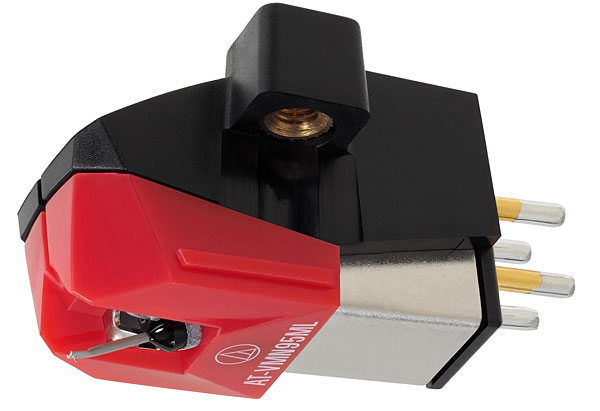 AT-VM95ML
The $169 version of the VM95, the VM95ML, features a nude, square-shanked stylus with a microline profile. Microline styli are narrower and longer than elliptical styli with, supposedly, more contact area with the LP groove wall. During the several days I used the VM95ML, I found myself drawn to early European music, especially records like George Guest directing the Choir of St. John's College, Cambridge, performing Evensong for Ascensiontide (LP, Argo ZRG 511). This cartridge, more than any of the others described here, had an exceptional ability to sort and separate voices in a choir. Likewise, this cartridge located the chapel walls and described the venue's pulsing atmosphere as well as did a cartridge costing 10 times as much. This "Ascensiontide Service" uses singing, spoken word, and a magnificent pipe organ to direct the listener's mind heavenward. The VM95ML cooperated by showing me that place where the sonic becomes numinous.
Goldring E3
This cartridge, more than any of the others described here, had an exceptional ability to sort and separate voices in a choir. Likewise, this cartridge located the chapel walls and described the venue's pulsing atmosphere as well as did a cartridge costing 10 times as much. This "Ascensiontide Service" uses singing, spoken word, and a magnificent pipe organ to direct the listener's mind heavenward. The VM95ML cooperated by showing me that place where the sonic becomes numinous.
Goldring E3
I first noticed Goldring moving magnet cartridges during the 1990s, when their suave, musical demeanor forced me to buy, first, a model 1040 and then a 1042. For a decade, these overachievers were my go-to moving magnets simply because they played solo piano with an authority that made CD players sound emotionally detached and PRaT-challenged.
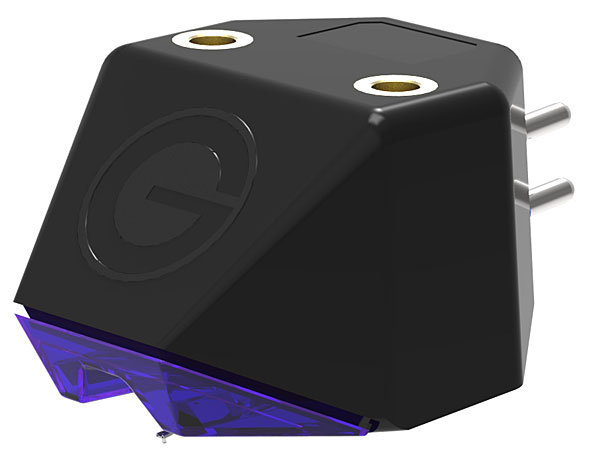 Goldring (footnote 2) introduced the budget E series in 2017. It replaced the popular Elektra and Elan models and consists of three versions: the conical-tipped, carbon-cantilevered E1 ($100), the conical-tipped, aluminum-cantilevered E2 ($129), and the elliptical-tipped, aluminum-cantilevered E3 ($169). The E-series Goldrings are one of those "designed in the UK, made in Japan" products. According to Jonathan Bennett, marketing director for Goldring/Armour Home Electronics, these cartridges are "based around an Audio-Technica generator but with some modifications and improved spec." What I mean by vivid is right there: right in front of me, almost like I could touch the performer.
 I am looking for a word stronger than "vivid" because, earlier today, in my room, the audio-specter of Hamza El Din was singing and playing his oud with full vividosity just a few feet away, and I was incapable of remembering—or caring—that this vibrant holography was created by a $169 Goldring E3 moving magnet cartridge. El Din's Escalay: The Water Wheel (LP, Nonesuch H-72041) played with much of the realism and complexity it does with a Koetsu. Everything was richly textured. There were no brash, harsh, or generalized sounds. This Nonesuch Explorer Series recording sounded a lot like it did with the Audio-Technica AT-VM95E except smoother and maybe a little softer. Maybe.
 On the Charles Mackerras and the Royal Philharmonic performance of Pineapple Poll (LP, EMI ESD 7028), the Goldring E3 played lean, lacking upper-bass warmth, but oh-my-God (!) did it move this fantastic music along. Talk about PRaT; the music for this Gilbert & Sullivan–inspired comic ballet virtually spins and does cartwheels while racing along at a heart-stuttering pace. The E3 played it with no hesitations. Best of all, the music for this ballet has a wonderful way of filling my mind with images of swirling dresses and starched sailor pants; the Goldring E3 seemed to enhance that quality. It brought out every note with a precision I never imagined a moving magnet could muster.
LP Gear Carbon Fidelity CF3600LE
On the Charles Mackerras and the Royal Philharmonic performance of Pineapple Poll (LP, EMI ESD 7028), the Goldring E3 played lean, lacking upper-bass warmth, but oh-my-God (!) did it move this fantastic music along. Talk about PRaT; the music for this Gilbert & Sullivan–inspired comic ballet virtually spins and does cartwheels while racing along at a heart-stuttering pace. The E3 played it with no hesitations. Best of all, the music for this ballet has a wonderful way of filling my mind with images of swirling dresses and starched sailor pants; the Goldring E3 seemed to enhance that quality. It brought out every note with a precision I never imagined a moving magnet could muster.
LP Gear Carbon Fidelity CF3600LE
Based on Audio-Technica's ubiquitous and universally heralded AT3600 ($29), LP Gear (footnote 3) describes their upgraded version, the $49 Carbon Fidelity CF3600LE, as "codeveloped and designed by Audio-Technica with LP Gear." The CF3600LE replaces the aluminum cantilever and 0.0006" conical diamond of the AT3600 with a 0.0003" × 0.0007" elliptical stylus bonded to a carbon-fiber cantilever. The first couple of discs I played with LPG's CF36000LE impressed me with their quiet transparency and smoothness. Then I got an urge for some Slovenian tango, so I played Mascara Quartet's Barco Negro (LP, Sazas VVE LP 001), a clean, simply miked, all-analog recording I know well because I enjoy dreaming to its female vocal, violin, and guitar sounds. With the $8495 Koetsu Rosewood Signature Platinum moving coil, the pure sensuality of Polona Udovic's singing fosters goosebumps, tears, and lust. At first, the budget cartridge failed to deliver. The CF3600LE's flowing-liquid smoothness dissolved transients and dulled the effect of Polona's voice. I was saddened. I should have been jetting between Buenos Aires and Ljubljana but instead I was thinking, maybe it needs more break-in? Happily, the floodwaters receded, and the transients returned, after only 12 hours with the CF3600's stylus working silently in Barco Negro's leadout groove. By midnight the same day, every recording I put on played with gleam and sparkle. The CF3600LE was showing itself as quiet, lushly detailed, and engaging, especially on female vocals.
Koetsu Rosewood Signature Platinum
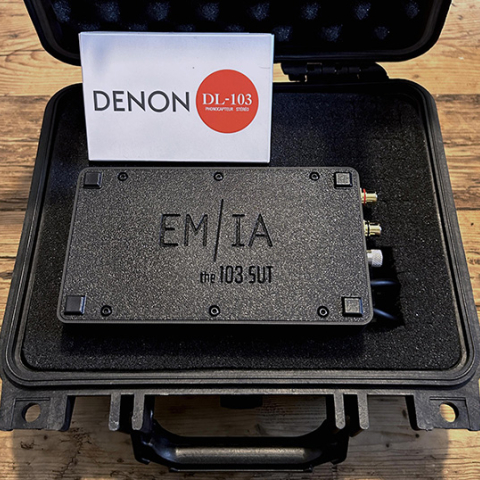
When comparing audio components, sequence is everything. So, please, try to imagine: After weeks comparing entry-level moving magnets, I halted my working-class tourism and replaced the $34 conical-tipped Audio-Technica VM95C with the quadrahedron-tipped, boron-cantilevered, $8495 Koetsu Rosewood Signature Platinum moving coil connected to my $2500 EMIA SUT. The VM95C and the Koetsu both drove the moving magnet input of Sunvalley's SV-EQ1616D phono equalizer. What did I get for the extra $11,000? Sublime ease and dramatic understatement. Immediately, I grasped how unsubtle the VM95C was. I also received what felt like infinite amounts of micro-level information that showed me room boundaries and microphone locations in recording venues like King's College Chapel and Columbia's 30th Street Studio. The Koetsu made recordings seem infinitely complex and layered in content and sound. The Koetsu gave me fewer distractions and more compelling reasons to disappear into each recording. However...with the Koetsu, I did not get closer to living performers, as Sanford Gross said I should. The cheap Audio-Technica made me feel closer to the performers. Neither was my heart directed to the "purpose of music" any better with the Koetsu than it was with the VM95C.
What the Koetsu did that made it worth every penny of extra cost was allow me to let out my breath and close my eyes. It forced tension out of my shoulders. It directed my dreamy attentions to the pure sensuousness of its sound and the capaciousness of its spatial illusion. The Koetsu did what it was designed to do: transform the quotidian into the marvelous.
The earth is flat
As I was finishing my auditions, I realized why all these almost-free, give-them-out-on-Halloween cartridges sounded so ridiculously sophisticated: I was playing them on a $6995 two-motor, belt-drive Dr. Feickert Blackbird turntable equipped with a 10.5", $1995 Schick tonearm. If you are old enough, you might remember that Linn Audio founder Ivor Tiefenbrun used to say that a cheap cartridge on a Sondek LP12 will sound better than an expensive cartridge on a budget deck. Well, I own a 1984 LP12 Valhalla with a Linn Basik LV X arm fitted with an AT95 cartridge, and I have tried a Koetsu Rosewood Signature on a Technics SL-1200 as well as that $699 Pioneer PLX-1000 turntable I reviewed in GD3. I can vouch completely for Ivor's claim.
On the Linn LP12 and the Dr. Feickert Blackbird, the Audio-Technica AT95 sounded dramatically more controlled and powerful, more nuanced and sophisticated, than it ever did on the Pioneer PLX-1000 or that stoop-sale Technics SL-1200 I modified in GD9.
On the Blackbird-Schick deck, these so-called entry-level cartridges played recordings with a layered, three-dimensional complexity that I thought was impossible at these price points. Quiet musical passages were not only quieter; they were filled with magic little details that got noised over, dulled over, or disappeared entirely on the Pioneer and Technics 'tables.
I am not a master cartridge installer, but I can recognize pretty well when a stylus is slipping properly through the grooves. I set VTA/SRA using a few familiar LPs, tweaking arm height until the sound snaps into low-distortion focus. I set azimuth using a Musical Surroundings Fozgometer. I set antiskate so that the arm cartridge moves slowly toward the label on a grooveless disc; then I tweak it a touch more so that it tracks as well as possible on a Shure or Ortofon test record.
I suspect that few audiophiles or reviewers have experienced the capability of these budget cartridges under such perfectionist conditions.
What I learned from this unusual investigation is that the difference between a $100 cartridge and a $10,000 cartridge is not nearly as big as I previously imagined. Also, the difference between a $1000 turntable and a $10,000 turntable is much greater than I thought it was.
If you are a budding phonophile, I recommend buying one of these inexpensive cartridges and putting your car-payment cash into a quiet, solid turntable and tonearm. That way, you can ride the bus while saving for a Koetsu.
Footnote 2: Goldring, Armour Home Electronics Woodside, 2 Dunmow Road, Bishop's Stortford, Herts CM23 5RG, UK. Tel: +44 1279 501111. Web: goldring.co.uk. US distributor: American Audio & Video, 310 West Newberry Road, Bloomfield, CT 16002. Tel: (800) 431-2602. Footnote 3: LP Gear, 3024 Via Venezia, Henderson, NV 89052. Tel: (702) 419-0220 Web: lpgear.com
Speaking of force and vigor, the AT-VM95C (conical)—which is even cheaper than the $49 elliptical version, at $34—sounded cool, fast, and powerful but also detailed and invigorating. It played complex recordings, like the Stravinsky Conducts Histoire Du Soldat Suite, with power-packed, pitch-perfect bass, a flawlessly toned and detailed midrange, and enough upper-octave energy to make trumpets, drums, and woodwinds sound lifelike and exciting. Drum impact was spectacular.
Music-pleasure–wise, Audio-Technica's VM95C was the most satisfying cartridge in this survey. It shifted my perspective and made me reconsider what I thought I knew about phonography.
AT-VM95MLThe $169 version of the VM95, the VM95ML, features a nude, square-shanked stylus with a microline profile. Microline styli are narrower and longer than elliptical styli with, supposedly, more contact area with the LP groove wall. During the several days I used the VM95ML, I found myself drawn to early European music, especially records like George Guest directing the Choir of St. John's College, Cambridge, performing Evensong for Ascensiontide (LP, Argo ZRG 511).
This cartridge, more than any of the others described here, had an exceptional ability to sort and separate voices in a choir. Likewise, this cartridge located the chapel walls and described the venue's pulsing atmosphere as well as did a cartridge costing 10 times as much. This "Ascensiontide Service" uses singing, spoken word, and a magnificent pipe organ to direct the listener's mind heavenward. The VM95ML cooperated by showing me that place where the sonic becomes numinous.
Goldring E3I first noticed Goldring moving magnet cartridges during the 1990s, when their suave, musical demeanor forced me to buy, first, a model 1040 and then a 1042. For a decade, these overachievers were my go-to moving magnets simply because they played solo piano with an authority that made CD players sound emotionally detached and PRaT-challenged.
Goldring (footnote 2) introduced the budget E series in 2017. It replaced the popular Elektra and Elan models and consists of three versions: the conical-tipped, carbon-cantilevered E1 ($100), the conical-tipped, aluminum-cantilevered E2 ($129), and the elliptical-tipped, aluminum-cantilevered E3 ($169). The E-series Goldrings are one of those "designed in the UK, made in Japan" products. According to Jonathan Bennett, marketing director for Goldring/Armour Home Electronics, these cartridges are "based around an Audio-Technica generator but with some modifications and improved spec." What I mean by vivid is right there: right in front of me, almost like I could touch the performer.
I am looking for a word stronger than "vivid" because, earlier today, in my room, the audio-specter of Hamza El Din was singing and playing his oud with full vividosity just a few feet away, and I was incapable of remembering—or caring—that this vibrant holography was created by a $169 Goldring E3 moving magnet cartridge. El Din's Escalay: The Water Wheel (LP, Nonesuch H-72041) played with much of the realism and complexity it does with a Koetsu. Everything was richly textured. There were no brash, harsh, or generalized sounds. This Nonesuch Explorer Series recording sounded a lot like it did with the Audio-Technica AT-VM95E except smoother and maybe a little softer. Maybe.
On the Charles Mackerras and the Royal Philharmonic performance of Pineapple Poll (LP, EMI ESD 7028), the Goldring E3 played lean, lacking upper-bass warmth, but oh-my-God (!) did it move this fantastic music along. Talk about PRaT; the music for this Gilbert & Sullivan–inspired comic ballet virtually spins and does cartwheels while racing along at a heart-stuttering pace. The E3 played it with no hesitations. Best of all, the music for this ballet has a wonderful way of filling my mind with images of swirling dresses and starched sailor pants; the Goldring E3 seemed to enhance that quality. It brought out every note with a precision I never imagined a moving magnet could muster.
Based on Audio-Technica's ubiquitous and universally heralded AT3600 ($29), LP Gear (footnote 3) describes their upgraded version, the $49 Carbon Fidelity CF3600LE, as "codeveloped and designed by Audio-Technica with LP Gear." The CF3600LE replaces the aluminum cantilever and 0.0006" conical diamond of the AT3600 with a 0.0003" × 0.0007" elliptical stylus bonded to a carbon-fiber cantilever. The first couple of discs I played with LPG's CF36000LE impressed me with their quiet transparency and smoothness. Then I got an urge for some Slovenian tango, so I played Mascara Quartet's Barco Negro (LP, Sazas VVE LP 001), a clean, simply miked, all-analog recording I know well because I enjoy dreaming to its female vocal, violin, and guitar sounds. With the $8495 Koetsu Rosewood Signature Platinum moving coil, the pure sensuality of Polona Udovic's singing fosters goosebumps, tears, and lust. At first, the budget cartridge failed to deliver. The CF3600LE's flowing-liquid smoothness dissolved transients and dulled the effect of Polona's voice. I was saddened. I should have been jetting between Buenos Aires and Ljubljana but instead I was thinking, maybe it needs more break-in? Happily, the floodwaters receded, and the transients returned, after only 12 hours with the CF3600's stylus working silently in Barco Negro's leadout groove. By midnight the same day, every recording I put on played with gleam and sparkle. The CF3600LE was showing itself as quiet, lushly detailed, and engaging, especially on female vocals.
When comparing audio components, sequence is everything. So, please, try to imagine: After weeks comparing entry-level moving magnets, I halted my working-class tourism and replaced the $34 conical-tipped Audio-Technica VM95C with the quadrahedron-tipped, boron-cantilevered, $8495 Koetsu Rosewood Signature Platinum moving coil connected to my $2500 EMIA SUT. The VM95C and the Koetsu both drove the moving magnet input of Sunvalley's SV-EQ1616D phono equalizer. What did I get for the extra $11,000? Sublime ease and dramatic understatement. Immediately, I grasped how unsubtle the VM95C was. I also received what felt like infinite amounts of micro-level information that showed me room boundaries and microphone locations in recording venues like King's College Chapel and Columbia's 30th Street Studio. The Koetsu made recordings seem infinitely complex and layered in content and sound. The Koetsu gave me fewer distractions and more compelling reasons to disappear into each recording. However...with the Koetsu, I did not get closer to living performers, as Sanford Gross said I should. The cheap Audio-Technica made me feel closer to the performers. Neither was my heart directed to the "purpose of music" any better with the Koetsu than it was with the VM95C.
As I was finishing my auditions, I realized why all these almost-free, give-them-out-on-Halloween cartridges sounded so ridiculously sophisticated: I was playing them on a $6995 two-motor, belt-drive Dr. Feickert Blackbird turntable equipped with a 10.5", $1995 Schick tonearm. If you are old enough, you might remember that Linn Audio founder Ivor Tiefenbrun used to say that a cheap cartridge on a Sondek LP12 will sound better than an expensive cartridge on a budget deck. Well, I own a 1984 LP12 Valhalla with a Linn Basik LV X arm fitted with an AT95 cartridge, and I have tried a Koetsu Rosewood Signature on a Technics SL-1200 as well as that $699 Pioneer PLX-1000 turntable I reviewed in GD3. I can vouch completely for Ivor's claim.
Footnote 2: Goldring, Armour Home Electronics Woodside, 2 Dunmow Road, Bishop's Stortford, Herts CM23 5RG, UK. Tel: +44 1279 501111. Web: goldring.co.uk. US distributor: American Audio & Video, 310 West Newberry Road, Bloomfield, CT 16002. Tel: (800) 431-2602. Footnote 3: LP Gear, 3024 Via Venezia, Henderson, NV 89052. Tel: (702) 419-0220 Web: lpgear.com