Be aware: When choosing speakers for use with low-power tube amps, the sensitivity spec is less important than finding a speaker with a flat, high, nonreactive impedance characteristic.
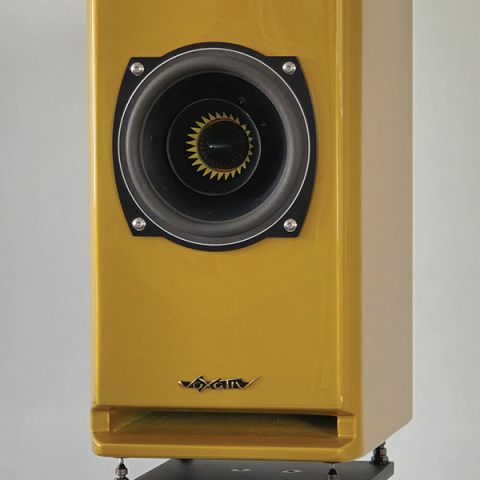
The Soul Supremes satisfy this requirement by using a crossover with only a voltage divider (two resistors), and a single capacitor to attenuate the 113dB/W/m–sensitive Radian ribbon tweeter at 12kHz. The Zu's doped-paper cone mid/woofer handles the other octaves wide open, with no crossover or response modeling. The tradeoff is, running full-range, the Zu's 10.3" cone makes a bit of jitter-like breakup noise as it rolls off in the treble. Fortunately, that noise is only noticeable when I listen for it. In exchange for this subtle disturbance, the crossover-less Soul Supremes achieve improved accuracy in the time domain resulting in a clarity and midrange immediacy that is not subtle but is extremely enjoyable.
 With the Zen amp driving the Soul Supremes, I was bouncing my head and grinning like a fool while playing the Monroe Brothers' classic "Roll in My Sweet Baby's Arms" from Bona Fide Bluegrass and Mountain Music (16/44.1 FLAC BMG/Tidal). If you are not familiar with American bluegrass music, just imagine a rabbit, running for its life through tall grass while being chased by a pack of Appalachian hound dogs. The mandolin imitates the panicked vibe of the rabbit's mind. Those quick-pulsed rabbit movements are what attract me to bluegrass. That delirious momentum is what makes bluegrass a tough genre for most systems to reproduce—especially behemoth audiophile systems. To my perceptions, complex speaker crossovers and amplifiers with gross amounts of feedback compress transients and slow the rabbit down. With this simple Zu-Zen system, the rabbit escaped every time.
Overall, this made-in-America system played all genres of music with nuance, great clarity, proper tone, and a sense of effortless dynamics, even at high volumes.
The Decware 25th Anniversary Zen Triode Amp
With the Zen amp driving the Soul Supremes, I was bouncing my head and grinning like a fool while playing the Monroe Brothers' classic "Roll in My Sweet Baby's Arms" from Bona Fide Bluegrass and Mountain Music (16/44.1 FLAC BMG/Tidal). If you are not familiar with American bluegrass music, just imagine a rabbit, running for its life through tall grass while being chased by a pack of Appalachian hound dogs. The mandolin imitates the panicked vibe of the rabbit's mind. Those quick-pulsed rabbit movements are what attract me to bluegrass. That delirious momentum is what makes bluegrass a tough genre for most systems to reproduce—especially behemoth audiophile systems. To my perceptions, complex speaker crossovers and amplifiers with gross amounts of feedback compress transients and slow the rabbit down. With this simple Zu-Zen system, the rabbit escaped every time.
Overall, this made-in-America system played all genres of music with nuance, great clarity, proper tone, and a sense of effortless dynamics, even at high volumes.
The Decware 25th Anniversary Zen Triode Amp
After making the same simple amp for 25 years, Deckert decided to have some fun. He made a souped-up "all-out" version just for himself. He felt he needed to experience the fuller potential of his original creation. After he built his personal hot rod, he liked what he heard so much that he decided to share it with customers, calling it the 25th Anniversary Zen Triode Amplifier (model SE84UFO25). This new fancy amp is priced at $2895 without tubes and $3295 with a special "curated" tubeset.
Most audio companies' anniversary editions are little more than tarted-up versions of the standard model, with maybe a few designer parts thrown in to justify the price. Deckert's 25th Anniversary Zen Triode Amp is tarted up a lot: with an African Padauk hardwood plinth, gold-plated switches, super-duty gold-plated tube sockets, NOS Western Electric Milliamp meters, and a choice of knobs for the dual-mono volume controls. My review sample came with cream-colored chickenhead knobs!
More importantly, the new 25th Anniversary Zen Triode is a very different amplifier on a fundamental, circuit-design level. It incorporates three independent tube-regulated power supplies, one for each tube, using the indestructible OD3, OA3, OC3 voltage regulator tubes. This change alone is worth more than the price increase, because it elevates the original design to a much higher level of performance. Can you name another amplifier with a tube-regulated power supply? I can't.
After he built his personal hot rod, he liked what he heard so much that he decided to share it with customers, calling it the 25th Anniversary Zen Triode Amplifier (model SE84UFO25). This new fancy amp is priced at $2895 without tubes and $3295 with a special "curated" tubeset.
Most audio companies' anniversary editions are little more than tarted-up versions of the standard model, with maybe a few designer parts thrown in to justify the price. Deckert's 25th Anniversary Zen Triode Amp is tarted up a lot: with an African Padauk hardwood plinth, gold-plated switches, super-duty gold-plated tube sockets, NOS Western Electric Milliamp meters, and a choice of knobs for the dual-mono volume controls. My review sample came with cream-colored chickenhead knobs!
More importantly, the new 25th Anniversary Zen Triode is a very different amplifier on a fundamental, circuit-design level. It incorporates three independent tube-regulated power supplies, one for each tube, using the indestructible OD3, OA3, OC3 voltage regulator tubes. This change alone is worth more than the price increase, because it elevates the original design to a much higher level of performance. Can you name another amplifier with a tube-regulated power supply? I can't.
 This 25th Anniversary Zen ships its optional tube package in a Pelican case that conveniently enables tube rolling by including extra (and alternative) new and NOS tubes. There are double sets of the Zen's 6N15N power tubes, two sets (different brands) of PCC88/7DJ8 input-driver tubes, and double sets (different brands) of voltage-regulator tubes. My review sample of the Anniversary Zen came with a nonstandard engraved four-pin NOS RCA Radiotron "Globe 80" rectifier and a 4-pin–to–octal adapter. Normally, these optional Pelican-case tubesets include a current-production Psvane 5U4G. (During the course of this review, I used a variety of rectifier tubes from my own collection.)
How good is the fancy Zen?
This 25th Anniversary Zen ships its optional tube package in a Pelican case that conveniently enables tube rolling by including extra (and alternative) new and NOS tubes. There are double sets of the Zen's 6N15N power tubes, two sets (different brands) of PCC88/7DJ8 input-driver tubes, and double sets (different brands) of voltage-regulator tubes. My review sample of the Anniversary Zen came with a nonstandard engraved four-pin NOS RCA Radiotron "Globe 80" rectifier and a 4-pin–to–octal adapter. Normally, these optional Pelican-case tubesets include a current-production Psvane 5U4G. (During the course of this review, I used a variety of rectifier tubes from my own collection.)
How good is the fancy Zen?
Somehow, just as I installed the 25th Anniversary Zen Triode, I fell into a jazz album that got its sensuous grip on me and I could not pull away. The album is called Driftglass. It is a debut recording by British composer-instrumentalist Cassie Kinoshi and her Seed Ensemble (24/44.1 FLAC Jazz Re:freshed/Qobuz). It features trumpeter Sheila Maurice-Gray, tenor saxophonist Chelsea Carmichael, and guitarist Shirley Tetteh. It wasn't as edgy or aggressive as my recent obsession album, Your Queen Is a Reptile; what it was was hip new-wave British jazz. (Seed's tuba player, Theon Cross, does play on the Reptile album, with my beloved Shabaka Hutchings in the Sons of Kemet.) The first thing that drew me to Driftglass was the extraordinary quality of its recorded sound. The plucked bass on the first track, "The Darkies," surged and darted about in a tantalizingly resonant manner, while the sound of Maurice-Gray's trumpet gleamed forcefully with burnished, satinlike textures. Theon Cross's tuba harmonics were revel-worthy. The mixing and mastering on Driftglass apparently were finessed to showcase each instrument's luminance and brilliance of tone. The pleasures of this recorded luminance gripped me on the first play and kept me replaying and replaying, eventually directing my attentions toward a fuller appreciation of these musicians' talents. The first several times I played Driftglass, I used a made-in-Japan, Electric Ind. Co. LTD. PCC88/7DJ8 driver tube; the luminosity quotient was intense as described above. Then I dug in the Pelican case and found a Russian 6H5N, which made the bass slightly stronger, more focused, and succinct. Drumbeats seemed more solid and punctual, horns had a more natural brassiness, but luminance was dramatically reduced. Both tubes delivered tube pleasures, but the Russian tube was more plain truth than the Japanese tube, which created a more dazzling effect.
This is just one simple example of the endlessly fascinating possibilities of tube rolling. Uniquely, the 25th Anniversary Zen Triode amplifier employs tube regulators and a tube rectifier, plus adjustable bias on its input tube, making it, in my view, the ultimate tube roller's fun machine. Without 100dB/W/m horns, the Zen Triode will not crush rocks or destroy planets. But driving the modest Zu Audio Soul Supremes, it will play Mahler's Symphony No.5 as performed by the Berlin Philharmoniker under the baton of Sir Simon Rattle (16/44.1 FLAC Werner Classics/Qobuz), and it will do it with dark, moody vigor and delicious microdetailed insights. In my room, sitting close to the speakers, the Berlin Philharmonic played quietly and majestically with no loss of sonic mass or instrumental detail. In my experience, high-sensitivity speakers playing large orchestras at low volumes seem better flowing, better described, and less compressed, transientwise, than conventional, low-sensitivity speakers at any volume. My main complaint with the Zu-Zen's handling of orchestral sound was that the timpani sounded more puffy than powerful. The Zu-Zen system will easily play much louder without noticeable distortion.
Zen-Orangutan
I knew when I switched from the 16 ohm Zu Soul Supremes to the 10 ohm, $8400/pair DeVore Fidelity Orangutan O/93 that I'd find a warmer, quieter, less papery-sounding midrange, and I did. What I noticed also was how the O/93's specified 93dB/W/m sensitivity was lower than the Zu's, but the Zen amp seemed perfectly comfortable with the Orangutan's load. The Decware 25th Anniversary amplifier drove the DeVore O/93s with such suave and natural competence that I felt my Zen amp-speaker experiments had reached a musically satisfying conclusion. The Zen-Orangutan marriage played all music genres elegantly and loudly without clipping or stress. (Sometimes, just to see how loud the O/93s would play with 2.3 watts, I'd turn up a big Mahler climax until the glow of the OD3 voltage regulator tubes would dim or pulse on and off, indicating visually that the Zen's output was clipping. That level wasn't metalhead loud, but it was always louder than I'd ever want to listen.)
I am in my first-ever Sir Simon Rattle period. Besides the Mahler, I've been binging on a new Czech-language version of Janácek's The Cunning Little Vixen and Sinfonietta (24/96 FLAC LSO Live/Qobuz) with Rattle conducting the London Symphony Orchestra. Many aficionados may prefer the Sir Charles Mackerras/Vienna Philharmonic version, but I was completely seduced by the lush tones of the LSO strings and the sensuous charm of soprano Lucy Crowe as Bystrouka, the cunning Vixen, and Gerald Finley (baritone) as Rev°rn°k the Forester. Listening to this recording was about laying back and bathing in the beauty of its sounds.
The LSO's taut-but-luxuriant string sound framed the tones of these talented young voices with a shimmering vivacity that I can't imagine being duplicated by a high-powered class-AB (or class-D) amp at any price. In addition to its charm, this LSO Live recording is an audiophile-grade sound spectacle. Few recordings and even fewer audio systems have held my attention better than The Cunning Little Vixen via the Zen Triode 25th Anniversary Edition driving the DeVore Fidelity Orangutan O/93s. The Zen amp and DeVore speaker truly complemented each other.
Zen vs Elekit TU-8600
Regular Dream readers will wonder how the 25th Anniversary Decware amp compares to the $1785 Elekit TU-8600R SE300B kit amplifier I reviewed in my April 2019 column.
At first, the Zen-to-Elekit switch was disconcerting—the sound was different in so many ways that I didn't know where to begin my descriptions.
After listening (with both amplifiers) to Rattle's Mahler and Janácek, Bill Monroe, Shabaka Hutchings (Your Queen Is a Reptile), and finally Cassie Kinoshi's Driftglass, I could see the bigger sonic picture. The Elekit TU-8600 offers 3–4dB more headroom than the 2.3W Zen amp, but it felt like much more. The Elekit's Electro Harmonix 300Bs played fuller, more relaxed, and more expansive than the Zen.
With the Elekit powering the DeVore O/93s, bass was stronger, more real-sounding, and more tautly described. On the other hand, the 300B's overall sound was less pure and brilliant than that of the triode-wired 6N15Ns in the Zen amp. I suspect that these differences are due in part to the fact that the Elekit uses 12AX7 driver tubes and the Zen uses a 6DJ8. The differences might also be due to the 300B's larger plates, higher standing currents, and the TU-8600's use of solid state rectifiers and small doses of negative feedback.
Comparing these two triode amps made me think of larger- and smaller-displacement automotive engines. The higher-torque 300Bs seemed to take bigger, more relaxing breaths than the higher-revving 6N15Ns. Both amps played beautifully with the O/93s.
Beauty and pleasure are their own rewards
If you imagine that brilliance of tone, luminous atmosphere, and beautiful sound are merely pleasant distortions, you might never understand the engineering savvy that Steve Deckert has brought to the creation of both the standard and 25th Anniversary editions of Decware's Zen Triode amplifier. If your mind is open, you will likely understand why few of my bunker systems have delivered a better marriage of pristine accuracy and low-power pleasure than the three amp-speaker systems described above. These Zen Triodes are unique amplifiers, built by a genuine wizard who is wise enough to offer a 30-day money-back guarantee and a lifetime warranty.
With the Zen amp driving the Soul Supremes, I was bouncing my head and grinning like a fool while playing the Monroe Brothers' classic "Roll in My Sweet Baby's Arms" from Bona Fide Bluegrass and Mountain Music (16/44.1 FLAC BMG/Tidal). If you are not familiar with American bluegrass music, just imagine a rabbit, running for its life through tall grass while being chased by a pack of Appalachian hound dogs. The mandolin imitates the panicked vibe of the rabbit's mind. Those quick-pulsed rabbit movements are what attract me to bluegrass. That delirious momentum is what makes bluegrass a tough genre for most systems to reproduce—especially behemoth audiophile systems. To my perceptions, complex speaker crossovers and amplifiers with gross amounts of feedback compress transients and slow the rabbit down. With this simple Zu-Zen system, the rabbit escaped every time.
After making the same simple amp for 25 years, Deckert decided to have some fun. He made a souped-up "all-out" version just for himself. He felt he needed to experience the fuller potential of his original creation.
After he built his personal hot rod, he liked what he heard so much that he decided to share it with customers, calling it the 25th Anniversary Zen Triode Amplifier (model SE84UFO25). This new fancy amp is priced at $2895 without tubes and $3295 with a special "curated" tubeset.
This 25th Anniversary Zen ships its optional tube package in a Pelican case that conveniently enables tube rolling by including extra (and alternative) new and NOS tubes. There are double sets of the Zen's 6N15N power tubes, two sets (different brands) of PCC88/7DJ8 input-driver tubes, and double sets (different brands) of voltage-regulator tubes. My review sample of the Anniversary Zen came with a nonstandard engraved four-pin NOS RCA Radiotron "Globe 80" rectifier and a 4-pin–to–octal adapter. Normally, these optional Pelican-case tubesets include a current-production Psvane 5U4G. (During the course of this review, I used a variety of rectifier tubes from my own collection.)
Somehow, just as I installed the 25th Anniversary Zen Triode, I fell into a jazz album that got its sensuous grip on me and I could not pull away. The album is called Driftglass. It is a debut recording by British composer-instrumentalist Cassie Kinoshi and her Seed Ensemble (24/44.1 FLAC Jazz Re:freshed/Qobuz). It features trumpeter Sheila Maurice-Gray, tenor saxophonist Chelsea Carmichael, and guitarist Shirley Tetteh. It wasn't as edgy or aggressive as my recent obsession album, Your Queen Is a Reptile; what it was was hip new-wave British jazz. (Seed's tuba player, Theon Cross, does play on the Reptile album, with my beloved Shabaka Hutchings in the Sons of Kemet.) The first thing that drew me to Driftglass was the extraordinary quality of its recorded sound. The plucked bass on the first track, "The Darkies," surged and darted about in a tantalizingly resonant manner, while the sound of Maurice-Gray's trumpet gleamed forcefully with burnished, satinlike textures. Theon Cross's tuba harmonics were revel-worthy. The mixing and mastering on Driftglass apparently were finessed to showcase each instrument's luminance and brilliance of tone. The pleasures of this recorded luminance gripped me on the first play and kept me replaying and replaying, eventually directing my attentions toward a fuller appreciation of these musicians' talents. The first several times I played Driftglass, I used a made-in-Japan, Electric Ind. Co. LTD. PCC88/7DJ8 driver tube; the luminosity quotient was intense as described above. Then I dug in the Pelican case and found a Russian 6H5N, which made the bass slightly stronger, more focused, and succinct. Drumbeats seemed more solid and punctual, horns had a more natural brassiness, but luminance was dramatically reduced. Both tubes delivered tube pleasures, but the Russian tube was more plain truth than the Japanese tube, which created a more dazzling effect.
I knew when I switched from the 16 ohm Zu Soul Supremes to the 10 ohm, $8400/pair DeVore Fidelity Orangutan O/93 that I'd find a warmer, quieter, less papery-sounding midrange, and I did. What I noticed also was how the O/93's specified 93dB/W/m sensitivity was lower than the Zu's, but the Zen amp seemed perfectly comfortable with the Orangutan's load. The Decware 25th Anniversary amplifier drove the DeVore O/93s with such suave and natural competence that I felt my Zen amp-speaker experiments had reached a musically satisfying conclusion. The Zen-Orangutan marriage played all music genres elegantly and loudly without clipping or stress. (Sometimes, just to see how loud the O/93s would play with 2.3 watts, I'd turn up a big Mahler climax until the glow of the OD3 voltage regulator tubes would dim or pulse on and off, indicating visually that the Zen's output was clipping. That level wasn't metalhead loud, but it was always louder than I'd ever want to listen.)
Regular Dream readers will wonder how the 25th Anniversary Decware amp compares to the $1785 Elekit TU-8600R SE300B kit amplifier I reviewed in my April 2019 column.
If you imagine that brilliance of tone, luminous atmosphere, and beautiful sound are merely pleasant distortions, you might never understand the engineering savvy that Steve Deckert has brought to the creation of both the standard and 25th Anniversary editions of Decware's Zen Triode amplifier. If your mind is open, you will likely understand why few of my bunker systems have delivered a better marriage of pristine accuracy and low-power pleasure than the three amp-speaker systems described above. These Zen Triodes are unique amplifiers, built by a genuine wizard who is wise enough to offer a 30-day money-back guarantee and a lifetime warranty.