

Sidebar 3: Measurements
I used DRA Labs' MLSSA system and a calibrated DPA 4006 microphone to measure the Harbeth Monitor 30.2's frequency response in the farfield, and an Earthworks QTC-40 for the nearfield responses. My estimate of the Harbeth's sensitivity was 87.3dB(B)/2.83V/m, which is usefully higher than the specified 85dB. The Monitor 30.2's nominal impedance is specified as 6 ohms, and its impedance magnitude (fig.1, solid trace) actually remains at or above 6 ohms throughout the audioband. I would have specified this speaker as an 8 ohm design; it should be an easy load for amplifiers to drive.
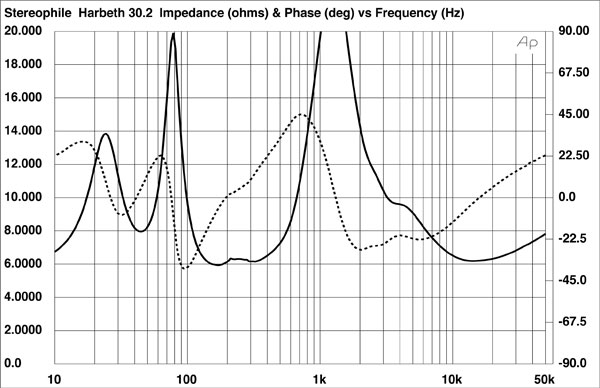
 The saddle between 40 and 50Hz in the impedance-magnitude trace implies that the port on the front panel is tuned to this frequency—and, looking at the woofer's output measured in the nearfield (fig.3), this does have the expected minimum-motion notch at 44Hz. (At this frequency, the woofer cone is held stationary by the back pressure from the port resonance.) The port's output, again measured in the nearfield (fig.3, blue trace), peaks in textbook fashion between 30 and 90Hz, and its upper-frequency rolloff is clean. The sum of the woofer's and port's outputs is shown as the black trace below 300Hz in fig.3; the apparent peak in the upper bass is entirely an artifact of the nearfield measurement technique, which assumes that the radiators are mounted in a true infinite baffle; ie, one that extends to infinity in both planes. In true BBC-heritage fashion, the Monitor 30.2 appears to be tuned to be maximally flat in the bass, with its output down by 6dB at the port tuning frequency.
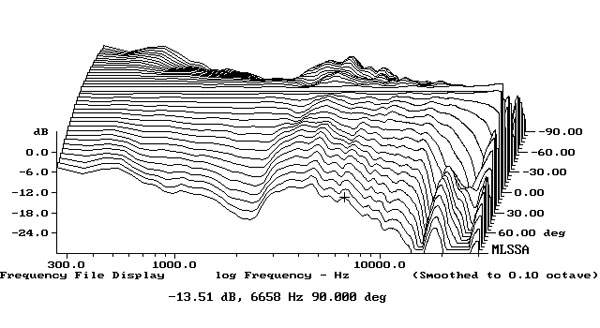
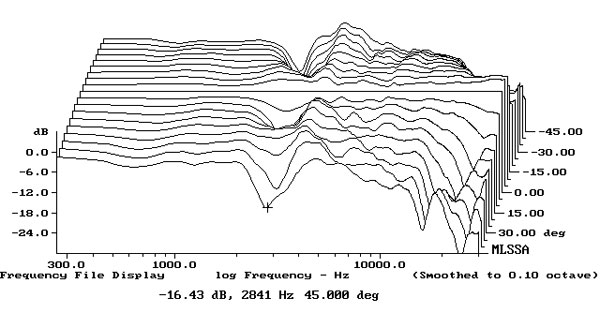
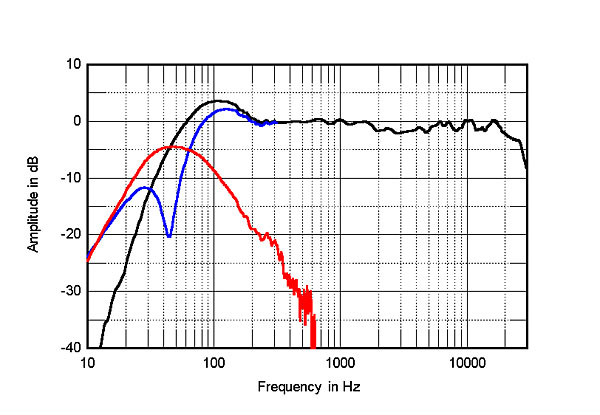 Fig.4 shows the Monitor 30.2's lateral dispersion, normalized to the tweeter-axis response, which thus appears to be a straight line. The recessed woofer becomes increasingly directional toward the top of its passband before crossing over to the wider-dispersion tweeter at the bottom of its passband. All things being equal, this will make the Harbeth speaker sound too polite in large rooms. The speaker's vertical dispersion is shown in fig.5. Suckouts in the crossover region occur more than 10° above and 5° below the tweeter axis, but there is slightly more mid-treble energy 5–10° above the tweeter axis. This speaker needs to be used with stands that place the tweeter axis just below the level of a seated listener's ears, to get the most neutral treble balance.
 In the time domain, the Monitor 30.2's step response on the tweeter axis (fig.6) reveals that its tweeter is connected in inverted acoustic polarity, its woofer in positive polarity—and that, in common with some other BBC-heritage designs I have measured, the tweeter's output has decayed before the output of the woofer arrives. This design is neither time-coherent nor time-coincident, but its design is optimized for its frequency-domain performance. The Harbeth's cumulative spectral-decay or waterfall plot (fig.7) is clean overall.

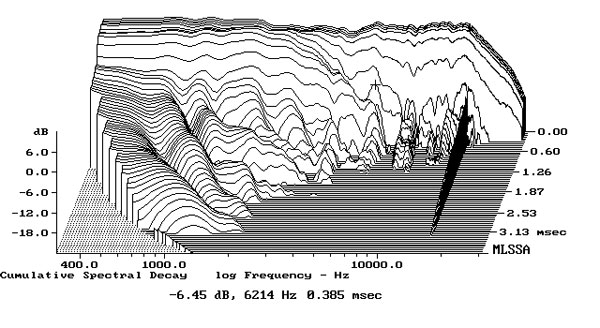
Fig.1 Harbeth Monitor 30.2, electrical impedance (solid) and phase (dashed) (2 ohms/vertical div.).
There are some small discontinuities in the impedance traces between 200 and 300Hz, and when I investigated the vibrational behavior of the enclosure's panels with a simple plastic-tape accelerometer, I did find some resonant modes on the top and side panels in this region. The side panel (fig.2) was more lively than the top (not shown), but these modes were relatively low in level.
Fig.2 Harbeth Monitor 30.2, cumulative spectral-decay plot calculated from output of accelerometer fastened to center of sidewall (MLS driving voltage to speaker, 7.55V; measurement bandwidth, 2kHz).
Fig.3 Harbeth Monitor 30.2, anechoic response on tweeter axis at 50", averaged across 30° horizontal window and corrected for microphone response, with nearfield responses of woofer (blue), port (red), and their complex sum, respectively plotted in the ratios of the square roots of their radiating areas below 300Hz, 600Hz, and 300Hz.
As recommended by Harbeth, I measured the Monitor 30.2's farfield behavior with its grille in place. The speaker's response, averaged across a 30° horizontal window centered on the tweeter axis (fig.3, black trace above 300Hz), is smooth and even, though with a slight loss of energy in the mid-treble. When I repeated the measurement with the grille removed—easier to write than to do, given its very tight fit—the on-axis response was basically identical to what it had been with the grille in place up to 5kHz, but was up to 2dB higher between 7 and 20kHz.
Fig.4 Harbeth Monitor 30.2, lateral response family at 50", normalized to response on tweeter axis, from back to front: differences in response 90–5° off axis, reference response, differences in response 5–90° off axis.
Fig.5 Harbeth Monitor 30.2, vertical response family at 50", normalized to response on tweeter axis, from back to front: differences in response 45–5° above tweeter axis, reference response, differences in response 5–45° below tweeter axis.
Fig.6 Harbeth Monitor 30.2, step response on tweeter axis at 50" (5ms time window, 30kHz bandwidth).
Fig.7 Harbeth Monitor 30.2, cumulative spectral-decay plot on tweeter axis at 50" (0.15ms risetime).
Its measured performance confirms that the Monitor 30.2 is as well-engineered a design as I have come to expect from Alan Shaw and his respect for the BBC tradition.—John Atkinson















