

Sidebar 3: Measurements
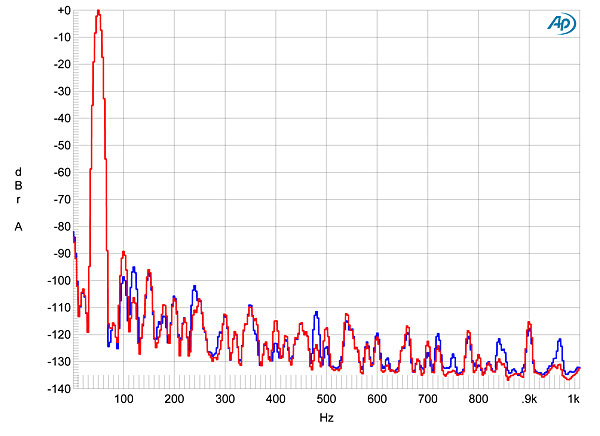
I measured the Hegel H160 using my recently recalibrated Audio Precision SYS2722 system (see www.ap.com, and the January 2008 "As We See It"). Before performing any measurements on an amplifier, I run it for an hour at one-third its specified maximum power, which, thermally, is the worst case for an amplifier with a class-B or -AB output stage. I cut short this preconditioning of the H160 after 20 minutes, however, as the THD+noise, which had been just 0.00315% with the amplifier cold, had risen to 0.83%. The chassis was mildly warm, at 92.2°F (33.4°C), but the temperature of the internal heatsinks must have been much higher. Allowing the amplifier to cool brought back correct operation, with very low distortion, but this is not an amplifier suitable for sustained high-power use, such as providing the music for a rambunctious party.
The volume control offers 99 steps, with "0" being full mute, activated by a relay. However, only alternate settings offered a reduction in gain; eg, both "99" and "98" offered maximum gain, "97" and "96" produced a reduction in level of –1dB, "95" and "94" a reduction of –2dB, and so on. The maximum voltage gain, measured at the speaker terminals, was a modest 31.6dB into 8 ohms for both the balanced and unbalanced inputs, while the fixed-gain, line-level outputs offered unity gain, with a source impedance of 1k ohms across the audioband. All outputs preserved absolute polarity (ie, were non-inverting). The unbalanced input impedance was a usefully high 47k ohms at low and middle frequencies, this dropping inconsequentially to 34k ohms at 20kHz. The balanced input impedance, however, was on the low side, at 9.4k ohms, at all audio frequencies.
The output impedance was very low over most of the audioband, at 0.07 ohm, rising to 0.1 ohm at 20kHz. (Both figures include 6' of speaker cable.) As a result, the modulation of the H160's frequency response with our standard simulated loudspeaker (fig.1, gray trace) was minimal. The Hegel offers a wide small-signal bandwidth, its output into 8 ohms being down by 3dB at greater than the 200kHz limit of this graph, which resulted in a superbly accurate shape to a 10kHz squarewave, with very short risetimes and no sign of overshoot or ringing (fig.2). The traces in fig.1 were taken with the balanced input and the volume control set to its maximum. Commendably, there was no change in the frequency response and channel balance for different settings of the volume control, or with the unbalanced inputs.


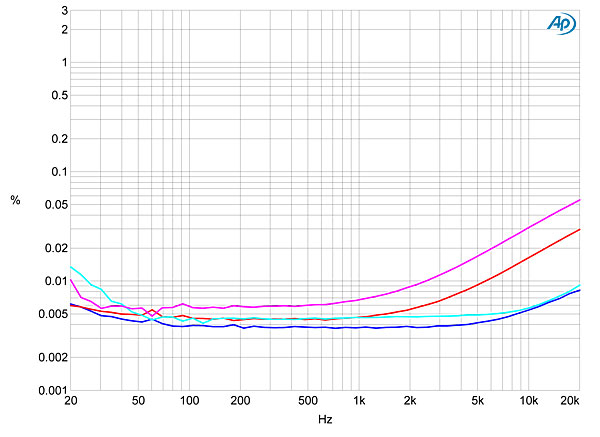
 Specified to produce 150Wpc into 8 ohms (21.75dBW) or 250Wpc into 4 ohms (21dBW), the H160 clipped (1% THD+N) at 175Wpc into 8 ohms (22.4dBW, fig.4) and 270Wpc into 4 ohms (21.3dBW, fig.5). The down-sloping shape of the traces in these two graphs implies that the actual distortion remains below the noise floor at levels below 50W or so. I therefore measured how the percentage of THD+N changed with frequency at a reasonably high level, 9V, equivalent to 10W into 8 ohms and 20W into 4 ohms. The results are shown in fig.6: the right channel (red and magenta traces) is not quite as linear as the left (blue, cyan), particularly in the top two audio octaves. However, the distortion remains very low across the audioband.


 Turning to the H160's digital inputs: With the volume control set to its maximum, digital data at –12dBFS gave rise to a level of 24.5V into 8 ohms (equivalent to 75W) from the speaker outputs, which suggests that the amplifier at full volume will clip with data at –6dBFS. Fortunately, this will never happen outside the test lab, but I measured the digital-domain performance at the fixed-level line outputs with the speaker outputs muted, to avoid overloading the amplifier's output stage. Data at 0dBFS resulted in an analog level of 2.53V at the line-level outputs.
I didn't test the H160's AirPlay input. The coaxial and optical S/PDIF inputs locked to datastreams with sample rates ranging from 44.1 to 192kHz. With the USB input fed data from my MacBook Pro running on battery power, Apple's USB Prober utility reported the product string as "DigiHug USB Audio" from "GFEC ASSP," though the AudioMIDI utility identified the Hegel as "TE7022 Audio w/ SPDIF." This implies that the H160 uses the Tenor USB receiver chip, which was confirmed by the fact that the Hegel's USB input will not accept data sampled at 88.2kHz, though it does accept 96kHz data. USB Prober also indicated that the H160's USB port operates in the isochronous adaptive mode, although, as you'll see later, this does not result in compromised jitter rejection.
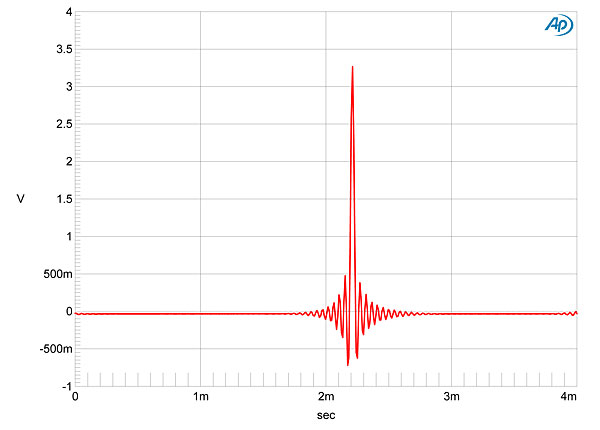
The impulse response with 44.1kHz data (fig.10) reveals that the H160's digital reconstruction filter is a conventional time-symmetrical type, with a rapid rolloff above the Nyquist frequency for 44.1kHz data, this indicated in fig.11 by the vertical green line at 22.05kHz. The red and magenta traces in this graph, taken with 44.1kHz-sampled white noise at –4dBFS, reveal that the rolloff has reached the stopband noise floor by 25kHz, the frequency of the aliasing image of a full-scale tone at 19.1kHz (blue and cyan traces). The harmonics of this 19.1kHz tone are all very low in level. Fig.12 shows a more conventional manner of presenting digital-domain frequency response, with S/PDIF data sampled at 44.1kHz (cyan and magenta traces), 96kHz (green, gray), and 192kHz (blue, red). All three pairs of traces feature a slight rise in response in the top audio octave, reaching +0.75dB at 40kHz with the higher sample rates; peculiarly, the response with 192kHz data is no more extended than with 96kHz data.
Turning to the H160's digital inputs: With the volume control set to its maximum, digital data at –12dBFS gave rise to a level of 24.5V into 8 ohms (equivalent to 75W) from the speaker outputs, which suggests that the amplifier at full volume will clip with data at –6dBFS. Fortunately, this will never happen outside the test lab, but I measured the digital-domain performance at the fixed-level line outputs with the speaker outputs muted, to avoid overloading the amplifier's output stage. Data at 0dBFS resulted in an analog level of 2.53V at the line-level outputs.
I didn't test the H160's AirPlay input. The coaxial and optical S/PDIF inputs locked to datastreams with sample rates ranging from 44.1 to 192kHz. With the USB input fed data from my MacBook Pro running on battery power, Apple's USB Prober utility reported the product string as "DigiHug USB Audio" from "GFEC ASSP," though the AudioMIDI utility identified the Hegel as "TE7022 Audio w/ SPDIF." This implies that the H160 uses the Tenor USB receiver chip, which was confirmed by the fact that the Hegel's USB input will not accept data sampled at 88.2kHz, though it does accept 96kHz data. USB Prober also indicated that the H160's USB port operates in the isochronous adaptive mode, although, as you'll see later, this does not result in compromised jitter rejection.
The impulse response with 44.1kHz data (fig.10) reveals that the H160's digital reconstruction filter is a conventional time-symmetrical type, with a rapid rolloff above the Nyquist frequency for 44.1kHz data, this indicated in fig.11 by the vertical green line at 22.05kHz. The red and magenta traces in this graph, taken with 44.1kHz-sampled white noise at –4dBFS, reveal that the rolloff has reached the stopband noise floor by 25kHz, the frequency of the aliasing image of a full-scale tone at 19.1kHz (blue and cyan traces). The harmonics of this 19.1kHz tone are all very low in level. Fig.12 shows a more conventional manner of presenting digital-domain frequency response, with S/PDIF data sampled at 44.1kHz (cyan and magenta traces), 96kHz (green, gray), and 192kHz (blue, red). All three pairs of traces feature a slight rise in response in the top audio octave, reaching +0.75dB at 40kHz with the higher sample rates; peculiarly, the response with 192kHz data is no more extended than with 96kHz data.


 Despite its USB input operating in the isochronous adaptive mode, the H160 offered excellent rejection of wordclock jitter via USB, and the S/PDIF inputs were equally good. With 16-bit J-Test data (fig.16), all the odd-order harmonics of the LSB-level, low-frequency squarewave were at or close to their correct levels, and no other sidebands were evident around the high-level tone at one-quarter the sample rate. With 24-bit J-Test data (fig.17), no sidebands are visible, and the noise floor is clean and free from spuriae.

 Hegel's H160 integrated amplifier is a well-engineered powerhouse, though owners should make sure it is well ventilated if they want to play music at sustained high levels. Its digital/analog circuitry is workmanlike rather than the state of the art, but a standalone digital processor offering better performance than this is going to cost as least as much as the Hegel's $3500.—John Atkinson
Fig.1 Hegel H160, volume control set to maximum, frequency response at 2.83V into: simulated loudspeaker load (gray), 8 ohms (left channel blue, right red), 4 ohms (left cyan, right magenta), 2 ohms (green) (0.5dB/vertical div.).
Fig.2 Hegel H160, small-signal, 10kHz squarewave into 8 ohms.
Channel separation was good rather than great, at >80dB below 2kHz but 60dB at 20kHz. The unweighted, wideband signal/noise ratio, taken with the unbalanced inputs shorted but the volume control set to its maximum—very much the worst-case situation—was good, at 76.3dB in the left channel and 77.5dB in the right, ref. 1W into 8 ohms, these respectively improving to 92.7 and 91.3dB when A-weighted. The primary source of noise was the presence of power-supply–related components at the even- and odd-order harmonics of 60Hz, though all of these lay at or below –94dB ref. 1W into 8 ohms (fig.3).
Fig.3 Hegel H160, spectrum of 1kHz sinewave, DC–1kHz, at 1W into 8 ohms (linear frequency scale).
Fig.4 Hegel H160, distortion (%) vs 1kHz continuous output power into 8 ohms.
Fig.5 Hegel H160, distortion (%) vs 1kHz continuous output power into 4 ohms.
Fig.6 Hegel H160, THD+N (%) vs frequency at 9V into: 8 ohms (left channel blue, right red), 4 ohms (left cyan, right magenta).
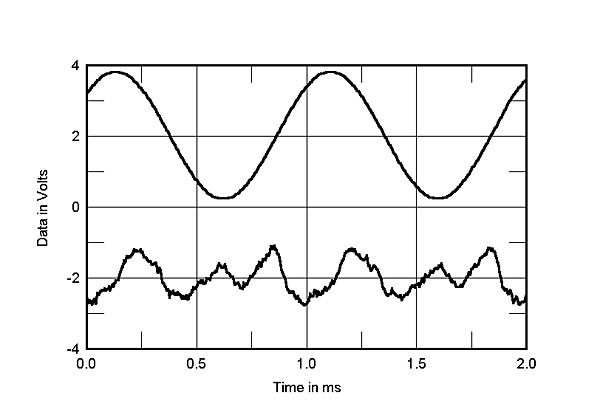
The distortion signature in the midband is predominantly the third harmonic (fig.7—I had to average 64 captures to reveal the waveform of the spuriae with the fundamental tone notched out. (Every time the number of captures is doubled, the level of the noise in the graph is reduced by 3dB.) This graph was taken from the left channel's output; the second harmonic was highest in the right channel (fig.8), though at –90dB ref. 50W into 8 ohms (0.003%), high is not really the appropriate adjective. Intermodulation distortion (fig.9) was similarly very low.
Fig.7 Hegel H160, 1kHz waveform at 20W into 4 ohms, 0.0049% THD+N (top); distortion and noise waveform with fundamental notched out (bottom, not to scale).
Fig.8 Hegel H160, spectrum of 50Hz sinewave, DC–1kHz, at 50W into 8 ohms (linear frequency scale).
Fig.9 Hegel H160, HF intermodulation spectrum, DC–30kHz, 19+20kHz at 50W peak into 8 ohms (linear frequency scale).
Fig.10 Hegel H160, line output, impulse response at 44.1kHz (4ms time window).
Fig.11 Hegel H160, line output, wideband spectrum of white noise at –4dBFS (left channel red, right magenta) and 19.1kHz tone at 0dBFS (left blue, right cyan), with data sampled at 44.1kHz (20dB/vertical div.).
Fig.12 Hegel H160, line output, frequency response at –12dBFS into 100k ohms with data sampled at: 44.1kHz (left channel cyan, right magenta), 96kHz (left green, right gray), 192kHz (left blue, right red) (0.5dB/vertical div.).
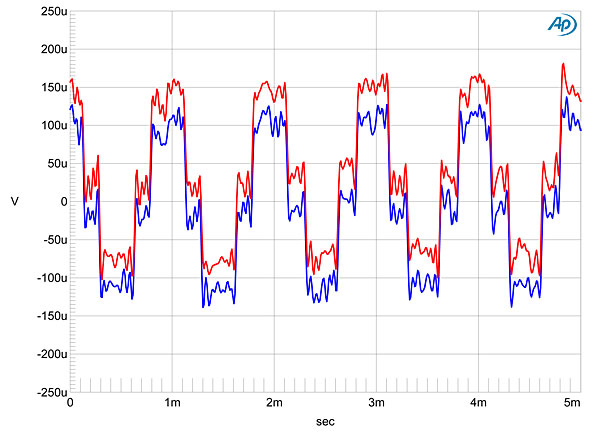
Channel separation for the digital inputs was >100dB below 600Hz, decreasing to 67dB at 20kHz. Fig.13 reveals that the H160's noise floor drops by up to 18dB when the bit depth is increased from 16 to 24 with a dithered 1kHz tone at –90dBFS, which implies resolution of almost 19 bits, which is excellent. However, an odd modulation of the noise floor is evident in the low treble with 24-bit data in this graph (blue and red traces). Nevertheless, the Hegel's reproduction of an undithered 16-bit sinewave at exactly –90.31dBFS (fig.14) was superb, with the three DC voltage levels described by the data readily resolved, while undithered 24-bit data gave a clean sinewave (fig.15). Figs. 13 and 14 were taken with S/PDIF data; repeating the tests with USB data gave identical results, though I had to make sure that the bit depth was correctly set to "24-bit integer" with the AudioMIDI utility to get the maximum resolution with 24-bit files.
Fig.13 Hegel H160, line output, spectrum with noise and spuriae of dithered 1kHz tone at –90dBFS with: 16-bit data (left channel cyan, right magenta), 24-bit data (left blue, right red) (20dB/vertical div.).
Fig.14 Hegel H160, line output, waveform of undithered 1kHz sinewave at –90.31dBFS, 16-bit data (left channel blue, right red).
Fig.15 Hegel H160, line output, waveform of undithered 1kHz sinewave at –90.31dBFS, 16-bit data (left channel blue, right red).
Fig.16 Hegel H160, line output, high-resolution jitter spectrum of analog output signal, 11.025kHz at –6dBFS, sampled at 44.1kHz with LSB toggled at 229Hz: 16-bit data from AP SYS2722 via TosLink (left channel blue, right red). Center frequency of trace, 11.025kHz; frequency range, ±3.5kHz.
Fig.17 Hegel H160, line output, high-resolution jitter spectrum of analog output signal, 11.025kHz at –6dBFS, sampled at 44.1kHz with LSB toggled at 229Hz: 24-bit data from AP SYS2722 via TosLink (left channel blue, right red). Center frequency of trace, 11.025kHz; frequency range, ±3.5kHz.















