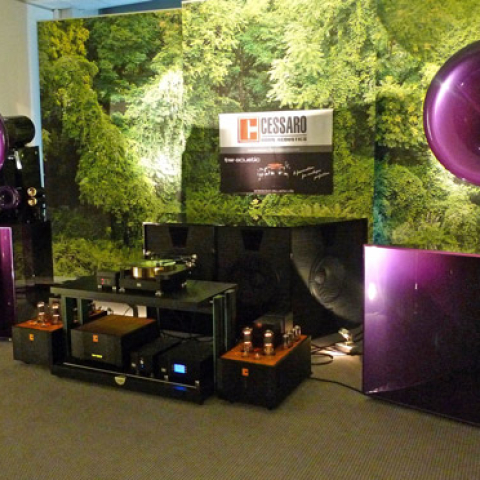
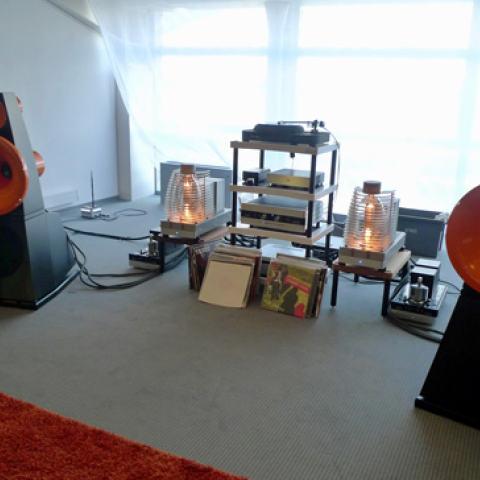
In the primary Living Voice room (there were two) I found the Vox Olympian & Vox Elysian loudspeakers (851,200/pair Euros in Macassar Ebony & Amboyna Burl with figured Eucalyptus wood), partnered with vintage Kondo electronics via both digital and analog sources. For analog, there was the Grand Prix Audio Monaco 2.0 turntable with a Kuzma 4-point tonearm, and a Fuuga MC cartridge (45,419 Euro total) connected via a Living Voice step-up transformer (6812 Euros) to a SJS enhanced model 3 phono-amplifier voiced for Living Voice (15,896 Euros).
 The digital source was Living Voice's "turbo'd" LV CD300 player (8516 Euros). Both sources were connected (with assorted Kondo and Living Voice cables) to a Kondo M77 preamplifier (45,119 Euros) and a pair of Kondo Gakuoh parallel 300B single-ended mono amplifiers (85,161 Euros/pair). The presentation felt deep full and natural like the ocean—not artificial or mechanical.
Most exciting of all was the fact that this completely exotic system was not plugged into the wall—it was connected entirely to Living Voice's own Pure Music Battery Power Supply System (below, 34,000 Euros). On recording after recording this fantasy system delivered a balanced flowing sound that never drew attention to itself in any negative way. If you are skeptical, or dismissive about horns and directly-heated triodes this setup could shift your mind.
The digital source was Living Voice's "turbo'd" LV CD300 player (8516 Euros). Both sources were connected (with assorted Kondo and Living Voice cables) to a Kondo M77 preamplifier (45,119 Euros) and a pair of Kondo Gakuoh parallel 300B single-ended mono amplifiers (85,161 Euros/pair). The presentation felt deep full and natural like the ocean—not artificial or mechanical.
Most exciting of all was the fact that this completely exotic system was not plugged into the wall—it was connected entirely to Living Voice's own Pure Music Battery Power Supply System (below, 34,000 Euros). On recording after recording this fantasy system delivered a balanced flowing sound that never drew attention to itself in any negative way. If you are skeptical, or dismissive about horns and directly-heated triodes this setup could shift your mind.
 Yes, this system is expensive, but I have owned and listened to equally expensive ones in my own home (also powered by vintage Kondo designs) and I can say with some assurance: this visually elegant system generates a type of dead-quiet, 0—60 in 3 seconds, totally musical, loves Igor Stravinsky and Wilhelm Furtwängler experience that exceeds the sum of its parts. It delivers the complete gestalt of horns and triodes high fidelity with no conspicuous compromise.
 Falcon Acoustics
It is not a secret that my forever reference for a properly engineered monitor-type loudspeaker is the Rogers LS3/5a and its numerous BBC-licensed incarnations—up to and especially the latest Falcon Acoustics version manufactured in Oxfordshire, England by Jerry Bloomfield under the technical supervision of KEF's first employee and Falcon Acoustics' retired founder, Malcolm Jones. When I die, if I can take only one pair of speakers to the other side, it will be the Falcon LS3/5a. That is the kind of bloke I am.
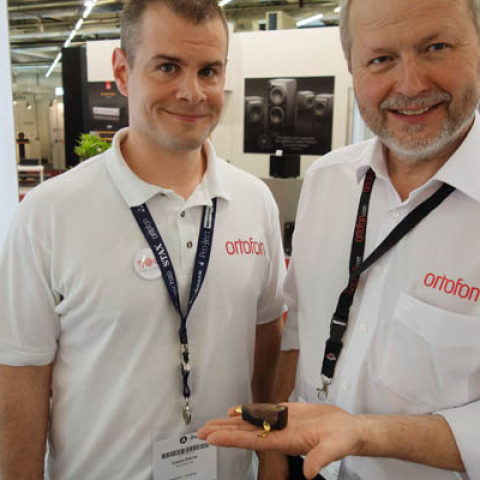
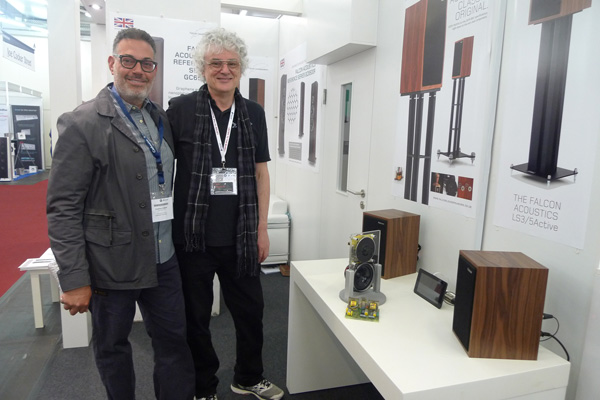
I am also the kind of bloke that becomes a rabid shameless fanboy when in the presence of audio designers I admire. Which is exactly how I felt meeting Falcon Acoustics' main man Jerry Bloomfield (right in photo). Jerry and Sugden's Patrick Miller were manning the Falcon-Sugden display in MOC Hall 3.
I was so happy to finally meet Mr. Bloomfield I forgot all the work I was sent to Munich to do. Mindless of the time, I stood there blabbering on and on about the essence of BBC monitors with Jerry Bloomfield and Falcon's American distributor, Jonathan Halpern of Tone Imports (left in photo). I was digging every second. Then Jerry disappeared for a minute, and returned holding this wondrous little green pre-production, prototype LS3/5 crossover circuit board with three Radio Metal chokes. While I held the sacred board in my hands, I went into a blackout, my mind began driving on the left side of the road and I speculated about how much pleasure to how many people this exotic little BBC design had provided.
Falcon Acoustics
It is not a secret that my forever reference for a properly engineered monitor-type loudspeaker is the Rogers LS3/5a and its numerous BBC-licensed incarnations—up to and especially the latest Falcon Acoustics version manufactured in Oxfordshire, England by Jerry Bloomfield under the technical supervision of KEF's first employee and Falcon Acoustics' retired founder, Malcolm Jones. When I die, if I can take only one pair of speakers to the other side, it will be the Falcon LS3/5a. That is the kind of bloke I am.
I am also the kind of bloke that becomes a rabid shameless fanboy when in the presence of audio designers I admire. Which is exactly how I felt meeting Falcon Acoustics' main man Jerry Bloomfield (right in photo). Jerry and Sugden's Patrick Miller were manning the Falcon-Sugden display in MOC Hall 3.
I was so happy to finally meet Mr. Bloomfield I forgot all the work I was sent to Munich to do. Mindless of the time, I stood there blabbering on and on about the essence of BBC monitors with Jerry Bloomfield and Falcon's American distributor, Jonathan Halpern of Tone Imports (left in photo). I was digging every second. Then Jerry disappeared for a minute, and returned holding this wondrous little green pre-production, prototype LS3/5 crossover circuit board with three Radio Metal chokes. While I held the sacred board in my hands, I went into a blackout, my mind began driving on the left side of the road and I speculated about how much pleasure to how many people this exotic little BBC design had provided.
 Then Jerry, snapped me out of my dream saying, "Herb, you need to come inside this room and hear out newest creation, the GC6 500R (£18,000/pair) floor-standing loudspeaker. The new speaker was sitting next to Falcon's R.A.M. Studio 30 and, like the 30, sported a 2" dome midrange. I asked who manufactured these domes. He said, "SEAS . . . to our specifications and tuning." The GC6 500R were powered by a Sugden Sapphire DAP 800 preamplifier/DAC (4935 Euros, above) which seemed to jump out of the system announcing its goodness. The DAP 800's DAC features no oversampling or digital filtering. Power to drive the Falcons came from a pair of Sugden (75W into 4 ohms) MPA-4 Masterclass mono amplifiers (11,500 Euros/pair).
While listening to Falcon's newest loudspeaker, I admired its rhythmic pulse, its midrange clarity and its burnished textures. But I could not decide where these charms originated: in the Falcon loudspeakers or the Sugden preamp/DAC? Either way I have to say . . . Rule, Britannia!
Then Jerry, snapped me out of my dream saying, "Herb, you need to come inside this room and hear out newest creation, the GC6 500R (£18,000/pair) floor-standing loudspeaker. The new speaker was sitting next to Falcon's R.A.M. Studio 30 and, like the 30, sported a 2" dome midrange. I asked who manufactured these domes. He said, "SEAS . . . to our specifications and tuning." The GC6 500R were powered by a Sugden Sapphire DAP 800 preamplifier/DAC (4935 Euros, above) which seemed to jump out of the system announcing its goodness. The DAP 800's DAC features no oversampling or digital filtering. Power to drive the Falcons came from a pair of Sugden (75W into 4 ohms) MPA-4 Masterclass mono amplifiers (11,500 Euros/pair).
While listening to Falcon's newest loudspeaker, I admired its rhythmic pulse, its midrange clarity and its burnished textures. But I could not decide where these charms originated: in the Falcon loudspeakers or the Sugden preamp/DAC? Either way I have to say . . . Rule, Britannia!
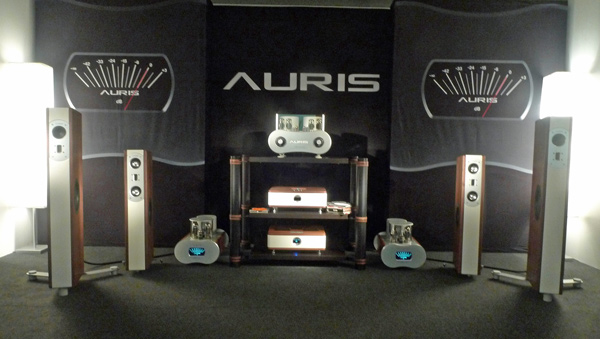 Whether "Auris" a car, an ear, a snail, a town in France, or a "Poison 8" loudspeaker made in Serbia, the word auris suggests a rounded sensuality that well describes both the visual and aural nature of what I experienced in the Auris room in the MOC.
 Components included in the demonstration were a Fortissimo integrated amp (2990 Euros), a D2D DAC (9100 Euros), the aforementioned Poison 8 loudspeakers (9400 Euros), and the new smaller Poison 9 speakers (4500 Euro)—which were not connected.
 I have noticed a widespread assumption that adding a high-performance external master clock to a digital system (either A/D or D/A) will improve its overall performance. And, for all I know (I always wear black—not a white lab coat), that may be true. But my ears often remind me: in digital audio, so-called improvements (ie, processing intended to reduce jitter or lower distortion) can actually add atonal or unmusical artifacts that may reduce the fundamental listenability of musical program.
When I stopped into the Titans Audio room they were making a demonstration comparing the regular output of an Esoteric K-03X CD/SACD player with and without Titans' Horae external "Super High Stability Audio Master Clock" (4200 Euros). The Titans people chose the K-03X player because it is highly regarded and allows easy front-panel switching between internal and external clock synchronization.
The comparison consisted of auditioning a variety of music tracks while switching between the Horae external clock and the Esoteric's internal clock. The difference in sound character was obvious. What was not obvious was which version an audiophile might prefer. With the Horae clock in, the effect was not unlike the effect of a powerline conditioner: more defined, better sorted, and maybe quieter. But the extra definition came with an added prickly shiny hardness. Every time they returned to the Esoteric's internal clock, I relaxed, and shut off my critical thinking—just enough to notice what type of music was playing.
I hate these kind of comparisons, but to make sure I really heard what I thought I heard, I asked them to repeat the demonstration three times. My observations were 100% consistent: I preferred the texture and musicality of the Esoteric's internal clock. Undoubtedly, many audiophiles would prefer the cleaner sharper Titans' version. Different strokes . . .
I have noticed a widespread assumption that adding a high-performance external master clock to a digital system (either A/D or D/A) will improve its overall performance. And, for all I know (I always wear black—not a white lab coat), that may be true. But my ears often remind me: in digital audio, so-called improvements (ie, processing intended to reduce jitter or lower distortion) can actually add atonal or unmusical artifacts that may reduce the fundamental listenability of musical program.
When I stopped into the Titans Audio room they were making a demonstration comparing the regular output of an Esoteric K-03X CD/SACD player with and without Titans' Horae external "Super High Stability Audio Master Clock" (4200 Euros). The Titans people chose the K-03X player because it is highly regarded and allows easy front-panel switching between internal and external clock synchronization.
The comparison consisted of auditioning a variety of music tracks while switching between the Horae external clock and the Esoteric's internal clock. The difference in sound character was obvious. What was not obvious was which version an audiophile might prefer. With the Horae clock in, the effect was not unlike the effect of a powerline conditioner: more defined, better sorted, and maybe quieter. But the extra definition came with an added prickly shiny hardness. Every time they returned to the Esoteric's internal clock, I relaxed, and shut off my critical thinking—just enough to notice what type of music was playing.
I hate these kind of comparisons, but to make sure I really heard what I thought I heard, I asked them to repeat the demonstration three times. My observations were 100% consistent: I preferred the texture and musicality of the Esoteric's internal clock. Undoubtedly, many audiophiles would prefer the cleaner sharper Titans' version. Different strokes . . .
 Sven Boenicke is a tall smart-looking man with hair the color of sawdust and look of a dedicated woodworker. His catalog tagline says, "Boenicke—the honest company" and when I walked in the room my thoughts turned entirely to wood, its color, its texture, and its home & hearth effect on my subconscious. The bass-mid driver on the 35,971 Euro W13 loudspeakers has a wooden cone and a bottle cap-shaped wooden phase plug. The W13's slender floor-standing cabinet features a rear-mounted brushed metal stabilizer, but underneath its rectangular base is a viscous platform that allows the W13 to move easily right to left and front to back; which actually lets the cabinet float—just slightly above the floor. The Boenicke Audio W13 is a three-way design with active bass and built-in amplifier with programmable DSP, adjustable volume, and four customer selectable presets.
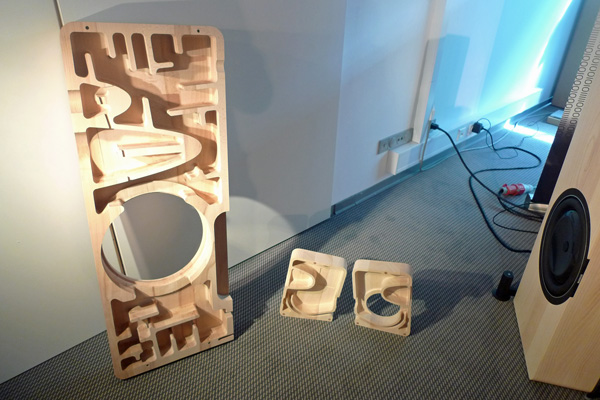 The CAD (Computer Audio Design) non-oversampling 1543 Mk.II DAC (8950 Euros) is built around a dual 16-bit Philips TDA 1543 chip, which was released in the 1980s. The CAD DAC drove a prototype Boenicke E2 integrated amp, which in turn, drove the W13s in a most lively, all-natural, and articulate fashion. Instrumental color was extraordinary and bass was strong in a subtle, inconspicuous way. This system sounded even better than it looked.
 I mentioned at the beginning of this Munich 2018 tale how European taste in high-end audio differs from the American viewpoint. What I forgot to mention was how different the audience is. American audiophiles are at least 95% men. At American audio shows, you will see some wives touring the rooms with their husbands but rarely will you see women alone and pro-actively auditioning components for purchase. Here in Munich, I saw numerous solo women pro-actively enjoying the hi-fi fare and even, a few female-female couples. One of these couples came into the Grimm Audio room, and sat down in the exact perfect sweet spot. After one or two song selections, the couple switched places—so the other could experience the sound from the seat of perfect focus. Who's ever seen that in America?
At one point, Guido Tent, owner of Grimm Audio, was playing Rammstein and everyone's head was bopping. Besides the two young women, the room was filled with young fit men in tight shirts. (Who's seen that in America?) All this unusual fun was provided by Grimm Audio's middle model, the 40,000 Euro LS1 with a LS1s-dmf Sub Bass Unit. The LS1s are completely self-powered and feature a built-in DAC. The sound was detailed and powerfully invigorating. (Undoubtedly, Grimm Audio's lively vigorous sound contributed to the diversity of its audience.). The women and fit youngsters stayed for several long songs and looked as relaxed and happy to be there as I was.
I mentioned at the beginning of this Munich 2018 tale how European taste in high-end audio differs from the American viewpoint. What I forgot to mention was how different the audience is. American audiophiles are at least 95% men. At American audio shows, you will see some wives touring the rooms with their husbands but rarely will you see women alone and pro-actively auditioning components for purchase. Here in Munich, I saw numerous solo women pro-actively enjoying the hi-fi fare and even, a few female-female couples. One of these couples came into the Grimm Audio room, and sat down in the exact perfect sweet spot. After one or two song selections, the couple switched places—so the other could experience the sound from the seat of perfect focus. Who's ever seen that in America?
At one point, Guido Tent, owner of Grimm Audio, was playing Rammstein and everyone's head was bopping. Besides the two young women, the room was filled with young fit men in tight shirts. (Who's seen that in America?) All this unusual fun was provided by Grimm Audio's middle model, the 40,000 Euro LS1 with a LS1s-dmf Sub Bass Unit. The LS1s are completely self-powered and feature a built-in DAC. The sound was detailed and powerfully invigorating. (Undoubtedly, Grimm Audio's lively vigorous sound contributed to the diversity of its audience.). The women and fit youngsters stayed for several long songs and looked as relaxed and happy to be there as I was.

The digital source was Living Voice's "turbo'd" LV CD300 player (8516 Euros). Both sources were connected (with assorted Kondo and Living Voice cables) to a Kondo M77 preamplifier (45,119 Euros) and a pair of Kondo Gakuoh parallel 300B single-ended mono amplifiers (85,161 Euros/pair). The presentation felt deep full and natural like the ocean—not artificial or mechanical.
Most exciting of all was the fact that this completely exotic system was not plugged into the wall—it was connected entirely to Living Voice's own Pure Music Battery Power Supply System (below, 34,000 Euros). On recording after recording this fantasy system delivered a balanced flowing sound that never drew attention to itself in any negative way. If you are skeptical, or dismissive about horns and directly-heated triodes this setup could shift your mind.
Yes, this system is expensive, but I have owned and listened to equally expensive ones in my own home (also powered by vintage Kondo designs) and I can say with some assurance: this visually elegant system generates a type of dead-quiet, 0—60 in 3 seconds, totally musical, loves Igor Stravinsky and Wilhelm Furtwängler experience that exceeds the sum of its parts. It delivers the complete gestalt of horns and triodes high fidelity with no conspicuous compromise.
Falcon Acoustics
It is not a secret that my forever reference for a properly engineered monitor-type loudspeaker is the Rogers LS3/5a and its numerous BBC-licensed incarnations—up to and especially the latest Falcon Acoustics version manufactured in Oxfordshire, England by Jerry Bloomfield under the technical supervision of KEF's first employee and Falcon Acoustics' retired founder, Malcolm Jones. When I die, if I can take only one pair of speakers to the other side, it will be the Falcon LS3/5a. That is the kind of bloke I am.
I am also the kind of bloke that becomes a rabid shameless fanboy when in the presence of audio designers I admire. Which is exactly how I felt meeting Falcon Acoustics' main man Jerry Bloomfield (right in photo). Jerry and Sugden's Patrick Miller were manning the Falcon-Sugden display in MOC Hall 3.
Then Jerry, snapped me out of my dream saying, "Herb, you need to come inside this room and hear out newest creation, the GC6 500R (£18,000/pair) floor-standing loudspeaker. The new speaker was sitting next to Falcon's R.A.M. Studio 30 and, like the 30, sported a 2" dome midrange. I asked who manufactured these domes. He said, "SEAS . . . to our specifications and tuning." The GC6 500R were powered by a Sugden Sapphire DAP 800 preamplifier/DAC (4935 Euros, above) which seemed to jump out of the system announcing its goodness. The DAP 800's DAC features no oversampling or digital filtering. Power to drive the Falcons came from a pair of Sugden (75W into 4 ohms) MPA-4 Masterclass mono amplifiers (11,500 Euros/pair).
While listening to Falcon's newest loudspeaker, I admired its rhythmic pulse, its midrange clarity and its burnished textures. But I could not decide where these charms originated: in the Falcon loudspeakers or the Sugden preamp/DAC? Either way I have to say . . . Rule, Britannia!
Whether "Auris" a car, an ear, a snail, a town in France, or a "Poison 8" loudspeaker made in Serbia, the word auris suggests a rounded sensuality that well describes both the visual and aural nature of what I experienced in the Auris room in the MOC.
Components included in the demonstration were a Fortissimo integrated amp (2990 Euros), a D2D DAC (9100 Euros), the aforementioned Poison 8 loudspeakers (9400 Euros), and the new smaller Poison 9 speakers (4500 Euro)—which were not connected.
I have noticed a widespread assumption that adding a high-performance external master clock to a digital system (either A/D or D/A) will improve its overall performance. And, for all I know (I always wear black—not a white lab coat), that may be true. But my ears often remind me: in digital audio, so-called improvements (ie, processing intended to reduce jitter or lower distortion) can actually add atonal or unmusical artifacts that may reduce the fundamental listenability of musical program.
Sven Boenicke is a tall smart-looking man with hair the color of sawdust and look of a dedicated woodworker. His catalog tagline says, "Boenicke—the honest company" and when I walked in the room my thoughts turned entirely to wood, its color, its texture, and its home & hearth effect on my subconscious. The bass-mid driver on the 35,971 Euro W13 loudspeakers has a wooden cone and a bottle cap-shaped wooden phase plug. The W13's slender floor-standing cabinet features a rear-mounted brushed metal stabilizer, but underneath its rectangular base is a viscous platform that allows the W13 to move easily right to left and front to back; which actually lets the cabinet float—just slightly above the floor. The Boenicke Audio W13 is a three-way design with active bass and built-in amplifier with programmable DSP, adjustable volume, and four customer selectable presets.
The CAD (Computer Audio Design) non-oversampling 1543 Mk.II DAC (8950 Euros) is built around a dual 16-bit Philips TDA 1543 chip, which was released in the 1980s. The CAD DAC drove a prototype Boenicke E2 integrated amp, which in turn, drove the W13s in a most lively, all-natural, and articulate fashion. Instrumental color was extraordinary and bass was strong in a subtle, inconspicuous way. This system sounded even better than it looked.
I mentioned at the beginning of this Munich 2018 tale how European taste in high-end audio differs from the American viewpoint. What I forgot to mention was how different the audience is. American audiophiles are at least 95% men. At American audio shows, you will see some wives touring the rooms with their husbands but rarely will you see women alone and pro-actively auditioning components for purchase. Here in Munich, I saw numerous solo women pro-actively enjoying the hi-fi fare and even, a few female-female couples. One of these couples came into the Grimm Audio room, and sat down in the exact perfect sweet spot. After one or two song selections, the couple switched places—so the other could experience the sound from the seat of perfect focus. Who's ever seen that in America?