

Sidebar 3: Measurements
I measured the HoloAudio Spring DAC "Kitsuné Tuned Edition" Level 3 with my Audio Precision SYS2722 system (see the January 2008 "As We See It"), using both the Audio Precision's optical and electrical digital outputs and USB data sourced from my MacBook Pro running on battery power with Pure Music 3.0 playing DSD and AIFF test-tone files. Apple's USB Prober utility identified the Holo Spring as "xCORE USB Audio 2.0" from "XMOS," its serial number as "0 (none)," and confirmed that its USB port operated in the optimal isochronous asynchronous mode. Apple's AudioMIDI utility revealed that, via USB, the Spring accepted 24-bit integer data. Its optical, coaxial, and AES/EBU inputs accepted datastreams with sample rates up to 192kHz, and its USB input accepted streams sampled up to 768kHz!
The maximum output level at 1kHz in the Spring's NOS, OS, and OS PCM modes was 4.95V from the balanced outputs and 2.475V from the unbalanced outputs, the latter 1.85dB higher than the CD standard's 2V. However, the output levels dropped by 6dB when I switched the Spring to DSD mode. All outputs preserved absolute polarity. (The XLR jacks are wired with pin 2 hot.) The unbalanced output impedance was close to the specified 200 ohms, at 218 ohms across the audioband. The balanced output impedance was twice that value, as expected.
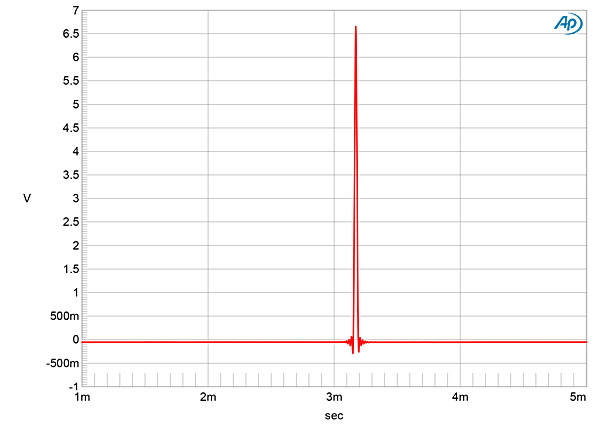
The reconstruction filter's impulse response in NOS mode was a perfect pulse (fig.1; ignore the tiny amounts of pre- and post-ringing, which are due to the SYS2722's anti-aliasing filter, operating at a sample rate of 200kHz). When I set the DAC to OS mode with oversampling engaged (the OS PCM and DSD modes behaved identically), the impulse response indicated that the reconstruction filter is a conventional, linear-phase, FIR type (fig.2).

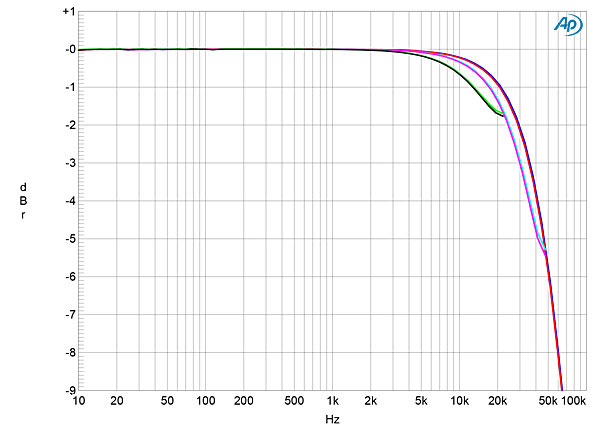
 In NOS mode a gentle rolloff begins in the mid-treble with PCM data sampled at 44.1kHz, but starts a little higher in frequency with data at 96 and 192kHz (fig.6). The surprise, however, is that in DSD mode the Holo Spring's frequency response extends no higher with 192kHz-sampled PCM data than it does with 44.1kHz data. This can be seen in fig.7, which compares the responses with 192kHz PCM data in NOS, OS, and OS PCM modes with that in DSD mode. The last rolls off sharply above 19kHz.
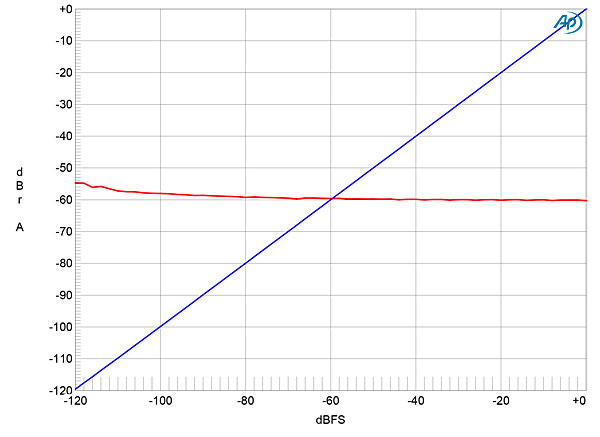
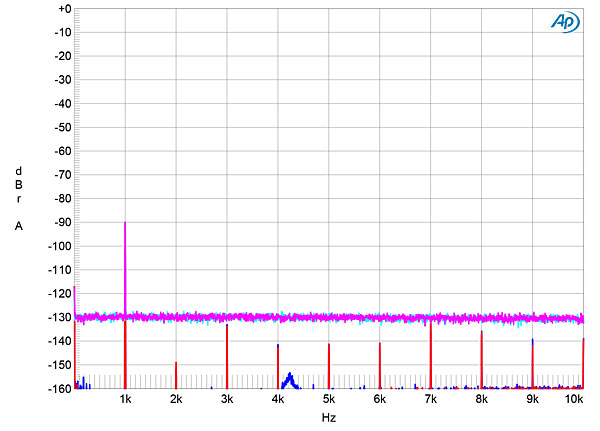
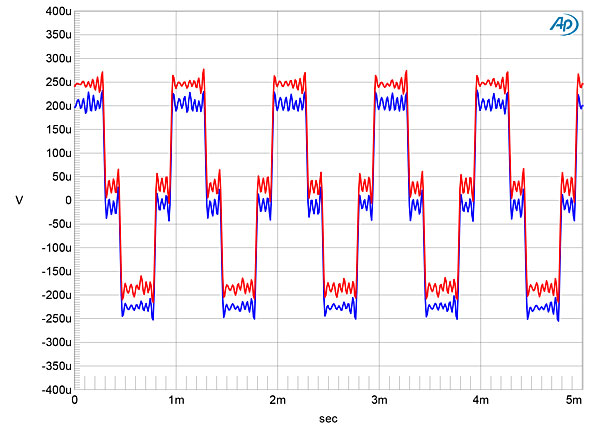
 Channel separation was superb, at >125dB in both directions below 1kHz, and the Spring's noise floor was both very low in level and commendably free from power-supply–related artifacts. A relevant issue with resistor-ladder DACs is the linearity error: Will a digital signal at, for example, –80dBFS be reproduced at the outputs by an analog signal the same 80dB down from full level? However, the Spring performed well in this respect (fig.8). When I examined linearity, the error was negligible down to –60dBFS, and remained below 1dB down to 90dBFS. Increasing the bit depth from 16 to 24 with a dithered 1kHz tone at –90dBFS (fig.9) dropped the noise floor by 30dB. However, the many distortion harmonics visible in the 24-bit signal suggests something is not optimal in the Spring's handling of low-level data with this bit depth. Perhaps the LSBs are being truncated. With undithered data representing a tone at exactly –90.31dBFS (fig.10), the three DC voltage levels described by the data were well resolved. With undithered 24-bit data, the result was a clean sinewave (fig.11).




Footnote 1: My thanks for Jürgen Reis of MBL for suggesting this test to me.
Fig.1 HoloAudio Spring, NOS mode, impulse response (one sample at 0dBFS, 44.1kHz sampling, 4ms time window).
Fig.2 HoloAudio Spring, OS mode, impulse response (one sample at 0dBFS, 44.1kHz sampling, 4ms time window).
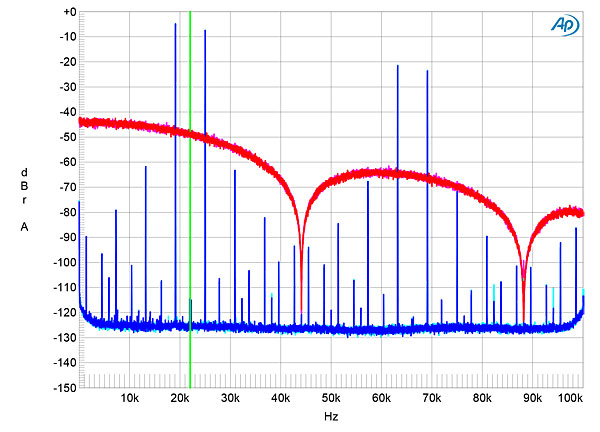
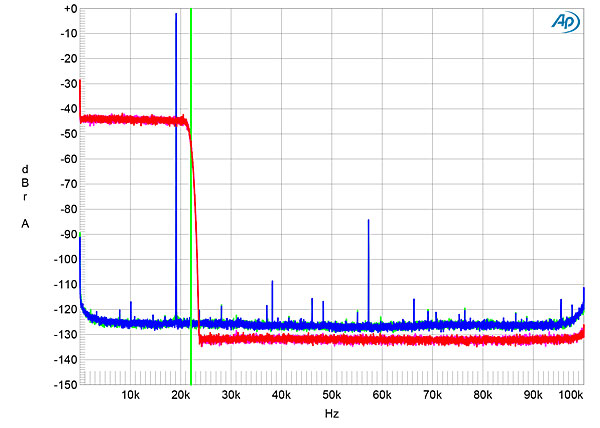
In NOS mode there is no digital reconstruction filter, and with white noise sampled at 44.1kHz (fig.3, magenta and red traces, footnote 1) there is a slow rolloff above the audioband, disturbed by nulls at 44.1 and 88.2kHz. Consequently, the aliased image of a full-scale 19.1kHz tone (cyan and blue traces) was hardly suppressed at all. With the Spring in OS and OS PCM modes, the filter rolled off rapidly above half the sampling frequency, and reached full stop-band suppression at 24kHz (fig.4, magenta and red traces). The image of a full-scale 19.1kHz tone (cyan and blue traces) is therefore suppressed by >100dB. The distortion harmonics of this tone are very low in level; the third harmonic is the highest in level, at –84dB (0.006%). In DSD mode (fig.5, magenta and red traces) the rolloff above 20kHz is also very steep, but the expected rise in the ultrasonic noise floor due to the DSD encoding is evident.
Fig.3 HoloAudio Spring, NOS, wideband spectrum of white noise at –4dBFS (left channel red, right magenta) and 19.1kHz tone at 0dBFS (left blue, right cyan), with data sampled at 44.1kHz (20dB/vertical div.).
Fig.4 HoloAudio Spring, OS PCM, wideband spectrum of white noise at –4dBFS (left channel red, right magenta) and 19.1kHz tone at 0dBFS (left blue, right cyan), with data sampled at 44.1kHz (20dB/vertical div.).
Fig.5 HoloAudio Spring, DSD, wideband spectrum of white noise at –4dBFS (left channel red, right magenta) and 19.1kHz tone at 0dBFS (left blue, right cyan), with data sampled at 44.1kHz (20dB/vertical div.).
Fig.6 HoloAudio Spring, NOS, frequency response at –12dBFS into 100k ohms with data sampled at: 44.1kHz (left channel green, right gray), 96kHz (left cyan, right magenta), 192kHz (left blue, right red) (1dB/vertical div.).
Fig.7 HoloAudio Spring, frequency response at –12dBFS into 100k ohms with data sampled at 192kHz in mode: NOS (left channel blue, right red), OS (left cyan, right magenta), OS PCM (left yellow, right gray), DSD (left green, right blue) (1dB/vertical div.).
Fig.8 HoloAudio Spring, NOS, spectrum with noise and spuriae of dithered 1kHz tone at –90dBFS with: 16-bit data (left channel cyan, right magenta), 24-bit data (left blue, right red) (20dB/vertical div.).
Fig.9 HoloAudio Spring, linearity error (red, 5dB/vertical div.) and output level vsdBFS (blue, 10dB/vertical div.), form 0dBFS to –120dBFS, 24-bit data.
Fig.10 HoloAudio Spring, OS PCM, waveform of undithered 1kHz sinewave at –90.31dBFS, 16-bit TosLink data (left channel blue, right red).
Fig.11 HoloAudio Spring, OS PCM, waveform of undithered 1kHz sinewave at –90.31dBFS, 24-bit TosLink data (left channel blue, right red).
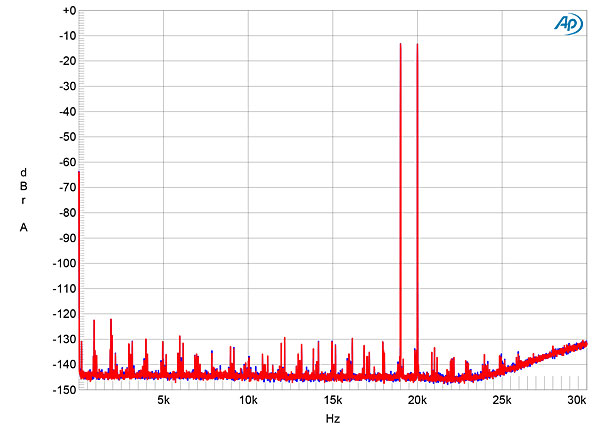
As suggested by figs. 4–5, harmonic distortion was very low. Even at maximum output into the punishingly low 600 ohm load, the distortion harmonics all lay at or below –114dB (0.0002%), though many higher-order harmonics are visible (fig.12). In NOS mode, the poor ultrasonic rejection gave rise to a multitude of aliased images with a full-scale mix of 19 and 20kHz tones (fig.13), and reducing the signal level by up to 10dB produced no change in the number of images. Fortunately, music rarely has significant energy toward the top of the audioband, and switching to the OS and OS PCM modes revealed that actual intermodulation distortion was very low (fig.14). It was even lower in DSD mode (fig.15), but that might be connected with the Spring's lower maximum output level in that mode.
Fig.12 HoloAudio Spring, spectrum of 50Hz sinewave, DC–1kHz, at 0dBFS into 600 ohms (left channel blue, right red; linear frequency scale).
Fig.13 HoloAudio Spring, NOS, HF intermodulation spectrum, DC–30kHz, 19+20kHz at 0dBFS into 600 ohms, 44.1kHz data (left channel blue, right red; linear frequency scale).
Fig.14 HoloAudio Spring, OS, HF intermodulation spectrum, DC–30kHz, 19+20kHz at 0dBFS into 600 ohms, 44.1kHz data (left channel blue, right red; linear frequency scale).
Fig.15 HoloAudio Spring, DSD, HF intermodulation spectrum, DC–30kHz, 19+20kHz at 0dBFS into 600 ohms, 44.1kHz data (left channel blue, right red; linear frequency scale).
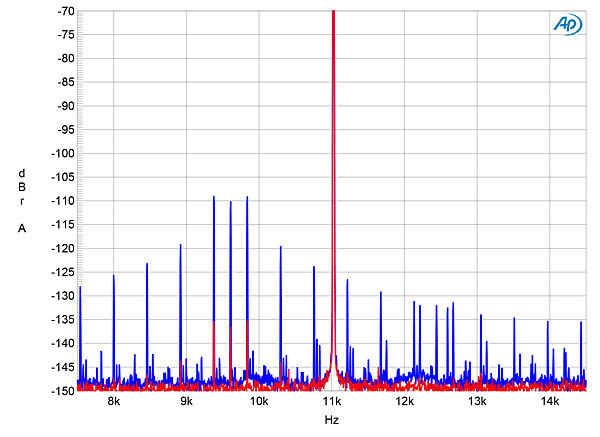
When I tested the Spring in NOS mode for its rejection of word-clock jitter, using undithered 16-bit J-Test data fed to the AES/EBU input, most of the odd-order harmonics of the low-frequency, LSB-level squarewave were at the correct levels, as shown by the sloping green line in fig.16. However, those harmonics closest to the spectral spike that represents the high-level tone at one-quarter the sample rate were exaggerated in level. This behavior was identical when I repeated the test using the optical, coaxial, and USB inputs, and when I used 24-bit J-Test data, it appeared that the Spring in NOS mode introduced sidebands spaced at ±229.16Hz and at odd-order multiples of that frequency (fig.17). Switching to any of the oversampling modes gave a much cleaner spectrum with 24-bit data in the right channel (fig.18 red trace), but there were still problems in the left channel (blue).
Fig.16 HoloAudio Spring, NOS, high-resolution jitter spectrum of analog output signal, 11.025kHz at –6dBFS, sampled at 44.1kHz with LSB toggled at 229Hz: 16-bit AES/EBU data (left channel blue, right red). Center frequency of trace, 11.025kHz; frequency range, ±3.5kHz.
Fig.17 HoloAudio Spring, NOS, high-resolution jitter spectrum of analog output signal, 11.025kHz at –6dBFS, sampled at 44.1kHz with LSB toggled at 229Hz: 24-bit AES/EBU data (left channel blue, right red). Center frequency of trace, 11.025kHz; frequency range, ±3.5kHz.
Fig.18 HoloAudio Spring, OS, high-resolution jitter spectrum of analog output signal, 11.025kHz at –6dBFS, sampled at 44.1kHz with LSB toggled at 229Hz: 24-bit USB data (left channel blue, right red). Center frequency of trace, 11.025kHz; frequency range, ±3.5kHz.
HoloAudio's Spring DAC offers mainly excellent measured performance. While some more questionable aspects of that performance are related to the NOS mode's lack of a conventional digital filter, the oversampling modes behave much better on those specific tests. But there's something funky in the Spring's rejection of word-clock jitter, particularly in the left channel.—John Atkinson
Footnote 1: My thanks for Jürgen Reis of MBL for suggesting this test to me.















