


Sound Quality
The Zoro slays the Solo! So, I had to break out a few headphones that compete well at around the $100 mark to see how good they really are. I compared the Zoro with the Skullcandy Aviator, Philips Citiscape Downtown, Creative Aurvana Live!, and Koss TBSE (DJ100). The Zoro held it's own in this crowd of $100 over-performers, I came away feeling it had the best balanced sound of the group. I detected a slight muffling in it's character relative to some of the other cans, but it pretty handily delivered the tightest bass, and seemed to deliver a heft and substantiality to voices the other cans couldn't quite pull off. The Creative Aurvana Live! hung in there close, but the Aviators poorer bass performance, and the poorer balance of the Koss and Philips had me preferring the Noontec Zoro as best of the bunch. Well, let's throw Zoro in with the big boys. I set up the listening station with the Sennheiser Amperior, Beyerdynamic DT1350, and V-Moda M-80. I listened to some test tracks with these three headphones and could easily hear greater control and balance with these than the previous set of $100 headphones. Maybe most noticeable was much better transitions from mids to treble---a more coherent and striking sense of realism (though the DT1350 was a little warm). When I returned to the Zoro I could now more easily hear it lacked some of the crunch of the electric guitar, some of the richness of trumpet and cymbal harmonics. It sounded a bit too laid back and slightly muffled. Throughout, though, the Noontec Zoro showed that it was a very competent $100 headphone, delivering terrifically tight and well extended bass, a good sense of balance through the mids, and a polite and pleasing treble---uneven maybe, but overall at about the right level and not strident or biting in the least.
Measurements
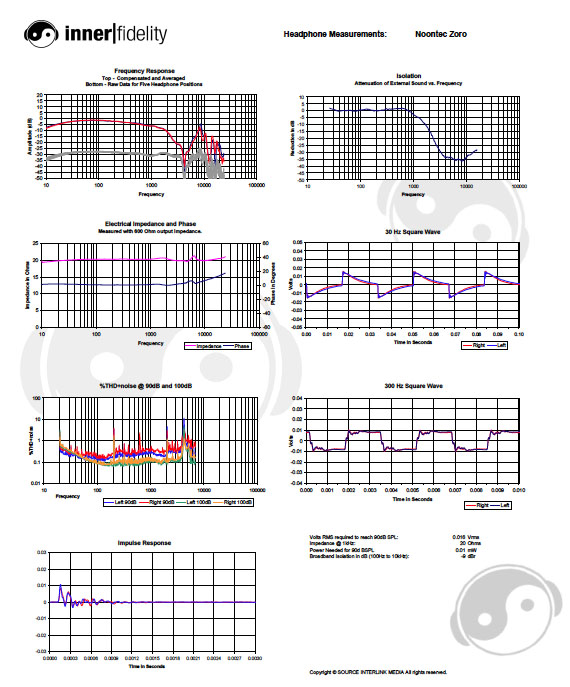 The 300Hz square wave is also very nicely shaped. It does look a bit rickety, and I usually like to see a bit of an overshoot on the leading edge, but it also shows this headphone is not going to tear you eardrum up with screeching highs. It is a bit slow on the rise, however, and coupled with the lack of some overshoot is indicative of the somewhat polite treble heard in listening.
Impulse response is a bit of a mess, but at least it doesn't ring for too long. I'm thinking the double blip comes from some porting of the backwave from the driver into the front resulting in a slightly delayed second pulse at the ear. My guess is the designers had a bit of trouble with something at 4kHz and just squelched it with a port creating the frequency response dip. A reasonable approach since a notch is far less audible than a peak at the same frequency. You'll also notice a rise in THD+noise at 4kHz probably from the same thing.
Impedance and phase plots show a 20 Ohm headphone with some modest resonances at 2kHz and 6kHz, likely originating from resonances behind the driver. With 16mVrms needed to achieve 90dB at the ear this is a very efficient headphone, and will easily be driven to loud levels from portable players. But the isolation plots shows that this headphone does not isolate well at all making this a headphone that can be used portably, but not for listening in loud environments. On the other hand, you will be able to remain aware of your surroundings, so using these cans portably in quite neighborhoods will work well.
Summary
The 300Hz square wave is also very nicely shaped. It does look a bit rickety, and I usually like to see a bit of an overshoot on the leading edge, but it also shows this headphone is not going to tear you eardrum up with screeching highs. It is a bit slow on the rise, however, and coupled with the lack of some overshoot is indicative of the somewhat polite treble heard in listening.
Impulse response is a bit of a mess, but at least it doesn't ring for too long. I'm thinking the double blip comes from some porting of the backwave from the driver into the front resulting in a slightly delayed second pulse at the ear. My guess is the designers had a bit of trouble with something at 4kHz and just squelched it with a port creating the frequency response dip. A reasonable approach since a notch is far less audible than a peak at the same frequency. You'll also notice a rise in THD+noise at 4kHz probably from the same thing.
Impedance and phase plots show a 20 Ohm headphone with some modest resonances at 2kHz and 6kHz, likely originating from resonances behind the driver. With 16mVrms needed to achieve 90dB at the ear this is a very efficient headphone, and will easily be driven to loud levels from portable players. But the isolation plots shows that this headphone does not isolate well at all making this a headphone that can be used portably, but not for listening in loud environments. On the other hand, you will be able to remain aware of your surroundings, so using these cans portably in quite neighborhoods will work well.
Summary
While the Noontec Zoro physically isn't quite the headphone that the Beats Solo is at twice the price, it's certainly well built for it's price. More importantly, it handily trounces the Solo in the sound quality department. When compared with some of my favorite headphones in the $100 price range, it seemed to best the other cans with a well balanced and authoritative bass and mid-range doing great justice to the natural sound of acoustic instruments and vocals. An uneven treble with a notch at 4kHz cause the cans to seem slightly muffled and laid back, but this was a modest flaw and really only heard as a problem when compared to much more expensive and better sounding headphones. I really loved the little Noontec Zoro. They're an absolutely great headphone for the price and I am going to put them on my Wall of Fame as a top performer in it's category. Their only downfall is that since they're a semi-sealed design they don't isolate very well, and they won't make a good can for noisy environments. They'll be great around the home or office, though ... just great!
Resources
I really loved the little Noontec Zoro. They're an absolutely great headphone for the price and I am going to put them on my Wall of Fame as a top performer in it's category. Their only downfall is that since they're a semi-sealed design they don't isolate very well, and they won't make a good can for noisy environments. They'll be great around the home or office, though ... just great!
Resources
Noontec corporate home page.
Noontec Zoro product website.
These are so new I had to start a thread on Head-Fi for them here.
As soon as I heard them I called Steve Guttenberg to give him the heads-up, he liked them too.
The Zoro slays the Solo! So, I had to break out a few headphones that compete well at around the $100 mark to see how good they really are. I compared the Zoro with the Skullcandy Aviator, Philips Citiscape Downtown, Creative Aurvana Live!, and Koss TBSE (DJ100). The Zoro held it's own in this crowd of $100 over-performers, I came away feeling it had the best balanced sound of the group. I detected a slight muffling in it's character relative to some of the other cans, but it pretty handily delivered the tightest bass, and seemed to deliver a heft and substantiality to voices the other cans couldn't quite pull off. The Creative Aurvana Live! hung in there close, but the Aviators poorer bass performance, and the poorer balance of the Koss and Philips had me preferring the Noontec Zoro as best of the bunch. Well, let's throw Zoro in with the big boys. I set up the listening station with the Sennheiser Amperior, Beyerdynamic DT1350, and V-Moda M-80. I listened to some test tracks with these three headphones and could easily hear greater control and balance with these than the previous set of $100 headphones. Maybe most noticeable was much better transitions from mids to treble---a more coherent and striking sense of realism (though the DT1350 was a little warm). When I returned to the Zoro I could now more easily hear it lacked some of the crunch of the electric guitar, some of the richness of trumpet and cymbal harmonics. It sounded a bit too laid back and slightly muffled. Throughout, though, the Noontec Zoro showed that it was a very competent $100 headphone, delivering terrifically tight and well extended bass, a good sense of balance through the mids, and a polite and pleasing treble---uneven maybe, but overall at about the right level and not strident or biting in the least.
Click on graphs image to download .pdf for closer inspection.
Well, what a pickle we have here. This is a perfect example of one of those time where you can't really even interpret what's going on with with the measurements without listening as well. Ugly frequency and impulse response on one hand, terrific square wave and THD+noise measurements on the other. Weird.
Raw frequency response plots show the earpads on these little on-ear cans are coupling very nicely as they're repositioned for measurement. Compensated frequency response plots show a very well behaves bass and mid-range for a headphone of this type. Bass extension is very good, and the knee of the curve in the treble tries to push up to 2kHz, which I like. However, there's a huge notch at 4kHz. When I first saw this plot I was shocked as my listening had not lead me to believe there was a mid-treble dropout of this magnitude. I did notice a lack of rich treble clarity and heard the Zoro as very slightly muffled, but I expected nowhere near the notch I see in the frequency response. Looking again at the gray uncompensated frequency response and how flat it is has me worried yet again about how accurate the HRTF used is to compensate frequency response with headphones. Argh.
The 30Hz square wave response is truly excellent for a small, on-ear headphone. I was continually impressed as I listened to the quality of the low notes, the fairly flat square wave top speaks of it. The THD+noise plot does as well, staying below 1% in the bass all the way to 20Hz is quite a trick.
While the Noontec Zoro physically isn't quite the headphone that the Beats Solo is at twice the price, it's certainly well built for it's price. More importantly, it handily trounces the Solo in the sound quality department. When compared with some of my favorite headphones in the $100 price range, it seemed to best the other cans with a well balanced and authoritative bass and mid-range doing great justice to the natural sound of acoustic instruments and vocals. An uneven treble with a notch at 4kHz cause the cans to seem slightly muffled and laid back, but this was a modest flaw and really only heard as a problem when compared to much more expensive and better sounding headphones.
I really loved the little Noontec Zoro. They're an absolutely great headphone for the price and I am going to put them on my Wall of Fame as a top performer in it's category. Their only downfall is that since they're a semi-sealed design they don't isolate very well, and they won't make a good can for noisy environments. They'll be great around the home or office, though ... just great!
ResourcesNoontec corporate home page.
Noontec Zoro product website.
These are so new I had to start a thread on Head-Fi for them here.
As soon as I heard them I called Steve Guttenberg to give him the heads-up, he liked them too.















