

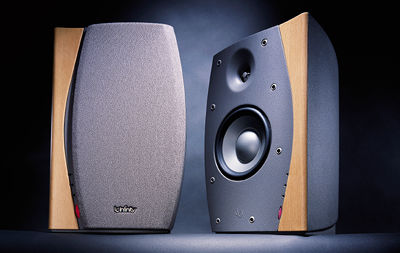
Only above 12kHz does the 2.6 start to beam, due to the tweeter's waveguide acoustic environment. As a result, in all but small, live rooms the Intermezzo might sound slightly softened in the extreme highs, as MF indeed found to be the case. A similar plot in the vertical plane (fig.6) reveals that the Infinity speaker is best auditioned on or slightly under the tweeter axis. Sit too high and a large suckout appears in the crossover region.  Fig.6 Infinity Intermezzo 2.6, vertical response family at 50", from back to front: differences in response 45 degrees-5 degrees above tweeter axis, reference response, differences in response 5 degrees-45 degrees below tweeter axis. In the time domain, the Intermezzo's step response (fig.7) indicates that both of its drive-units are connected with positive acoustic polarity but that, as is almost always the case, the design is not time-coherent. The associated cumulative spectral-decay plot (fig.8) is one of the best I have ever seen in any speaker at any price! A smooth, grain-free presentation should be the result.
 Fig.7 Infinity Intermezzo 2.6, step response on tweeter axis at 50" (5ms time window, 30kHz bandwidth).
 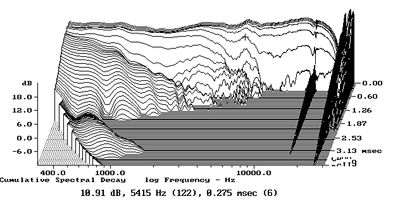 Fig.8 Infinity Intermezzo 2.6, cumulative spectral-decay plot at 50" (0.15ms risetime). This is yet another in a series of superbly engineered, high-quality loudspeaker designs emanating from Harman's Northridge plant. It is a tribute to its designers, and to the research and testing facility set up there by Floyd Toole.—John Atkinson
Fig.6 Infinity Intermezzo 2.6, vertical response family at 50", from back to front: differences in response 45 degrees-5 degrees above tweeter axis, reference response, differences in response 5 degrees-45 degrees below tweeter axis. In the time domain, the Intermezzo's step response (fig.7) indicates that both of its drive-units are connected with positive acoustic polarity but that, as is almost always the case, the design is not time-coherent. The associated cumulative spectral-decay plot (fig.8) is one of the best I have ever seen in any speaker at any price! A smooth, grain-free presentation should be the result. Fig.7 Infinity Intermezzo 2.6, step response on tweeter axis at 50" (5ms time window, 30kHz bandwidth). Fig.8 Infinity Intermezzo 2.6, cumulative spectral-decay plot at 50" (0.15ms risetime). This is yet another in a series of superbly engineered, high-quality loudspeaker designs emanating from Harman's Northridge plant. It is a tribute to its designers, and to the research and testing facility set up there by Floyd Toole.—John Atkinson














