

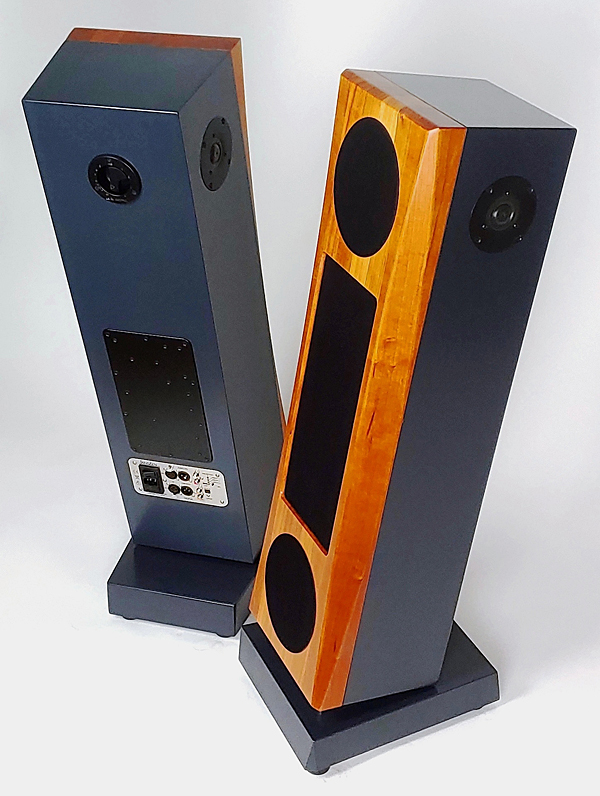
According to the manual, the speakers should be positioned with the rearmost corners between 24" and 32" from the wall behind them—but no more because the P8 is designed to rely on wall reinforcement for optimal low-frequency performance. Unfortunately, such close placement was not possible in my room due to a short flight of stairs to the vestibule behind the right speaker. I ended up with the rear corners of the Valentinas 67" from the wall behind them, which meant that I should compensate by switching the woofers to the +3dB level setting. However, when I did so, the upper midrange sounded too prominent. I therefore left the woofer level set to the 0dB switch position and experimented with the distances to the sidewalls to get the best balance between the upper bass and midrange. The woofers of the left speaker ended up 32" from the LPs that line much of the nearest sidewall, the right speaker's woofers 53" from the books that line its nearest sidewall. (The manual recommends asymmetrical sidewall placement.) Neither distance was the same as the height of the upper woofer, which is 35.5" from the floor.
The speakers were initially toed in to the listening position with the dome tweeters on the P8's outboard sides set to the highest level. This gave too much top-octave energy, so I turned those tweeters down by 4dB, which gave a smooth, even high end. (The manual recommends –10dB, which I found made the top-octave balance a tad too mellow.) After a couple of days' listening, I felt that the low treble still sounded too forward. Although the manual recommends the speakers be toed out so their axes cross a foot or so behind the listening position, I preferred the opposite strategy and gradually increased the toe-in angle until the upper midrange and treble sounded correctly balanced with the ESL panels set to their maximum level. The speaker axes now crossed 24" in front of my listening position, which gave the most stable stereo imaging with the dual-mono pink noise track on the Editor's Choice CD (Stereophile STPH016-2).
 Listening
Continuing with test tones, the Valentina P8s reproduced the 1/3-octave warble tones on Editor's Choice down to the 50Hz band, with the 100Hz and 80Hz warbles a little lower in level than those on either side. I could still hear the 40Hz warble at my usual listening level, and the 32Hz tone was reinforced by the lowest room mode. The 25Hz and 20Hz tones were inaudible. The half-step–spaced tonebursts on Editor's Choice spoke cleanly down to 40Hz, though those just below 1kHz and between 2kHz and 4kHz were slightly accentuated. This accentuation in the 2–4kHz range was very sensitive to the degree of toe-in.
Turning to music, my initial impression was that the JansZen speaker was less sensitive than the GoldenEar BRX that had preceded it in the listening room. Roon's volume control setting needed to be set 3–4dB higher for similar listening levels.
 My next impression was due to my falling victim to Floyd Toole's "Circle of Confusion": when you insert a new component into your system and listen to a specific recording, you have no way of knowing whether what you hear is a characteristic of the recording or of the product. I wasn't intending to do any critical listening, just play some music for pleasure. I have been a fan of Brian Wilson for almost 50 years, so I started streaming his new album, At My Piano, from Qobuz (24/96 FLAC, Decca).
Good grief, where were the highs? Did I mess up the Valentinas' setup?
My next impression was due to my falling victim to Floyd Toole's "Circle of Confusion": when you insert a new component into your system and listen to a specific recording, you have no way of knowing whether what you hear is a characteristic of the recording or of the product. I wasn't intending to do any critical listening, just play some music for pleasure. I have been a fan of Brian Wilson for almost 50 years, so I started streaming his new album, At My Piano, from Qobuz (24/96 FLAC, Decca).
Good grief, where were the highs? Did I mess up the Valentinas' setup?
 It turned out that this album was recorded with a suppressed high end, and the JansZen speakers were letting me hear it. I cued up one of my own recordings, Mendelssohn's Sextet in D Major for Violin, Two Violas, Violoncello, Double Bass, and Piano, from Encore, captured live at the 1997 Santa Fe Chamber Music Festival (16/44.1 ALAC, Stereophile STPH011-2). Phew! The highs were all there, the midrange was uncolored and clear, and I could sit back to enjoy Christopher O'Riley's insanely speedy piano playing, his instrument clearly placed behind the strings as I intended in the mix.
Mendelssohn's writing for the piano led to Schubert's: Leonard Shure playing the Sonata in B-flat, D.960 (24/96 ALAC, released on LP as Audiofon 72010). Engineer Peter McGrath had told me that the microphones were placed relatively close to the piano, which means there is very little hall sound around the image of the piano. Nevertheless, the JansZen speakers presented a clear window into what there was of the hall, with the natural-sounding piano set slightly back behind the plane of the speakers.
Schubert led to Rachmaninoff, specifically Vladimir Ashkenazy conducting his reconstruction of the First Symphony with the Concertgebouw Orchestra (16/44.1 ALAC ripped from CD, Decca 415 617-2). The orchestral image was wide and deep, with the images of specific instruments well-defined and stably positioned. The double basses and bassdrum had sufficient midbass weight to support the music making. To judge low-frequency extension, I use a recording I made of Jonas Nordwall playing the Toccata from Widor's Organ Symphony No.5 (24/88.2 AIFF file). This track has significant content below 40Hz, much of which was suppressed on the JansZens with the woofers set to 0dB. But there was still sufficient midbass energy coupled with excellent soundstage depth.
It turned out that this album was recorded with a suppressed high end, and the JansZen speakers were letting me hear it. I cued up one of my own recordings, Mendelssohn's Sextet in D Major for Violin, Two Violas, Violoncello, Double Bass, and Piano, from Encore, captured live at the 1997 Santa Fe Chamber Music Festival (16/44.1 ALAC, Stereophile STPH011-2). Phew! The highs were all there, the midrange was uncolored and clear, and I could sit back to enjoy Christopher O'Riley's insanely speedy piano playing, his instrument clearly placed behind the strings as I intended in the mix.
Mendelssohn's writing for the piano led to Schubert's: Leonard Shure playing the Sonata in B-flat, D.960 (24/96 ALAC, released on LP as Audiofon 72010). Engineer Peter McGrath had told me that the microphones were placed relatively close to the piano, which means there is very little hall sound around the image of the piano. Nevertheless, the JansZen speakers presented a clear window into what there was of the hall, with the natural-sounding piano set slightly back behind the plane of the speakers.
Schubert led to Rachmaninoff, specifically Vladimir Ashkenazy conducting his reconstruction of the First Symphony with the Concertgebouw Orchestra (16/44.1 ALAC ripped from CD, Decca 415 617-2). The orchestral image was wide and deep, with the images of specific instruments well-defined and stably positioned. The double basses and bassdrum had sufficient midbass weight to support the music making. To judge low-frequency extension, I use a recording I made of Jonas Nordwall playing the Toccata from Widor's Organ Symphony No.5 (24/88.2 AIFF file). This track has significant content below 40Hz, much of which was suppressed on the JansZens with the woofers set to 0dB. But there was still sufficient midbass energy coupled with excellent soundstage depth.
 If you have been reading my speaker reviews, you know that I value low-frequency quality over sheer extension. The last thing I want is a soggy soup of uncontrolled boom. On the Valentina P8s, the kickdrum in the percussion intro to "You Bring Out the Savage in Me," from Cécile McLorin Salvant's WomanChild (24/96 FLAC, Qobuz), was well-defined while still having good weight. The double bass at the start of Salvant's "John Henry" on the same album had excellent articulation and could readily be distinguished from the kickdrum despite its overlapping register. Similarly, Rob Wasserman's double bass supporting Jennifer Warnes's plaintive vocal on "Ballad of the Runaway Horse," from Duets (16/44.1 FLAC, Tidal), was reproduced with an excellent balance between body and leading-edge definition.
It's no coincidence that the three tracks I have just mentioned feature woman singers. When optimally set up, the JansZen Valentina P8's combination of midrange transparency and low coloration served female voices well, with palpable, stable imaging. But this was only true when I sat in the sweet spot: The sound acquired a touch of brightness when I moved to the side.
If you have been reading my speaker reviews, you know that I value low-frequency quality over sheer extension. The last thing I want is a soggy soup of uncontrolled boom. On the Valentina P8s, the kickdrum in the percussion intro to "You Bring Out the Savage in Me," from Cécile McLorin Salvant's WomanChild (24/96 FLAC, Qobuz), was well-defined while still having good weight. The double bass at the start of Salvant's "John Henry" on the same album had excellent articulation and could readily be distinguished from the kickdrum despite its overlapping register. Similarly, Rob Wasserman's double bass supporting Jennifer Warnes's plaintive vocal on "Ballad of the Runaway Horse," from Duets (16/44.1 FLAC, Tidal), was reproduced with an excellent balance between body and leading-edge definition.
It's no coincidence that the three tracks I have just mentioned feature woman singers. When optimally set up, the JansZen Valentina P8's combination of midrange transparency and low coloration served female voices well, with palpable, stable imaging. But this was only true when I sat in the sweet spot: The sound acquired a touch of brightness when I moved to the side.
 I finished my critical listening to the Valentina P8s with a recording I used in a review of the Krell KSA-50 amplifier, which was published in 1983: Andreas Vollenweider's Behind the Gardens—Behind the Wall—Under the Tree (16/44.1 ALAC, ripped from CD, CBS MK 37793). Vollenweider produced a series of albums in the 1980s that combined ambient sounds with his electronically enhanced harp to create sonic soundscapes. The first track on Gardens opens with a forest scene. The sound of birds is interrupted by a woman laughing and coughing followed by a distant pheasant overlaying the sound of the harp positioned way behind the wall of my listening room. The harp approaches to the front center of the stage with the distinctive "purr" of its bass notes sounding evenly balanced. Aural memory is notoriously unreliable, of course, but I can't remember hearing the details on this soundscape as clearly as when they were reproduced by the Valentina P8 speakers.
 Summing up
The reason I discussed the setup of the JansZen Audio Valentina P8 at such length was that this is a speaker that requires such attention to detail in order to get it to sing. But as I found in my auditioning, when everything is just right, this made-in-America loudspeaker can indeed sing, as long as you are in the sweet spot. I particularly appreciated the detailed, transparent midrange and treble, the articulate, reasonably extended low frequencies, and the well-defined imaging. To repeat J. Gordon Holt's words about the 1966 JansZen speaker, the Valentina P8 offered a "musically natural window" to the sound of my favorite recordings. And I must include a tip of the hat to David Janszen for his comprehensive manual, which I found essential during the setup process.
ListeningContinuing with test tones, the Valentina P8s reproduced the 1/3-octave warble tones on Editor's Choice down to the 50Hz band, with the 100Hz and 80Hz warbles a little lower in level than those on either side. I could still hear the 40Hz warble at my usual listening level, and the 32Hz tone was reinforced by the lowest room mode. The 25Hz and 20Hz tones were inaudible. The half-step–spaced tonebursts on Editor's Choice spoke cleanly down to 40Hz, though those just below 1kHz and between 2kHz and 4kHz were slightly accentuated. This accentuation in the 2–4kHz range was very sensitive to the degree of toe-in.
My next impression was due to my falling victim to Floyd Toole's "Circle of Confusion": when you insert a new component into your system and listen to a specific recording, you have no way of knowing whether what you hear is a characteristic of the recording or of the product. I wasn't intending to do any critical listening, just play some music for pleasure. I have been a fan of Brian Wilson for almost 50 years, so I started streaming his new album, At My Piano, from Qobuz (24/96 FLAC, Decca).
Good grief, where were the highs? Did I mess up the Valentinas' setup?
It turned out that this album was recorded with a suppressed high end, and the JansZen speakers were letting me hear it. I cued up one of my own recordings, Mendelssohn's Sextet in D Major for Violin, Two Violas, Violoncello, Double Bass, and Piano, from Encore, captured live at the 1997 Santa Fe Chamber Music Festival (16/44.1 ALAC, Stereophile STPH011-2). Phew! The highs were all there, the midrange was uncolored and clear, and I could sit back to enjoy Christopher O'Riley's insanely speedy piano playing, his instrument clearly placed behind the strings as I intended in the mix.
If you have been reading my speaker reviews, you know that I value low-frequency quality over sheer extension. The last thing I want is a soggy soup of uncontrolled boom. On the Valentina P8s, the kickdrum in the percussion intro to "You Bring Out the Savage in Me," from Cécile McLorin Salvant's WomanChild (24/96 FLAC, Qobuz), was well-defined while still having good weight. The double bass at the start of Salvant's "John Henry" on the same album had excellent articulation and could readily be distinguished from the kickdrum despite its overlapping register. Similarly, Rob Wasserman's double bass supporting Jennifer Warnes's plaintive vocal on "Ballad of the Runaway Horse," from Duets (16/44.1 FLAC, Tidal), was reproduced with an excellent balance between body and leading-edge definition.
I finished my critical listening to the Valentina P8s with a recording I used in a review of the Krell KSA-50 amplifier, which was published in 1983: Andreas Vollenweider's Behind the Gardens—Behind the Wall—Under the Tree (16/44.1 ALAC, ripped from CD, CBS MK 37793). Vollenweider produced a series of albums in the 1980s that combined ambient sounds with his electronically enhanced harp to create sonic soundscapes. The first track on Gardens opens with a forest scene. The sound of birds is interrupted by a woman laughing and coughing followed by a distant pheasant overlaying the sound of the harp positioned way behind the wall of my listening room. The harp approaches to the front center of the stage with the distinctive "purr" of its bass notes sounding evenly balanced. Aural memory is notoriously unreliable, of course, but I can't remember hearing the details on this soundscape as clearly as when they were reproduced by the Valentina P8 speakers.
Summing upThe reason I discussed the setup of the JansZen Audio Valentina P8 at such length was that this is a speaker that requires such attention to detail in order to get it to sing. But as I found in my auditioning, when everything is just right, this made-in-America loudspeaker can indeed sing, as long as you are in the sweet spot. I particularly appreciated the detailed, transparent midrange and treble, the articulate, reasonably extended low frequencies, and the well-defined imaging. To repeat J. Gordon Holt's words about the 1966 JansZen speaker, the Valentina P8 offered a "musically natural window" to the sound of my favorite recordings. And I must include a tip of the hat to David Janszen for his comprehensive manual, which I found essential during the setup process.















