

 Once upon a time, in audio's infancy, anyone who wanted better than average sound—average sound during the 1940s being rich, boomy and dull—had no choice but to buy professional loudspeakers. In those days, "professional" meant one of two things: movie-theater speakers or recording-studio speakers. Both were designed, first and foremost, to produce high sound levels, and used horn loading to increase their efficiency and project the sound forwards. They sounded shockingly raw and harsh in the confines of the typical living room (footnote 1).
When high fidelity took off during the early '50s, consumer loudspeaker systems were nothing more than cheaper, scaled-down versions of those professional systems, with much the same sonic flavor but even rougher highs. Then, in 1956, Edgar Villchur patented a new kind of speaker system designed specifically for consumer use.
Recognizing the fact that, in the home, bass extension was more important than efficiency, Villchur's "acoustic suspension" system achieved tremendous LF extension by (among other things) reducing mid- and upper-range sensitivity to match the system's bass sensitivity. By comparison with professional speakers, Villchur's AR-1 had a muted, almost withdrawn middle and upper range, which was far more pleasant to listen to in small rooms. It also launched high fidelity loudspeaker design on a tangent from "pro" sound, and independent evolution in those divergent directions has made the two increasingly different since then. While professional systems grew ever more efficient and forward, so-called audiophile speakers became more laid-back, polite. (Our Bill Sommerwerck dubbed this kind of sound "Boston bland," in honor of its place of origin.) The greater the schism, the more the audiophile community sneered at the "brashness" of professional speaker systems (footnote 2).
But that brashness has proven to be exactly what's needed for music normally heard at very high levels, such as hard rock. The result has been the evolution of two distinctly different kinds of "audiophile" speaker systems: highly efficient, up-front systems for rock enthusiasts, and the laid-back, "polite" systems with exaggerated depth and spaciousness favored by many classical listeners and most audio perfectionists.
Once upon a time, in audio's infancy, anyone who wanted better than average sound—average sound during the 1940s being rich, boomy and dull—had no choice but to buy professional loudspeakers. In those days, "professional" meant one of two things: movie-theater speakers or recording-studio speakers. Both were designed, first and foremost, to produce high sound levels, and used horn loading to increase their efficiency and project the sound forwards. They sounded shockingly raw and harsh in the confines of the typical living room (footnote 1).
When high fidelity took off during the early '50s, consumer loudspeaker systems were nothing more than cheaper, scaled-down versions of those professional systems, with much the same sonic flavor but even rougher highs. Then, in 1956, Edgar Villchur patented a new kind of speaker system designed specifically for consumer use.
Recognizing the fact that, in the home, bass extension was more important than efficiency, Villchur's "acoustic suspension" system achieved tremendous LF extension by (among other things) reducing mid- and upper-range sensitivity to match the system's bass sensitivity. By comparison with professional speakers, Villchur's AR-1 had a muted, almost withdrawn middle and upper range, which was far more pleasant to listen to in small rooms. It also launched high fidelity loudspeaker design on a tangent from "pro" sound, and independent evolution in those divergent directions has made the two increasingly different since then. While professional systems grew ever more efficient and forward, so-called audiophile speakers became more laid-back, polite. (Our Bill Sommerwerck dubbed this kind of sound "Boston bland," in honor of its place of origin.) The greater the schism, the more the audiophile community sneered at the "brashness" of professional speaker systems (footnote 2).
But that brashness has proven to be exactly what's needed for music normally heard at very high levels, such as hard rock. The result has been the evolution of two distinctly different kinds of "audiophile" speaker systems: highly efficient, up-front systems for rock enthusiasts, and the laid-back, "polite" systems with exaggerated depth and spaciousness favored by many classical listeners and most audio perfectionists.
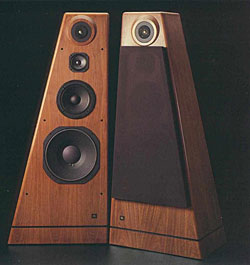
One of the leading manufacturers of professional speakers during the '40s was a firm called Altec Lansing. The Lansing part of the name belonged to a young engineer named James B., who parted company with Altec to form his own firm, JBL. Through the years, JBL has always tried for high efficiency and a forward, gutsy sound in their consumer line, thus earning the undying scorn of all audio perfectionists, who consider "JBL" synonymous with sonic trash. This never bothered JBL as long as "high end" was a mental aberration afflicting only a miniscule part of the population. The masses preferred JBL's kind of sound. But two developments in the past three years have prompted JBL to reconsider their public image. First, the masses discovered the snob appeal of the High End, and learned from the purists that liking the sound of JBL speakers was—well, it just wasn't done! And second, JBL recognized that digital recordings, whose lack of surface noise is an invitation to play them at high volume, put their own products at a decided advantage over those of most audiophile manufacturers. JBLs could play loudly without burning out; most audiophile loudspeakers can't. The Ti Series of loudspeakers is JBL's bid for a new image—respectability. The Ti in the 250Ti's model designation stands for titanium; some techniques JBL developed for working with this tricky metal made their new tweeters possible. Titanium has an extremely high mass-to-stiffness ratio. A very thin sheet of it has enough stiffness to behave very much like the ideal piston radiator, with its entire surface area moving in unison. But its stiffness also makes it very brittle, and likely to split when subjected to the kind of forming processes necessary to produce an effective radiating surface. JBL claims to have found a solution, and has even found a way of embossing a pattern of diamond-shaped ribs into the surface of the tweeter dome to increase its stiffness. The result is the new tweeter which shows up on the high end of all their new speaker systems, the 440Ti.
I have never much cared for most aspects of the traditional JBL sound: boomy midbass, shallow soundstage, vague imaging, lack of deep bass or really high highs, and (often) piercingly shrill middle highs. But I have always admired their midrange performance. Whether it was their professional or consumer lines, JBL's speakers always had a punchiness and detailed immediacy, an ability to make a voice or a solo instrument sound right in the room, that has not been equalled by any audiophile speakers I know of. "Wouldn't it be great," I thought, "if JBL has retained that middle-range performance, and just augmented it with state-of-the-art performance in those other areas?" I should have known better! JBL did their homework, all right. In their bid for the perfectionist audiophile market (and who else would pay $3400/pair for loudspeakers?), JBL has produced nothing more than yet another high-priced "Boston bland" behemoth. Every vestige of the middle-range immediacy, aliveness, and incredible detailing that characterized their previous speakers is gone. Instead, what we have are outstanding lows, superb highs, excellent soundstaging, very good imaging, and a total inability to make anything sound real. It's another instance of the baby going down the drain with the bath water. Perhaps I'm being too hard on the 250Ti. I acknowledge that it is capable of producing prodigiously high listening levels without a trace of strain, and that its highs are simply gorgeous!—silky smooth, open, completely effortless, and free from steeliness, even at the highest listening levels any sane person would tolerate (footnote 3). I acknowledge its remarkably smooth low end (usable to around 35Hz), and its ability to float a wide, deep soundstage around the instruments in simply-miked recordings.
Overall, this is a very pleasant-sounding system that can produce some very impressive sounds, but it lacks the feeling of life that makes the difference between excellent reproduction and literally accurate reproduction. For $3400/pair, I expected more.—J. Gordon Holt















