

Measurements Wired Passive

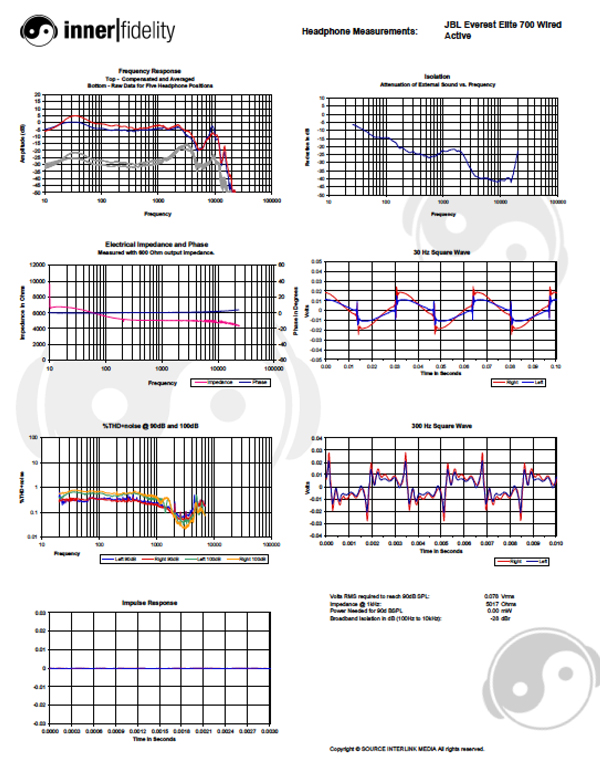
 Distortion is a bit high in passive mode, but you can see distortion is lozer in active modes. I think this is mostly due to the noise canceling reducing the noise component of the THD+noise measurement. These headphones do sound a bit hard to me, which is usually the sound of distortion making itself known. I hear it less in noise canceling modes—maybe the DSP is putting in some fixes—but it's still there.
Raw frequency response plots of the active wired mode show a significant difference in level between the two channels. I think this should be largely ignored. I had the chance to measure these headphones a number of times and the matching would change each time a bit. The right channel did seem to reliable have less bass extension. I think there's a combination of factors here: The pads didn't really like to seal on my head very well, and the matching would change when I did the TruNote calibration...depending on the seal possibly. At any rate, I think there might be a missmatch, but I don't think it's quite as big as shown.
Frequency response profile is quite good and fairly even to 2kHz. Worthy of note is a loss of bass extension, probably due to low frequency limiting of the DSP or capacitive coupling in the headphone electronics. Bass did sound a bit looser but was better balanced with the midrange in active mode.
Also worth noting is the slightly broader than normal peak at 3kHz. I'm guessing they did something to widen the peak so that it always fell within the natural concha bowl peak of the listeners ear...or something like that. The dip between 4-8kHz remains, and does reduce nuanced treble, however, it is a bit more emphasized here than in passive wired mode, and the treble did seem a bit more natural here as a result.
30Hz square waves now show a significantly more curve wave form top, related to the lack of extension as shown on raw FR plots. You can also now note some pre-ringing likely due to high-frequency phase shifting in DSP. This doesn't seem as audible as it looks in the plots.
In the 300Hz square wave the pre-ringing is now quite obvious and make a complete mess of the waveshape. Again, I don't think it sounds as bad as it looks.
There is no impulse response plot because the DSP messes with the MLSS waveform too much for the AP tester to synchronize.
THD+noise plots show modest levels, but it is important to note the noise canceling might make this measurement better than it appears.
Impedance plots show the input impedance of the electrical circuits and show a nominal (as expected) response.
Isolation is quite good at -28dB broadband. Equaling the Bose QC35 broadband measurement, but is not quite as good at low frequencies.
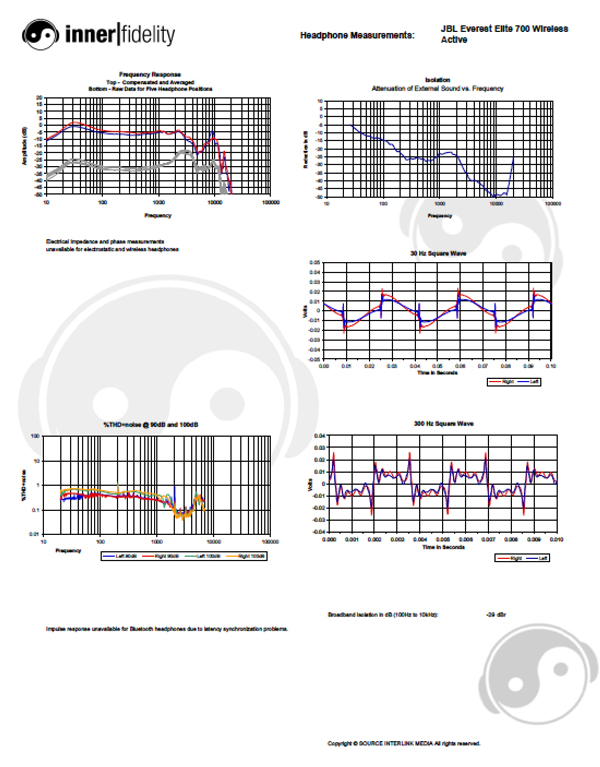
Distortion is a bit high in passive mode, but you can see distortion is lozer in active modes. I think this is mostly due to the noise canceling reducing the noise component of the THD+noise measurement. These headphones do sound a bit hard to me, which is usually the sound of distortion making itself known. I hear it less in noise canceling modes—maybe the DSP is putting in some fixes—but it's still there.
Raw frequency response plots of the active wired mode show a significant difference in level between the two channels. I think this should be largely ignored. I had the chance to measure these headphones a number of times and the matching would change each time a bit. The right channel did seem to reliable have less bass extension. I think there's a combination of factors here: The pads didn't really like to seal on my head very well, and the matching would change when I did the TruNote calibration...depending on the seal possibly. At any rate, I think there might be a missmatch, but I don't think it's quite as big as shown.
Frequency response profile is quite good and fairly even to 2kHz. Worthy of note is a loss of bass extension, probably due to low frequency limiting of the DSP or capacitive coupling in the headphone electronics. Bass did sound a bit looser but was better balanced with the midrange in active mode.
Also worth noting is the slightly broader than normal peak at 3kHz. I'm guessing they did something to widen the peak so that it always fell within the natural concha bowl peak of the listeners ear...or something like that. The dip between 4-8kHz remains, and does reduce nuanced treble, however, it is a bit more emphasized here than in passive wired mode, and the treble did seem a bit more natural here as a result.
30Hz square waves now show a significantly more curve wave form top, related to the lack of extension as shown on raw FR plots. You can also now note some pre-ringing likely due to high-frequency phase shifting in DSP. This doesn't seem as audible as it looks in the plots.
In the 300Hz square wave the pre-ringing is now quite obvious and make a complete mess of the waveshape. Again, I don't think it sounds as bad as it looks.
There is no impulse response plot because the DSP messes with the MLSS waveform too much for the AP tester to synchronize.
THD+noise plots show modest levels, but it is important to note the noise canceling might make this measurement better than it appears.
Impedance plots show the input impedance of the electrical circuits and show a nominal (as expected) response.
Isolation is quite good at -28dB broadband. Equaling the Bose QC35 broadband measurement, but is not quite as good at low frequencies.
Click on graphs image to download .pdf for closer inspection.
Measurements Wired Active
Click on graphs image to download .pdf for closer inspection.
Measurements Wireless Active
Click on graphs image to download .pdf for closer inspection.
Raw frequency response plots of the wired passive mode show respons between 400Hz and 2kHz somewhat above target response giving this headphone an emphasized and forward upper half of the midrange. Bass response is fairly on-target and punchy sounding, but is a bit overwhelmed by the midrange emphasis. Treble between 4-8kHz is significantly suppressed; I would like it to be about 5dB higher in this region.
30Hz square wave is nicely shaped showing good impact and bass extension. But the initial transient is too high, which tends to overwhelm the good bass response.
300Hz square wave is a little slow to rise and a little too high. This evidences the lack of mid-treble and overemphatic upper-midrange.















