I began by using the LS60s the way I usually listen to music, playing music files stored on my NAS using Roon or JRiver. The LS60 system is Roon Ready; Roon sees it as a valid output capable of accepting up to 32/384 and DSD256, and of decoding MQA. However, all internal processing in the Primary LS60 is PCM, the rate determined by how the Primary speaker is connected to the Secondary. When wireless is used, sources are resampled to 24/96 PCM (footnote 3). If the two speakers are linked by the supplied Ethernet cable, all are resampled to 24/192. I could not discern an audible difference, but I used the cable.
There are also two basic setup options, Normal Mode and Expert Mode, to optimize the speakers' performance in your room and, optionally, for adding subwoofers. While they accomplish much the same thing, the latter is more granular in its details and uses slightly more technical terminology. Normal mode is easy, but, as an audio nerd, I opted for the latter to leave no option unexamined. Here are the choices:
Wall Mode (On/Off, –10.0dB to 0.0dB)
Treble Trim (–4.0dB to 4.0dB)
Phase Correction (On/Off)
Bass Extension (Less/Standard/Extra)
Balance Control (L–C–R)
How many subwoofers are you using (None/One/Two)
Subwoofer channel (Mono/Stereo)
Subwoofer model?
High-Pass Frequency (On/Off, 50Hz to 120Hz)
Subwoofer Out Low-Pass Frequency (40Hz to 250Hz)
Subwoofer Gain (–10dB to 10dB)
Subwoofer Polarity (On/Off)
Is your subwoofer a KW1?
I will not detail how I arrived at all my settings, since they are specific to my situation, but I will discuss a few of them, particularly Phase Correction and the subwoofer settings, in the course of this report.
Where to start?
Initially, the LS60s were placed where the Revel Studios had been, but they did not sound right so close to the sidewalls. After all, the LS60's side-mounted woofers operate up to >300Hz, and the outside woofers are aimed directly at the wall. I pulled them a foot farther from the walls and moved them a foot nearer to the listening position, aiming them straight ahead without any toe-in. Now 7' apart and 9' from the listening position, they blossomed. I began with a long-awaited (by me) recording of violin and piano sonatas by Janacek, Brahms, and Bartók with Patricia Kopatchinskaja and Fazil Say (16/44.1 download, Alpha ALPHA885). I love this duo, having discovered Say in a Liszt extravaganza at the 92nd Street Y years back, where he stood out for the color and vivacity of his playing. Kopatchinskaja is easily his match, as she has demonstrated over her widely ranging repertoire. She begins the Brahms (the D-minor violin sonata) with softly feathered strains. I hear them just left of center, at standing height (although I do not know how tall she is). After the introduction, Say asserts the beginning of the Allegro in a prominent statement from right of center. The tonal balance of both instruments is natural, and their placement, in both the horizontal and vertical planes, is what one would expect at a recital.
Keeping with a small ensemble but shifting genres, I played Tierro Band's Everlasting Dance (24/192 download, Octave Records OCT0020). This amalgam, described as Gypsy Grass, draws on multiple cultures and is performed with acoustic and electric guitar (Tierro Lee), fiddle (Bridget Law), acoustic bass (Charles Parker Mertens), percussion (Jonny Jyemo), tabla (Nabin Shrestha), and vocals. To me it is quintessential swingy Americana. The crystalline recording arrays the performers across a soundstage wider than the speaker span, stable and continuous between, with no hole in the middle. Tonal balance was reassuringly neutral/natural with palpable bass that belied the speakers' small size. As with the Kopatchinskaja/Say duo, the visual image of the small LS60s, its Uni-Q mid-high driver only about 31" off the floor, did not impair my firm conviction of a soundstage with spacious ambience and voices/instruments at full height. After this, I stopped trying to convince myself that the diminutive LS60s were constrained by their small size. I just threw everything at them to see what stuck, from a capella voices and solo instruments to pop, rock, and on through the massive forces of orchestra, chorus, and organ.
I began with a long-awaited (by me) recording of violin and piano sonatas by Janacek, Brahms, and Bartók with Patricia Kopatchinskaja and Fazil Say (16/44.1 download, Alpha ALPHA885). I love this duo, having discovered Say in a Liszt extravaganza at the 92nd Street Y years back, where he stood out for the color and vivacity of his playing. Kopatchinskaja is easily his match, as she has demonstrated over her widely ranging repertoire. She begins the Brahms (the D-minor violin sonata) with softly feathered strains. I hear them just left of center, at standing height (although I do not know how tall she is). After the introduction, Say asserts the beginning of the Allegro in a prominent statement from right of center. The tonal balance of both instruments is natural, and their placement, in both the horizontal and vertical planes, is what one would expect at a recital.
Keeping with a small ensemble but shifting genres, I played Tierro Band's Everlasting Dance (24/192 download, Octave Records OCT0020). This amalgam, described as Gypsy Grass, draws on multiple cultures and is performed with acoustic and electric guitar (Tierro Lee), fiddle (Bridget Law), acoustic bass (Charles Parker Mertens), percussion (Jonny Jyemo), tabla (Nabin Shrestha), and vocals. To me it is quintessential swingy Americana. The crystalline recording arrays the performers across a soundstage wider than the speaker span, stable and continuous between, with no hole in the middle. Tonal balance was reassuringly neutral/natural with palpable bass that belied the speakers' small size. As with the Kopatchinskaja/Say duo, the visual image of the small LS60s, its Uni-Q mid-high driver only about 31" off the floor, did not impair my firm conviction of a soundstage with spacious ambience and voices/instruments at full height. After this, I stopped trying to convince myself that the diminutive LS60s were constrained by their small size. I just threw everything at them to see what stuck, from a capella voices and solo instruments to pop, rock, and on through the massive forces of orchestra, chorus, and organ.
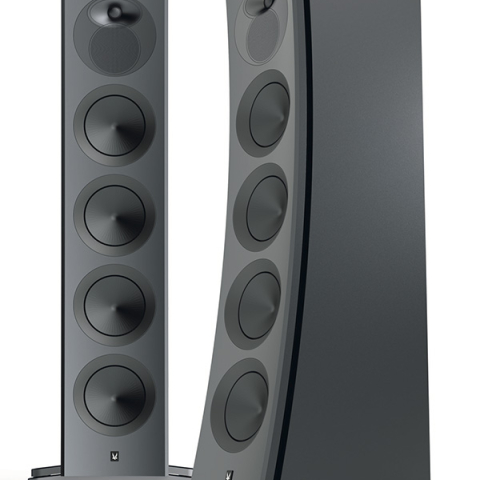
 With familiar tracks like Alison Kraus's "Sister Rosetta Goes Before Us," from Raising Sand with Robert Plant (CD, Rounder 11661-9075-2), and Sara K's "I Can't Stand the Rain" from Hell or High Water (SACD, Stockfisch SFR 357.4039.2), both of which support their sparse instrumentation with potent bass, the LS60s were completely up to the task. The voices were pure and centrally placed, Kraus's violin was sweet and just a bit back, and Sara K's guitar was big and rich. The low drum in each was as tight, deep, and weighty as I have heard it with many larger speakers. The LS60s did not sound small. In fact, they sounded much like the KEF Blade Twos.
A favorite track, "Lunge da voi ben mio," which opens Il Tedesco a Roma, a recording of Kapsberger's music by L'Escadron Volant de la Reine (WAV rip from CD, Harmonia Mundi HMM902645), begins with a handful of voices, a capella, up close in a reverberant space. Soon, the instrumental ensemble joins, revealing the scale of the performance space: large. This is one of a small number of recordings where I found the LS60's Phase Correction default ("On") not the best choice, or not obviously so. With Phase Correction on, voices and instruments were precisely delineated in a reasonable soundspace. When I switched it off, the voices and instruments were less finely delineated, but they were also less tightly constrained between the speakers, and the soundstage was slightly deeper.
With familiar tracks like Alison Kraus's "Sister Rosetta Goes Before Us," from Raising Sand with Robert Plant (CD, Rounder 11661-9075-2), and Sara K's "I Can't Stand the Rain" from Hell or High Water (SACD, Stockfisch SFR 357.4039.2), both of which support their sparse instrumentation with potent bass, the LS60s were completely up to the task. The voices were pure and centrally placed, Kraus's violin was sweet and just a bit back, and Sara K's guitar was big and rich. The low drum in each was as tight, deep, and weighty as I have heard it with many larger speakers. The LS60s did not sound small. In fact, they sounded much like the KEF Blade Twos.
A favorite track, "Lunge da voi ben mio," which opens Il Tedesco a Roma, a recording of Kapsberger's music by L'Escadron Volant de la Reine (WAV rip from CD, Harmonia Mundi HMM902645), begins with a handful of voices, a capella, up close in a reverberant space. Soon, the instrumental ensemble joins, revealing the scale of the performance space: large. This is one of a small number of recordings where I found the LS60's Phase Correction default ("On") not the best choice, or not obviously so. With Phase Correction on, voices and instruments were precisely delineated in a reasonable soundspace. When I switched it off, the voices and instruments were less finely delineated, but they were also less tightly constrained between the speakers, and the soundstage was slightly deeper.
 To test this further, I turned to an old chestnut, "Yulunga (Spirit Dance)" from Dead Can Dance's album Into the Labyrinth (SACD, 4AD SAD 2711). The ambience on this recording is generous. Lisa Gerrard's voice, and the acceleration and accumulation of instruments that begins with the isolated shaker emanating from the left speaker, are all eerily realistic and present, with or without Phase Correction. However, with it switched off, the depth of the soundstage increased to such a degree that I imagined I could see the space. I suspect KEF would profess that the enhanced soundstage is an anomaly of phase shifts, which is corrected by their all-pass filters. I won't argue the point. On the other hand, I've long enjoyed that deep soundstage on this album, with the best systems.
It was time to challenge the LS60s with major forces. I went with Benjamin Britten's War Requiem in a relatively obscure but highly recommendable performance conducted by Paul McCreesh and recorded in 2013 (16/44.1 FLAC download, Signum SIGCD340). This excellent recording is blessed with warm, spacious acoustics, which encompass and reveal the intimacy and power in this masterpiece. Could two little LS60s do it justice? They could—they did—including in the "Dies Irae," which opens with the four soloists across the front (but not so far forward that they're in your face). As the music proceeds, we hear instrumental choirs, bass drum, tam-tam, and tutti eminently clear, tonally balanced, and comfortably arrayed across a huge and realistic space—all, for what it's worth, with Phase Correction on.
In these comments, I've not felt the need to be picky about tonality, timbre, or other matters related to frequency response, because the LS60s didn't seem colored or biased. Several direct comparisons to the nearby Blade Two Metas, with the same music, confirmed this.
Are they perfect?
To test this further, I turned to an old chestnut, "Yulunga (Spirit Dance)" from Dead Can Dance's album Into the Labyrinth (SACD, 4AD SAD 2711). The ambience on this recording is generous. Lisa Gerrard's voice, and the acceleration and accumulation of instruments that begins with the isolated shaker emanating from the left speaker, are all eerily realistic and present, with or without Phase Correction. However, with it switched off, the depth of the soundstage increased to such a degree that I imagined I could see the space. I suspect KEF would profess that the enhanced soundstage is an anomaly of phase shifts, which is corrected by their all-pass filters. I won't argue the point. On the other hand, I've long enjoyed that deep soundstage on this album, with the best systems.
It was time to challenge the LS60s with major forces. I went with Benjamin Britten's War Requiem in a relatively obscure but highly recommendable performance conducted by Paul McCreesh and recorded in 2013 (16/44.1 FLAC download, Signum SIGCD340). This excellent recording is blessed with warm, spacious acoustics, which encompass and reveal the intimacy and power in this masterpiece. Could two little LS60s do it justice? They could—they did—including in the "Dies Irae," which opens with the four soloists across the front (but not so far forward that they're in your face). As the music proceeds, we hear instrumental choirs, bass drum, tam-tam, and tutti eminently clear, tonally balanced, and comfortably arrayed across a huge and realistic space—all, for what it's worth, with Phase Correction on.
In these comments, I've not felt the need to be picky about tonality, timbre, or other matters related to frequency response, because the LS60s didn't seem colored or biased. Several direct comparisons to the nearby Blade Two Metas, with the same music, confirmed this.
Are they perfect?
No speakers are. However, the LS60s come close, especially when one considers their reasonable price, their discreet size, and their attractive cosmetics. As for that Phase Correction, turning it off made the LS60 sound more like its much larger sibling, the Blade Two Meta, when the two pairs of speakers were compared side by side. The Blades demonstrated an even more spacious soundstage and sounded firmer and fuller through the mid and upper bass, but the speakers were surprisingly close.
Some readers may be incredulous about my comments on the bass performance of the LS60s, which was in fact remarkable for their size and very good in absolute terms. But it's true: As well as those four small woofers performed (supported by DSP), they could not equal the Blade Two's larger drivers. Extension rivaled that of the Blade Two's, but only at lower output levels. The LS60's DSP progressively rolls off the lowest frequencies as you raise the volume, painlessly accommodating themselves to Hofmann's Iron Law, pushing it to its limits. With tracks from Tierro Band, Alison Kraus, Sara K, and, to a degree, Dead Can Dance, all cited above, the LS60s had ample bass until they were turned up too loud for musical enjoyment and neighbor comfort. With big orchestras (Mahler, Holst, etc.), organ, and—just a guess here, since I didn't listen to these genres—hard rock, techno, or electronica, a subwoofer or two would provide a simple solution.
Using subs with the LS60 was a piece of cake because the necessary tools are built into KEF Connect. I ran an RCA interconnect from the sub output of each LS60 cabinet to an SVS SB-3000, which, conveniently, were already sitting behind the little KEFs, and set them up as stereo subs. High Pass and Low Pass filters were set at 92.5Hz, sub gain at –9.0dB, with positive polarity—all determined by ear then checked with Room EQ Wizard. With the subs installed, the LS60s became monsters, their output capacity unleashed. The low bass was perfectly integrated, superior to that from the sub-less Blades. Ease and transparency increased in the lower midrange, marginally but meaningfully, best revealed by acoustic guitar, presumably due to the lightened load on the LS60's woofers.
Conclusions
If you have read this far, you know how impressed I am with the LS60s. The bottom line, however, is that they are more than a pair of speakers. The LS60 Wireless is a near–state-of-the-art sound system that will fit in almost any room and play any source with the addition of only a smartphone loaded with music or a streaming app. If you're in the market for speakers or even a complete system for just over $5000, the KEF LS60 demands your consideration. Unbeatable!
Footnote 3: Analog inputs are digitized at 24/96.
Initially, the LS60s were placed where the Revel Studios had been, but they did not sound right so close to the sidewalls. After all, the LS60's side-mounted woofers operate up to >300Hz, and the outside woofers are aimed directly at the wall. I pulled them a foot farther from the walls and moved them a foot nearer to the listening position, aiming them straight ahead without any toe-in. Now 7' apart and 9' from the listening position, they blossomed.
I began with a long-awaited (by me) recording of violin and piano sonatas by Janacek, Brahms, and Bartók with Patricia Kopatchinskaja and Fazil Say (16/44.1 download, Alpha ALPHA885). I love this duo, having discovered Say in a Liszt extravaganza at the 92nd Street Y years back, where he stood out for the color and vivacity of his playing. Kopatchinskaja is easily his match, as she has demonstrated over her widely ranging repertoire. She begins the Brahms (the D-minor violin sonata) with softly feathered strains. I hear them just left of center, at standing height (although I do not know how tall she is). After the introduction, Say asserts the beginning of the Allegro in a prominent statement from right of center. The tonal balance of both instruments is natural, and their placement, in both the horizontal and vertical planes, is what one would expect at a recital.
Keeping with a small ensemble but shifting genres, I played Tierro Band's Everlasting Dance (24/192 download, Octave Records OCT0020). This amalgam, described as Gypsy Grass, draws on multiple cultures and is performed with acoustic and electric guitar (Tierro Lee), fiddle (Bridget Law), acoustic bass (Charles Parker Mertens), percussion (Jonny Jyemo), tabla (Nabin Shrestha), and vocals. To me it is quintessential swingy Americana. The crystalline recording arrays the performers across a soundstage wider than the speaker span, stable and continuous between, with no hole in the middle. Tonal balance was reassuringly neutral/natural with palpable bass that belied the speakers' small size. As with the Kopatchinskaja/Say duo, the visual image of the small LS60s, its Uni-Q mid-high driver only about 31" off the floor, did not impair my firm conviction of a soundstage with spacious ambience and voices/instruments at full height. After this, I stopped trying to convince myself that the diminutive LS60s were constrained by their small size. I just threw everything at them to see what stuck, from a capella voices and solo instruments to pop, rock, and on through the massive forces of orchestra, chorus, and organ.
With familiar tracks like Alison Kraus's "Sister Rosetta Goes Before Us," from Raising Sand with Robert Plant (CD, Rounder 11661-9075-2), and Sara K's "I Can't Stand the Rain" from Hell or High Water (SACD, Stockfisch SFR 357.4039.2), both of which support their sparse instrumentation with potent bass, the LS60s were completely up to the task. The voices were pure and centrally placed, Kraus's violin was sweet and just a bit back, and Sara K's guitar was big and rich. The low drum in each was as tight, deep, and weighty as I have heard it with many larger speakers. The LS60s did not sound small. In fact, they sounded much like the KEF Blade Twos.
A favorite track, "Lunge da voi ben mio," which opens Il Tedesco a Roma, a recording of Kapsberger's music by L'Escadron Volant de la Reine (WAV rip from CD, Harmonia Mundi HMM902645), begins with a handful of voices, a capella, up close in a reverberant space. Soon, the instrumental ensemble joins, revealing the scale of the performance space: large. This is one of a small number of recordings where I found the LS60's Phase Correction default ("On") not the best choice, or not obviously so. With Phase Correction on, voices and instruments were precisely delineated in a reasonable soundspace. When I switched it off, the voices and instruments were less finely delineated, but they were also less tightly constrained between the speakers, and the soundstage was slightly deeper.
To test this further, I turned to an old chestnut, "Yulunga (Spirit Dance)" from Dead Can Dance's album Into the Labyrinth (SACD, 4AD SAD 2711). The ambience on this recording is generous. Lisa Gerrard's voice, and the acceleration and accumulation of instruments that begins with the isolated shaker emanating from the left speaker, are all eerily realistic and present, with or without Phase Correction. However, with it switched off, the depth of the soundstage increased to such a degree that I imagined I could see the space. I suspect KEF would profess that the enhanced soundstage is an anomaly of phase shifts, which is corrected by their all-pass filters. I won't argue the point. On the other hand, I've long enjoyed that deep soundstage on this album, with the best systems.
No speakers are. However, the LS60s come close, especially when one considers their reasonable price, their discreet size, and their attractive cosmetics. As for that Phase Correction, turning it off made the LS60 sound more like its much larger sibling, the Blade Two Meta, when the two pairs of speakers were compared side by side. The Blades demonstrated an even more spacious soundstage and sounded firmer and fuller through the mid and upper bass, but the speakers were surprisingly close.
If you have read this far, you know how impressed I am with the LS60s. The bottom line, however, is that they are more than a pair of speakers. The LS60 Wireless is a near–state-of-the-art sound system that will fit in almost any room and play any source with the addition of only a smartphone loaded with music or a streaming app. If you're in the market for speakers or even a complete system for just over $5000, the KEF LS60 demands your consideration. Unbeatable!
Footnote 3: Analog inputs are digitized at 24/96.