

John Atkinson wrote about the KEF LSX in June 2019 (Vol.42 No.6):
When Herb Reichert reviewed this tiny, network-connected active speaker system ($1099.99/pair) in our May 2019 issue, he concluded by saying: "The LSXes sounded pure and resolving. Detail was always exceptional, bass always clean. Soundstage mapping was top shelf." I was sufficiently intrigued by what Herb described, and what I'd found when I measured the LSX, that I spent a couple of weeks living with the speakers.
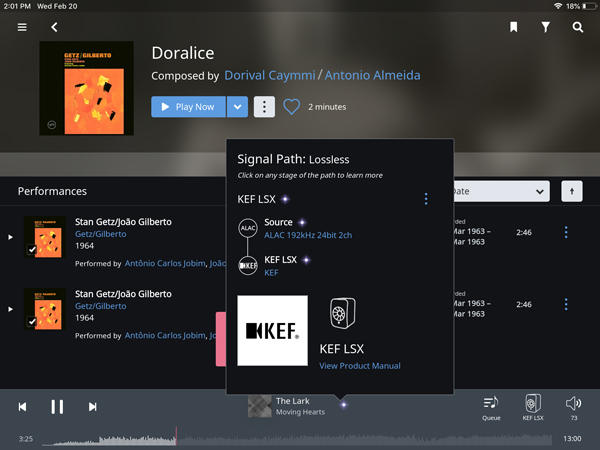
Herb didn't use Roon with the KEFs, but as the LSX is Roon Ready, I used the speakers with my Roon Nucleus+ server. Roon recognized the speakers as "KEF LSX," and once I'd selected the speakers for playback, I could adjust their volume with the Roon app on my iPad mini. I used a wired connection between the speakers so I could play files with a 2x or 4x sample rate. And when I selected a DSD file for playback, such as Dejan Lazic's live performance of Rachmaninoff's Piano Concerto 2, with the London Philharmonic conducted by Kirill Petrenko (Channel Classics CCS SA26308), Roon automatically converted the DSD64 file to 24/176.4 PCM, and the KEFs played it without any problems.
 But before discussing my reactions to the LSX's sound, I offer some more measurements.

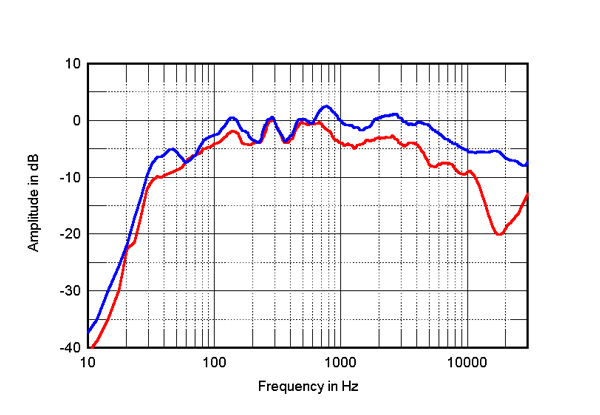
 The spatially averaged response of the LSXes is the red trace in figs.3 and 4. For reference, the blue trace shows the spatially averaged response of the KEFs in the same positions but normalized at different frequencies.
In deciding at which frequency to normalize the levels, there is a bit of what I heard speaker maven Floyd E. Toole call "handwaving" at a 1990s AES convention. With responses that are not flat—and in-room responses never are—choosing which frequency to take as the reference will depend on the music played. A speaker with a peak in the midrange will sound as if it has insufficient treble with music whose midrange listeners hear as correct. Contrariwise, if the treble balance sounds correct in level with some music, the midrange will sound exaggerated to listeners.
The spatially averaged response of the LSXes is the red trace in figs.3 and 4. For reference, the blue trace shows the spatially averaged response of the KEFs in the same positions but normalized at different frequencies.
In deciding at which frequency to normalize the levels, there is a bit of what I heard speaker maven Floyd E. Toole call "handwaving" at a 1990s AES convention. With responses that are not flat—and in-room responses never are—choosing which frequency to take as the reference will depend on the music played. A speaker with a peak in the midrange will sound as if it has insufficient treble with music whose midrange listeners hear as correct. Contrariwise, if the treble balance sounds correct in level with some music, the midrange will sound exaggerated to listeners.
 Fig.3 shows the levels of the LSX and LS50 matched in the treble and upper bass; in fig.4, the levels are matched in the midrange. In fig.3, the in-room balance of the two speakers matches closely up to 11kHz, where the LSX's output drops rapidly. (Because of the increasing absorption of the room furnishings at high frequencies, the LS50's sloped-down output in this region is close to ideal.) The radiation-pattern plot in the original review showed that the LSX is very directional in the top octave, a region where the on-axis response also lacks energy; this is reflected in both the in-room graphs.
 The first things to strike me about the sound were: 1) the sweet-sounding top octaves; and 2) the stable, accurate stereo imaging. Peter Skellern's voice in "Let's Call the Whole Thing Off," from his Astaire (24/192 ALAC needle drop from LP, English Mercury 9109 702) was presented as a narrow, stable source midway between the speakers, surrounded by a multitracked choir of multiple Skellerns. And the midrange articulation was to die for. In the channel-identification and phasing tracks on Editor's Choice (16/44.1 ALAC, Stereophile STPH016-2), my Fender bass guitar was reproduced with superb definition but not quite enough body. The low frequencies were lightweight, however, as were the double basses in Lazic's recording of Rachmaninoff's Piano Concerto 2. The 1/3-octave warble tones on Editor's Choice were shelved down at 80 and 63Hz and disappeared at 50Hz and below.
But ah, that midrange. It sounded correctly balanced with the Skellern and Rachmaninoff recordings—piano recordings in general sounded well balanced if warm—but in the Cleveland Quartet's recording of Borodin's String Quartet 2 (16/44.1 ALAC from CD, Telarc CD-80178), the mids were indeed balanced too forward, as they were with my recording of the Mozart Flute Quartet movement on Editor's Choice. Interestingly, though I'd gone for a natural treble balance when I made this live recording, the highs still sounded too sweet through the KEFs—with the Borodin recording, which has a scratchy top end, the LSX's treble sounded more natural.
Overall, however, I very much enjoyed my time with the KEF LSXes, and the fit'n'forget nature of using them with Roon was a boon. Indeed, I fell in love with these beautiful little speakers. However, I couldn't bring myself to buy the review samples. I already have a pair of wired AudioEngine 2+ powered speakers for TV sound in our kitchen, where my wife and I tend to watch movies—that's where the LSXes would have been an excellent upgrade.—John Atkinson
The first things to strike me about the sound were: 1) the sweet-sounding top octaves; and 2) the stable, accurate stereo imaging. Peter Skellern's voice in "Let's Call the Whole Thing Off," from his Astaire (24/192 ALAC needle drop from LP, English Mercury 9109 702) was presented as a narrow, stable source midway between the speakers, surrounded by a multitracked choir of multiple Skellerns. And the midrange articulation was to die for. In the channel-identification and phasing tracks on Editor's Choice (16/44.1 ALAC, Stereophile STPH016-2), my Fender bass guitar was reproduced with superb definition but not quite enough body. The low frequencies were lightweight, however, as were the double basses in Lazic's recording of Rachmaninoff's Piano Concerto 2. The 1/3-octave warble tones on Editor's Choice were shelved down at 80 and 63Hz and disappeared at 50Hz and below.
But ah, that midrange. It sounded correctly balanced with the Skellern and Rachmaninoff recordings—piano recordings in general sounded well balanced if warm—but in the Cleveland Quartet's recording of Borodin's String Quartet 2 (16/44.1 ALAC from CD, Telarc CD-80178), the mids were indeed balanced too forward, as they were with my recording of the Mozart Flute Quartet movement on Editor's Choice. Interestingly, though I'd gone for a natural treble balance when I made this live recording, the highs still sounded too sweet through the KEFs—with the Borodin recording, which has a scratchy top end, the LSX's treble sounded more natural.
Overall, however, I very much enjoyed my time with the KEF LSXes, and the fit'n'forget nature of using them with Roon was a boon. Indeed, I fell in love with these beautiful little speakers. However, I couldn't bring myself to buy the review samples. I already have a pair of wired AudioEngine 2+ powered speakers for TV sound in our kitchen, where my wife and I tend to watch movies—that's where the LSXes would have been an excellent upgrade.—John Atkinson
Footnote 1: I usually perform the loudspeaker measurements published in Stereophile either outside or in my living room. In the latter case, the furniture is pushed to the sides of the room, and the speaker is set on a tall stand that puts its tweeter midway between floor and ceiling as the speaker fires across the room's diagonal. This gives me an anechoic time window of 4ms. For these tests, I set up both LSXes in my listening room and measured the Master speaker.
But before discussing my reactions to the LSX's sound, I offer some more measurements.
Fig.1 KEF LSX, step response on tweeter axis at 50" (5ms time window, 30kHz bandwidth).
The step-response graph in our May 2019 review (reprinted here as fig.1) was taken with the KEF's Phase Correction enabled and with the speaker fed via its analog input. It reveals that the outputs of the tweeters and woofer arrive at the microphone at the same time, resulting in an almost perfect positive-polarity, time-coincident, right-triangle shape. I repeated the test at a closer distance in my listening room (footnote 1), this time using the optical S/PDIF input and plotting the speaker's output over a 10-millisecond time window.
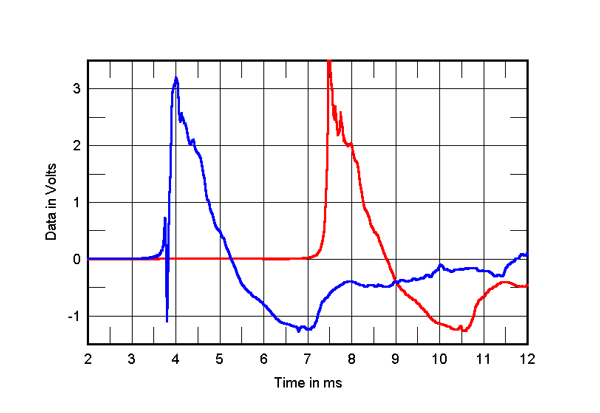
Fig.2 KEF LSX, step response on tweeter axis at 24" with (red) and without (blue) Phase Correction (10ms time window, 48kHz bandwidth).
That step response, also with Phase Correction enabled, is shown as the red trace in fig.2. Again, it is time-coincident, though a reflection of the speaker's output from the floor can be seen 3ms after the step. Disabling the Phase Correction with the control panel in KEF's iPad app gave the step response shown as the blue trace in fig.2. The tweeter's output is now visible as the small positive-polarity spike arriving at the microphone about 200µs before the woofer's peak output. You can also see that the Phase Correction introduces a delay of 3.5ms with the digital input. (The original measurements showed that the LSX's analog inputs appeared to introduce a delay closer to 48ms.)
Next was to examine the LSX's spatially averaged response in my room. For this I average 20 1/6-octave–smoothed spectra, taken for the left and right speakers individually using a 96kHz sample rate, in a vertical rectangular grid 36" wide by 18" high and centered on the positions of my ears. For this measurement and my preliminary auditioning, the LSXes were placed on 24"-high, single-pillar stands positioned where my KEF LS50s usually live, well away from room boundaries, and with each speaker sitting on a small pile of books to raise the tweeters to the height of my ears. Again I fed the Master LSX the test signal (what's called a "chirp," a 5-second sinewave sweep from 10Hz to 48kHz) via its optical S/PDIF input, and swapping the left and right channels as required. Again using the KEF Control app, the speakers were set to 0dB Treble trim and Standard bass extension for this measurement.
Fig.3 KEF LSX, spatially averaged, 1/6-octave response in JA's listening room (red), and of KEF LS50 (blue), with levels normalized at 1kHz.
Fig.4 KEF LSX, spatially averaged, 1/6-octave response in JA's listening room (red), and of KEF LS50 (blue), with levels normalized at 300Hz.
The midrange in fig.3 is exaggerated, so repeating the data to match levels at 300Hz (fig.4) shows that the smaller speaker's low frequencies are lower in level than the LS50's, and that the treble is shelved down. This is indeed what I heard with the speakers placed well away from room boundaries, so I did most of my listening with the speakers closer to walls, which I assume is where they are balanced to sound best. Even so, I set the speakers' Treble trim to +2.0dB with the app. I also turned Phase Correction on; if I had to swear to it, the sound was a touch more coherent than without it.
Footnote 1: I usually perform the loudspeaker measurements published in Stereophile either outside or in my living room. In the latter case, the furniture is pushed to the sides of the room, and the speaker is set on a tall stand that puts its tweeter midway between floor and ceiling as the speaker fires across the room's diagonal. This gives me an anechoic time window of 4ms. For these tests, I set up both LSXes in my listening room and measured the Master speaker.















