

Sidebar 3: Measurements
I used DRA Labs' MLSSA system and a calibrated DPA 4006 microphone to measure the Kii Three's frequency response in the farfield, and an Earthworks QTC-40 for the nearfield responses. I fed MLSSA's single-ended analog output to the Three's balanced XLR jack using an adapter, and used the Kii Control to set the speaker's operating conditions, including setting the polarity to Pos, and disabling the contour and boundary equalization so that I'd be examining the Three's fundamental behavior.
Had I read Kal Rubinson's review text when I began taking the measurements, I would not have been surprised by what I found at first. When using MLSSA to measure a speaker's quasi-anechoic performance, I usually set the program to capture about 10 milliseconds of data. However, when I took my first measurement, all I had was 10ms of analog noise. I tried again and again captured noise, but I heard a distinct pause before the Three emitted the test signal. So I increased the capture window to MLSSA's maximum, 32,768 samples, equivalent to 364ms at the 90kHz sample rate I use, and repeated the measurement. Now I had the expected impulse response—at the 310ms mark!
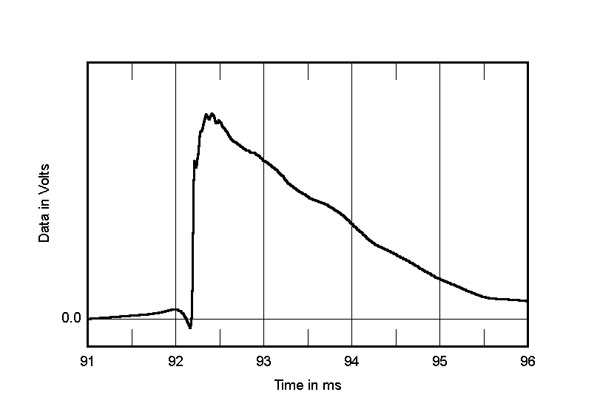
I then read KR's text, and yes: Not only does the Three take a certain amount of time to apply its digital signal processing (DSP), it also allows the user to set an arbitrary amount of delay, or latency. Using the Kii Control set to its default latency of about 90ms (indicated as Phase Exact on the Control's display), I captured the Three's impulse response and calculated the step response. The result is shown in fig.1—other than a very slight rise and dip at the 92ms mark, the Kii Three has a superbly time-coincident wavefront launch. Its step response is almost a perfect right-triangle shape, indicating that the outputs of the drive-units all arrive at the microphone at the same time. The Kii Control offers a Phase Minimum setting, which almost entirely eliminates the DSP latency, so I captured the speaker's step response in that condition. Fig.2 reveals that while the latency is now less than 1ms, there is also no time-correction of the drive-unit outputs. However, while the speaker's output is no longer time-coincident, it is still time-coherent, in that the decay of each drive-unit's step blends smoothly with the start of the step of the next driver lower in frequency.


 One thing I noticed while taking these measurements was that the usual reflections from the room's floor, ceiling, and sidewalls were less intense than usual. I assume that this is due to the Kii speaker's controlled directivity. I examined the Three's dispersion in the horizontal and vertical planes with it set to Exact; ie, with the time-coincident output and 90ms latency. The horizontal dispersion (fig.5) is textbook, with smooth, evenly spaced contour lines and a well-controlled narrowing of the radiation pattern in the mid-treble and above. I could plot the vertical dispersion only over a limited (±15°) window centered on the tweeter axis, as the fact that the speaker has a woofer on each side meant I could not lay it on its side on the Outline turntable I use for this measurement. However, the radiation pattern throughout that window (fig.6) is very even, with just the suggestion of a suckout at 2.5kHz—which I suspect is the crossover frequency between the midrange unit and tweeter—appearing 15° below the tweeter axis.

 The cumulative spectral-decay plot (fig.7) demonstrates a superbly clean initial decay, with just a slight amount of delayed energy apparent in the upper midrange. (Ignore the ridge at 15.75kHz, which is due to interference from the MLSSA host computer's video circuitry.)
 As with Dynaudio's Focus 200 XD active loudspeaker, which Jason Victor Serinus reviewed in October 2016, Kii Audio's Three demonstrates that judicious use of DSP in a powered speaker allows a multiway, moving-coil design to offer superb performance in the frequency and time domains—things that are usually mutually exclusive. Other than that rather lively enclosure, which raised my eyebrows, I was impressed by the Kii Three's measured behavior. Very impressed.—John Atkinson
Fig.1 Kii Three, Exact setting, step response on tweeter axis at 50" (5ms time window, 30kHz bandwidth).
Fig.2 Kii Three, Minimum setting, step response on tweeter axis at 50" (5ms time window, 30kHz bandwidth).
I measured the Three's frequency response at the Exact and Minimum settings, and they were identical. The trace above 300Hz in fig.3 shows the anechoic response on the Kii's tweeter axis at 50", averaged across a 30° horizontal window. The response is superbly even, though with a slight downward slope from 1.5 to 25kHz. This measurement was taken with the high-frequency Contour set to "0." Repeating the measurement with the Contour set to "+5.8" (the maximum), "+3," "–3," and "–6" revealed that the output tilted up or down above 1kHz, with the octave above 10kHz boosted or attenuated by the specified amount, in dB (fig.4).
Fig.3 Kii Three, anechoic response on tweeter axis at 50", averaged across 30° horizontal window and corrected for microphone response, with complex sum of nearfield midrange and woofer responses plotted below 300Hz.
Fig.4 Kii Three, in-room response on HF axis at 24" with treble shelf control set to Flat (blue), ±3dB (red, green), and ±6dB (purple, orange) (1dB/small vertical div.).
The trace below 300Hz in fig.3 shows the complex sum of the nearfield midrange and woofer outputs. (The crossover between these units appears to be set to 220Hz.) The apparent boost in the midbass is entirely due to the nearfield measurement technique, which assumes that the drive-units are mounted on a true infinite baffle; ie, a plane that extends to infinity in both dimensions.
Fig.5 Kii Three, lateral response family at 50", from back to front: responses 90–5° off axis, response on tweeter axis, responses 5–90° off axis.
Fig.6 Kii Three, vertical response family at 50", normalized to response on tweeter axis, from back to front: differences in response 15–5° above axis, reference response, differences in response 5–15° below axis.
Fig.7 Kii Three, cumulative spectral-decay plot on tweeter axis at 50" (0.15ms risetime).
I measure the sensitivity of a conventional passive loudspeaker by looking at the sound-pressure level at 1m on the tweeter axis when the speaker is driven by 2.83V, which is equivalent to 1W into 8 ohms. This is not appropriate for an active speaker such as the Kii Three, but when I fed its analog input unbalanced white noise at 1V RMS and set the Three's volume control to "0.0," the SPL at 1m on the tweeter axis was 81.0dB(C).
Finally, I examined the vibrational behavior of the Kii Three's enclosure. I couldn't get my plastic-tape accelerometer to stick to the textured inset sections of the top and side panels, so I'm unable to show my usual cumulative spectral-decay plots calculated from the accelerometer's output. However, listening to the panels with a stethoscope as I swept a sinewave up and down in frequency revealed very strong resonant modes at 150 and 225Hz on all surfaces, and that the enclosure was generally lively between 280 and 400Hz. The metal panel that surrounds the two woofers on the speaker's rear also vibrated very strongly. I was alarmed by this behavior, but note that KR didn't remark on any coloration in this region, so I assume that the affected areas are too small to couple efficiently to the air.















