

Sidebar 3: Measurements
I used DRA Labs' MLSSA system and a calibrated DPA 4006 microphone to measure the KLH Model Five's frequency response in the farfield. The manual doesn't specify a vertical listening axis, but with the loudspeaker sitting on its Slant Riser Base, it appears that the tweeter axis will be typical for a seated listener. My reference axis for the measurements was therefore in line with the tweeter. I used an Earthworks QTC-40 mike for the nearfield responses and Dayton Audio's DATS V2 system to measure the impedance.
KLH specifies the Model Five's free-field sensitivity as 87.5dB/2.83V/m; my estimate was 87.9dB(B)/2.83V/m, which is within the margin of experimental error. The Model Five's impedance is specified as 6 ohms with a minimum magnitude of 3.5 ohms at 140Hz. Fig.1 was taken with the Acoustic Balance switch set to HI. The impedance magnitude lies between 4 and 8 ohms over most of the audioband, with a minimum value of 3.7 ohms at 122Hz. The electrical phase angle (dashed trace) is generally low, but the EPDR (footnote 1) drops below 2 ohms between 64Hz and 93Hz with a minimum value of 1.82 ohms at 74Hz. The Model Five must be used with amplifiers that don't have problems driving 4 ohms. Repeating the impedance measurement with the Acoustic Balance switch set to MID increased the impedance above 1kHz by 1 ohm; with it set to "LO," the impedance rose by another ohm in the treble.
 The traces in fig.1 are free from the small discontinuities that would imply that resonances of some kind are present. However, the enclosure seemed lively when I rapped its walls with my knuckles. When I investigated the cabinet's vibrational behavior with a plastic-tape accelerometer, I found a fairly strong resonant mode at 215Hz on the sidewalls and top panel (fig.2) and others at 441Hz and 602Hz on the top and back panels. Even though it has a relatively high Q (Quality Factor), the mode at 215Hz is sufficiently low in frequency and high enough in level that it might add some lower-midrange congestion.

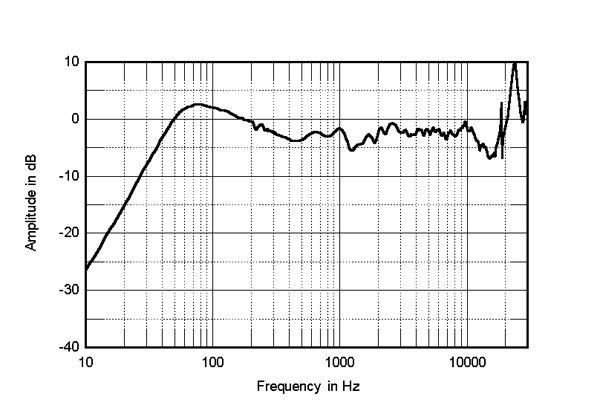 Fig.4 shows the Model Five's horizontal dispersion, normalized to the response on the tweeter axis, which thus appears as a straight line. The apparent peak off-axis, indicated by the cursor position, reveals that the lack of energy between 1kHz and 2kHz in the on-axis output tends to fill in to the speaker's sides. The off-axis gulley just below that region suggests that the slight on-axis peak centered on 1kHz becomes smoother off-axis. Experimenting with toe-in will be useful in obtaining the optimal low-treble balance. However, as the relatively wide baffle results in the tweeter's output smoothly rolling off to the sides as the frequency rises, excessive toe-in will make the Model Five sound a little lacking in top-octave air. In the vertical plane (fig.5), the KLH's response doesn't change by much over a ±10° window centered on the tweeter axis.

 In the time domain, the Model Five's step response on the tweeter axis (fig.6) reveals that the tweeter and midrange unit are connected in inverted acoustic polarity, the woofer in positive polarity. (I confirmed this by looking at the step responses of the individual drive-units.) The decay of the tweeter's step smoothly blends with the negative-going start of the midrange unit's step, which implies optimal crossover design. The decay of the midrange unit's step doesn't quite smoothly blend with the positive-going start of the woofer's step, which implies that the optimum blend will occur just below the tweeter axis. The Model Five's cumulative spectral-decay plot (fig.7) is dominated by the twin tweeter dome resonances at the top of and above the audioband. However, there are some small ridges of delayed energy at 1kHz and between 2kHz and 3kHz.


Footnote 1: EPDR is the resistive load that gives rise to the same peak dissipation in an amplifier's output devices as the loudspeaker. See "Audio Power Amplifiers for Loudspeaker Loads," JAES, Vol.42 No.9, September 1994, and stereophile.com/reference/707heavy/index.html.
Fig.1 KLH Model Five, electrical impedance (solid) and phase (dashed) with the Acoustic Balance switch set to HI (2 ohms/vertical div.).
Fig.2 KLH Model Five, cumulative spectral-decay plot calculated from output of accelerometer fastened to center of side panel level with the woofer (MLS driving voltage to speaker, 7.55V; measurement bandwidth, 2kHz).
The peak at 42.7Hz in the impedance magnitude trace suggests that this is the tuning frequency of the woofer. As it uses a sealed enclosure, the Model Five's low-frequency response, measured in the nearfield (fig.3, below 300Hz), rolls off with a relatively gentle 12dB/octave slope below the tuning frequency. The peak in the upper bass, which is due to the nearfield measurement technique, is a little higher in amplitude than I usually see.
Fig.3 KLH Model Five, anechoic response on tweeter axis at 50", averaged across 30° horizontal window and corrected for microphone response, with the nearfield response of the woofer plotted below 300Hz.
Other than a small drop in energy between 1kHz and 2kHz, the KLH's farfield response, averaged across a 30° horizontal window centered on the tweeter axis (fig.3, above 300Hz), is even up to 10kHz. The tweeter's output rolls off in the top octave before the output rises due to the high-Q, high-amplitude "oil-can" aluminum-dome resonance at 23.7kHz. Another resonance is present a little lower in frequency, at 18.7kHz. This is unusual, so I repeated the measurements on the other sample of the pair, but the resonance was present with that loudspeaker also. I should note the excellent pair matching of the two samples, within 0.5dB in the treble.
Fig.3 was taken without the grille, which I understood from KM was how he had auditioned the Model Fives. Repeating the measurement with the grille reduces the level between 3kHz and 10kHz by up to 3dB. KM also told me that he preferred the Model Five's balance with the Acoustic Balance switch set to HI. Repeating the response measurement shown in fig.3 with the control set to MID reduced the level above 800Hz by 1dB; setting it to LO reduced the treble output by another dB.
Fig.4 KLH Model Five, lateral response family at 50", normalized to response on tweeter axis, from back to front: differences in response 90–5° off axis, reference response, differences in response 5–90° off axis.
Fig.5 KLH Model Five, vertical response family at 50", normalized to response on tweeter axis, from back to front: differences in response 15–5° above axis, reference response, differences in response 5–10° below axis.
Fig.6 KLH Model Five, step response on tweeter axis at 50" (5ms time window, 30kHz bandwidth).
Fig.7 KLH Model Five, cumulative spectral-decay plot on tweeter axis at 50" (0.15ms risetime).
Having never auditioned the original Model Five, I wasn't sure what to expect when I set the new loudspeaker up in the test lab. However, considering its relatively affordable price—$1999.98/pair—the KLH Model Five offers respectable measured performance.—John Atkinson
Footnote 1: EPDR is the resistive load that gives rise to the same peak dissipation in an amplifier's output devices as the loudspeaker. See "Audio Power Amplifiers for Loudspeaker Loads," JAES, Vol.42 No.9, September 1994, and stereophile.com/reference/707heavy/index.html.















