

Sidebar 3: Measurements
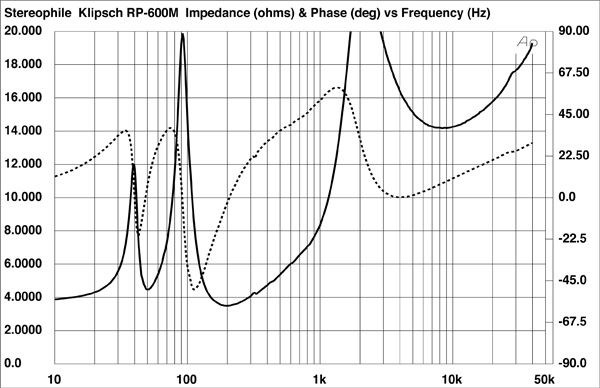
I used DRA Labs' MLSSA system and a calibrated DPA 4006 microphone to measure the Klipsch Reference Premiere RP-600M's frequency response in the farfield, and an Earthworks QTC-40 mike for the nearfield responses. I left the grille off for the measurements, The Klipsch's specified sensitivity is an extraordinarily high 96dB/2.83V/m. My estimate was much lower, at 89.6dB(B)/2.83V/m, though this is still higher than is typical for a small two-way speaker. Fig.1 shows that the RP-600M's impedance magnitude (solid trace) remains above 10 ohms for the entire treble, which means that in this region at least, the Klipsch is very efficient, the speaker drawing significantly less current from the partnering amplifier than would a nominal 8 ohm design. The impedance is lower in the midrange and bass, with a minimum value of 3.5 ohms between 180 and 220Hz. There is also a current-hungry combination of 5.3 ohms magnitude and –42° electrical phase angle (dotted trace) at 128Hz, which suggests that the RP-600M will work best with tube amplifiers when driven from their 4 ohm output-transformer taps.
 The impedance-magnitude plot has a saddle centered on 48Hz, which implies that this is the tuning frequency of the flared port on the RP-600's rear panel. The blue trace in fig.3 shows the woofer's nearfield response, including a minimum-motion notch at this frequency (ie, when the back pressure from the port resonance holds the cone stationary). The port's nearfield response (red trace) peaks slightly lower in frequency, and its upper-frequency rolloff is disturbed by a peak at 700Hz. As this resonance is low in level and the port fires to the rear, it will probably be inaudible. The woofer is crossed over to the tweeter (green trace) close to the specified 1.8kHz with what appear to be symmetrical, fourth-order acoustic slopes. Both drive-units are relatively flat in their passbands, but this graph suggests that the tweeter is a couple of dB higher in level than the woofer.



Footnote 1: See my article on the loudspeaker/stand interface, "The Sound of Surprise."
Fig.1 Klipsch RP-600M, electrical impedance (solid) and phase (dashed) (2 ohms/vertical div.).
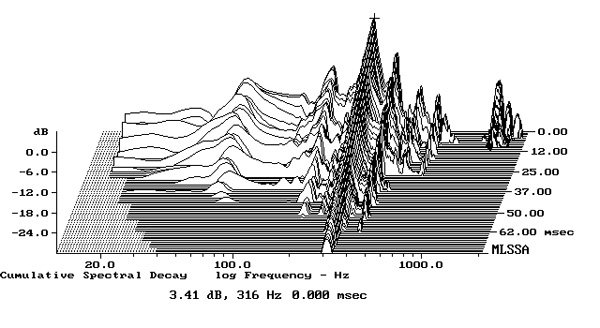
A small discontinuity just above 300Hz in the impedance-magnitude trace suggests some sort of resonance in that region. When I investigated the enclosure's vibrational behavior with a plastic-tape accelerometer, I found on all panels a strong, high-Q mode at 316Hz and a lower-level one at 422Hz (fig.2). These are low enough in frequency and high enough in level that I would have thought they would lead to some midrange congestion. It's fair to note, however, that HR didn't comment on any problems in this region, perhaps because of his use of Blu-Tack to resistively couple the speakers to the stands (footnote 1).
Fig.2 Klipsch RP-600M, cumulative spectral-decay plot calculated from output of accelerometer fastened to center of sidewall (MLS driving voltage to speaker, 7.55V; measurement bandwidth, 2kHz).
Fig.3 Klipsch RP-600M, acoustic crossover on tweeter axis at 50", corrected for microphone response, with nearfield woofer (blue) and port (red) responses respectively plotted below 350Hz and 750Hz.
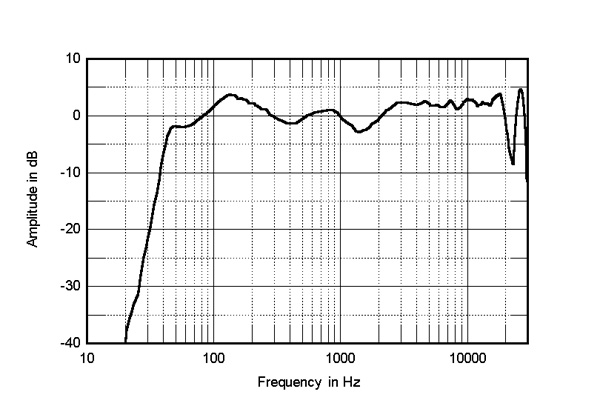
The trace above 300Hz in fig.4 shows the Klipsch's farfield response averaged across a 30° horizontal window centered on the tweeter axis, while below 300Hz it shows the sum of the nearfield woofer and port outputs, taking into account acoustic phase and the different distance of each radiator from a nominal farfield microphone position. The rise in response in the upper bass is an artifact of the nearfield measurement technique. However, it does look as if the port doesn't fully extend the SP-600M's low-frequency output. As HR found, the distance of the speaker from the wall behind it needs to be carefully arranged to balance soundstage precision against bass weight.
Fig.4 Klipsch RP-600M, anechoic response on tweeter axis at 50", averaged across 30° horizontal window and corrected for microphone response, with complex sum of nearfield woofer and port responses plotted below 300Hz.
The Klipsch's farfield response has a slight lack of energy in the crossover region. Despite the spatial averaging, the tweeter is still balanced a little too high in level. I wasn't surprised, therefore, that HR found that the RP-600Ms "slightly emphasized the leading edges of notes." HR also wrote that he had "a slight preference" for the sound of the RP-600Ms with their grilles on. The grille reduces the tweeter's output by 1dB or so between 3 and 8kHz.
The Klipsch's horizontal dispersion (fig.5) is characterized by an even and well-controlled rolloff in the treble to the speaker's sides as the frequency increases. This usually correlates with precise stereo imaging, though HR noted a "moderate lack of soundstage width." Above 13kHz, however, the horn-loaded tweeter becomes very directional, which might make the speaker sound a little lacking in top-octave air in large or overdamped rooms. In the vertical plane (fig.6), a suckout develops in the crossover region 10° above and 20° below the tweeter axis.
Fig.5 Klipsch RP-600M, lateral response family at 50", normalized to response on tweeter axis, from back to front: differences in response 90–5° off axis, reference response, differences in response 5–90° off axis.
Fig.6 Klipsch RP-600M, vertical response family at 50", normalized to response on tweeter axis, from back to front: differences in response 45–5° above axis, reference response, differences in response 5–45° below axis.
In the time domain, the RP-600M's step response (fig.7) indicates that both drive-units are connected in positive acoustic polarity. The tweeter's step has begun to decay before the woofer's step begins, which suggests that the best blend between the units occurs just below the tweeter axis. The Klipsch's cumulative spectral-decay plot (fig.8) is superbly clean.
Fig.7 Klipsch RP-600M, step response on tweeter axis at 50" (5ms time window, 30kHz bandwidth).
Fig.8 Klipsch RP-600M, cumulative spectral-decay plot on tweeter axis at 50" (0.15ms risetime).
Overall, and that lively enclosure aside, the Klipsch Reference Premiere RP-600M offers impressive measured performance, especially when its affordable price is taken into account.—John Atkinson
Footnote 1: See my article on the loudspeaker/stand interface, "The Sound of Surprise."















