

Sidebar 2: Measurements
Rated at a straight 100W, 20dBW into 8 ohms, and supplied with standard line voltage (50Hz supply in the UK), the amplifier delivered a continuous 136W (21.35dBW) into 8 ohms, with a single channel driven. At both 4 and 8 ohms the power bandwidth was superb, with maximum falloff of only 0.25dB at the 20Hz and 20kHz frequency extremes. The flat-out maximum power (using a 10ms 1kHz toneburst) was 138Wpc into 8 ohms (21.4dBW) with 246W available into 4 ohms (20.9dBW) and 418W into 2 ohms (20.2dBW), comfortably meeting Krell's specification. This was backed by a peak-current capacity of 40A, sufficient for all but the most impossible speaker loadings. Krell claims an 800W short-term delivery into 1 ohm, and I can believe it!
Claimed at 0.125 ohms, my measured figure for output impedance was close at 0.15 ohms, rising to 0.2 ohms by 20kHz. This was where Krell's specified damping factor of 150 appears to be optimistic: 0.2 ohms for an 8 ohm load gives a damping factor of 8 divided by 0.2—40 in anyone's math. As a matter of interest, 0.125 ohms yields a figure of 64. The output impedance was more than sufficiently low regardless of the claims of yesteryear—I remember 4000 being claimed for an early Phase Linear design. Nevertheless, with very low impedance speakers and a moderate cable impedance, a very slight interaction is theoretically possible with a speaker impedance which was not uniform with frequency. Its moderate output-impedance value is a consequence of the low overall feedback factor adopted for the KST-100 in keeping with the philosophy of the KSA-150.
Likewise, while full-power distortion figures were wholly satisfactory, they set no records. The specification indicated a 0.1%, –60dB figure "under all conditions," whatever that means. With a rated-power measurement of –63dB at low frequencies, worsening to –54dB by 20kHz, there was broad agreement with the spec. At 1W, a moderate volume cruise level, the harmonic distortion content had fallen to below –83dB over the audible range. A spectrum analysis showed that the distortion harmonics fell rapidly and progressively with order; eg, third at –65dB, fourth at –75dB, and fifth at –80dB with negligible high-order products.
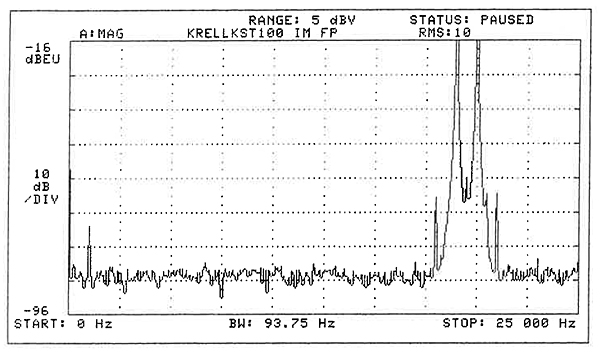
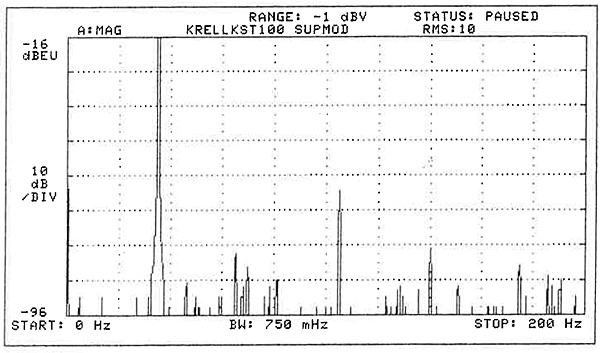
The amplifier was checked for high-frequency intermodulation with an 8 ohm load, a drive of equal-amplitude 19 and 20kHz tones reaching peak level. Here the amplifier proved to be highly linear, delivering a 1kHz difference tone at –88dB, or 0.004%. This good behavior can be seen in the resultant spectrogram (fig.1). Even at 1W, an excellent –70dB spuriae figure was recorded on this test. Another modulation test concerns driving the amplifier to 2/3 rated level into a 4 ohm load, with a low-frequency signal of 37.5Hz, this harmonically related to the 50Hz UK line frequency. This test stresses the power supply and seeks to explore supply modulation appearing at the audio output. With fig.2 covering a dynamic range of 96dB (including some spectrum-analyzer noise-floor "grass") and a linear frequency range of 200Hz, no 50Hz-related breakthrough can be seen, indicating excellent power-supply rejection and negligible supply-modulation effects.
 Channel balance held to a 0.02dB tolerance and DC offset at the output registered as 0mV; ie, less than the 1mV instrument sensitivity, a fine result. On frequency response, there was considerable low-frequency extension, to 1.2Hz, –0.5dB with a trace of treble rolloff, reaching –0.5dB at 18.5kHz; the –3dB points were at 1Hz and 52kHz. Using the DC mode of the Hewlett-Packard 3561A spectrum analyzer, the low-frequency response was plotted (fig.3), revealing an interesting but innocuous 2dB of lift at 2.2Hz before the final rolloff.
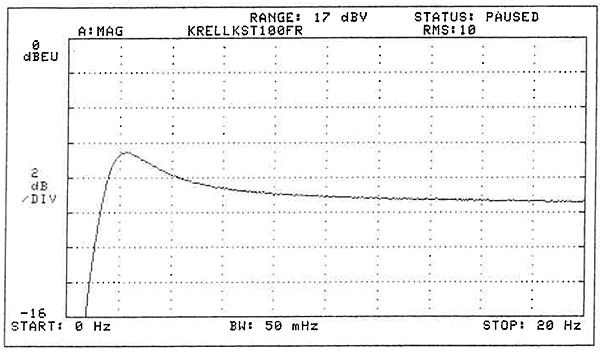
Fig.1 Krell KST, HF intermodulation spectrum, DC–25kHz, 19+20kHz at 100W peak into 8 ohms (linear frequency scale).
Fig.2 Krell KST, spectrum of 37.5Hz sinewave, DC–200Hz, at 67W into 8 ohms (linear frequency scale).
Fig.3 Krell Solo KST, balanced frequency response at 2.83V into 8 ohms (2dB/vertical div.).
Easy to drive, the input impedance was virtually as claimed, measuring 48k ohms in parallel with 95pF of capacitance. A 1.6V input was required for program clip or maximum output, nearly 10dB above typical maximum levels from normal CD sources of 0.7V. This explains the 10dB of gain provided in the matching KSL and means that CD sources of normal 2V peak output level will not produce a loud enough level for direct connection. An input of 145mV was required for 1W output. Signal/noise ratios were fine, the "A"-weighted result of 84dB corresponding to a subjectively biased assessment while the 101dB unweighted reading confirmed the absence of electrical hum. (Both results are referenced to the KST-100 full rated output.)
Channel separation was checked, and in single-ended mode was satisfactory at 71dB (1kHz) and 55dB (20kHz). In balanced mode, just 45dB separation was measured at 20Hz, compared with 60dB unbalanced, this "averaged" result being partly to do with the command power-supply arrangements and the input balance circuitry which doubles as a phase splitter for monaural operation. In monoblock mode, with two KSTs used for stereo, each channel would now deliver a basic 400Wpc into 8 ohms, 800W into 4 (both 26dBW), with the recommendation that speaker loads known to rate lower than 5 ohms be avoided as the peak current limit of this powerful amplifier is approached. In this mode I can see the KST as a worthy choice for studio monitoring, where its more compact package and superior value make sense compared with the bigger Krells. The sound quality of the mono KST amplifier will leave most "professional" amplifiers for dead. A trial short circuit at half-power resulted in a harmless spark and successful protection operation. This is a fine set of results from a well-designed amplifier.—Martin Colloms















