I found out about
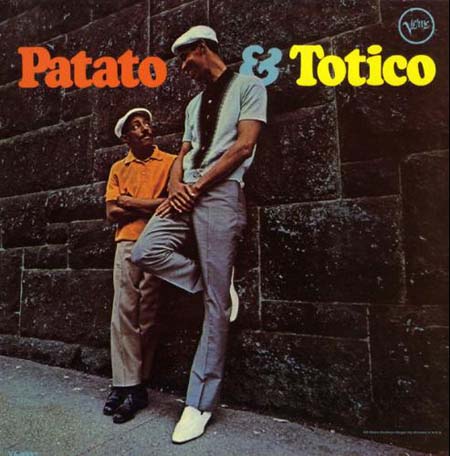
Patato & Totico all on my own, and completely by accident. It happened during the height of my salsa fixation, just after I completed
my first Salsa Means Soul compilation. Searching the compact disc shelves at the Virgin Megastore for an album called
Cuban Pearls, and specifically for a
song called "Oriente" by Cheo Marquetti, I instead stumbled upon the Verve reissue of this 1967 work by famed congero Carlos "Patato" Valdes and vocalist Eugenio "Totico" Arango.
At the time, I knew very little about the two musicians and I knew nothing at all about the album. Nevertheless, I was
expecting salsa. When I played the CD for the first time, it scared the living hell out of me. This was not salsa. This was the devil's music.
Not quite
the devil's music, in fact, but close. Patato and Totico are playing Cuban rumba, a street music traditionally consisting of only voice and drums, but here assisted by the slinky bass work of Israel "Cachao" Lopez and inimitable tres guitar of Arsenio Rodriguez, master of the odd, six-stringed instrument. There may be no other album that features these four great players together. The album begins with Patato's hands slapping against the flesh of the congas, first slowly from the right channel, then quickly from the left. Totico comes in with a melodic roll of sounds,
belebelin bele bele belebelin bele bele belebelin bele bele bele—calls to the African spirits of the Santeria religion still practiced in Cuba. In the background, you'll hear the frenetic
cascara rhythm; two sticks are tapped together in a steady, relentless, seemingly chaotic pulse by Mario Munoz Salazar, better known as "Papaito."
All of this builds and builds and builds until you reach to turn down the volume because the pace is just too unsettling. Something frightening and powerful is being conjured, and you're not ready for it.
But by the time you catch the trill of Arsenio Rodriguez's unforgettable tres line in "Ingrato Corazon," goddamn goddamn
goddamn, you are in love. At that point, you know you stumbled onto something very special, and you can't wait to share it with others.
Ironically, perhaps prophetically, the Verve reissue comes with a small, pull-out poster of the original album liner notes. "How nice," I thought at the time. Infinitely nicer, however, to actually have the real thing, as I do now, thanks to the WFMU Record Fair.
Caridad, caricu-ya-ye-o. Caridad Malda.