Switching gears, I checked out "My Home Is In the Delta," from Muddy Waters's Folk Singer (24/192 FLAC & 24/48 MQA.FLAC, Chess). The results were similar. MQA not only delivered more color saturation of Waters's voice, but Clifton James's drums had greater impact.
MQA Downloads and Streaming
As of mid-February, 4000 MQA albums were available for download from 2L, onkyomusic.com, nugs.net, highresaudio.com, and the Japan-based e-onkyo.com/music. The last site offered the most MQA files, but neither it nor highresaudio.com was licensed to sell to the US. Up to now, to stream MQA, music lovers equipped for either computer audio or network streaming have accessed Tidal Masters, which they played using the Tidal computer app or Audirvana, Amarra, Roon, Foobar, or other software. (I was told that by publication time, Roon will likely be able to unfold MQA in systems with non–MQA-decoding DACs.) While the Tidal app for Android and iOS devices did not yet support MQA at press time, I was told that MQA streaming via the Tidal app would be available by the time this is printed.
As I wrote this, HDtracks was reportedly preparing its own MQA streaming apps for Android and iOS that would be back-compatible with older versions of Windows and iOS operating systems, and should be available when this issue hits newsstands. One rumor was that, even for phones equipped for hi-rez but lacking MQA capability, the HDtracks app might unfold MQA tracks up to 24/96. Since the resolutions of the huge majority of hi-rez files do not exceed 24/96, this is far more of a gain than a limitation. As for how many MQA tracks HDtracks might stream, estimates were in the seven figures.
Without hi-rez and MQA, CD-quality files streamed via the V30's Tidal app sounded remarkably clear, open, and musical. Files uploaded to the phone sounded even more vivid, especially in hi-rez. Ditto for non-MQA streaming via the phone's Qobuz app. Qobuz plans to introduce hi-rez streaming, without MQA, in the US in the second quarter of 2018. As for which app sounds better with non-MQA tracks, I expect it's on a case-by-case basis. Nonetheless, comparing Tidal and Qobuz's versions of Brandi Carlile's "Every Time I Hear that Song" and the Eagles' "Hotel California" (the studio version, from the 40th anniversary remastering of Hotel California, Qobuz's versions sounded significantly fuller, with greater body and resonance.
 In the Reference System
What blew me away was the sound of the LG V30 through my reference system. I invited my audiophile physician, Gary Forbes, to take it a listen. "With MQA, the dynamic range from the little phone was startling," he reported. "I thought the separation of instruments was better with MQA, although the horns sounded a little thin. The soundstage certainly widened with the Rossini DAC [$24,000], and there was more midrange information, and clearly more control and realistic decay of the bass. But for a phone, for Chrissakes, that's amazing sound to come out of such a little piece! How much did you say it costs?"
The Competition
John Atkinson has reviewed two portable music players for Stereophile that are based on an Android phone chassis: Questyle Audio Technology's QP1R (now $1030 on Amazon), with 5" screen and 32GB of internal storage, expandable to 288GB; and Acoustic Research's AR-M2 ($1119 on Amazon), with 5" screen and 64GB of internal storage, expandable to 192GB. While I had neither on hand for comparison, I noted that, during his auditions, John also used Audeze LCD-X headphones, and listened to tracks from David Abel and Julie Steinberg and Daft Punk. The Questyle QP1R, which John reviewed in December 2015, has two 3.5mm jacks: one for headphones, and the other for analog and digital outputs; the latter can be set for fixed- or variable-level output. The battery life is estimated at 10 hours; charging is only by host computer, and can take up to eight hours. Although not equipped for MQA, the QP1R's Cirrus Logic CS4398 chip handled PCM up to 24/192 and DSD up to 128. JA felt he could "confidently recommend it," citing the ease and clarity of its sound. He also noted how it dug deep into recorded acoustics, and got the tonalities of instruments correct. John reviewed the Acoustic Research AR-M2 in March 2016, and it looks as if the LG V30 uses the same AR-M2 Music Player app. Like the V30, the AR-M2 runs the Android OS; offers Android apps and widgets, apps for Tidal and Spotify, and WiFi connectivity; and copies files the same way. It offers separate 3.5mm jacks for headphone and line output, and claims to be biased into class-A. Its estimated battery life is nine hours. Not equipped for MQA, its 24-bit Burr-Brown PCM1794A handles PCM up to 24/192. While the AR-M2 handled DSD up to at least 128, JA surmised that it first converted it to PCM. He praised the player's "rich, extended low frequencies" and "airy-sounding highs," and felt it would be hard to choose between it and the twice-as-expensive Astell&Kern AK240 ($2500).
In terms of features alone, the less expensive LG V30 trumps both models with a bigger touchscreen, far more storage capacity, longer battery life and faster charging, playback of DSD256 and MQA, and smartphone features galore. It's two devices in one, with extremely impressive sound quality that includes warmth, smoothness, and full-range tonal accuracy.
For my final test, I compared the sound of the LG V30 and Apple iPhone 7 with Tidal and Qobuz 16/44.1 streams. For the iPhone, which lacks a headphone output, I used a little double-branched Lightning-to-stereo-3.5mm female adapter. With both the first movement of Brahms's Piano Quartet 1, as performed by the Brahms Project (SACD/CD, Eudora), and the Eagles' "Hotel California," the LG delivered a warmer, naturally smoother sound with greater color saturation, better bass, and fuller images. The iPhone sounded drier, with some grayness in the midrange and an overall flatness to the sound. Note, too, that the iPhone lacks a choice of digital filters and response curves.
Even before I listened, I asked my neighbor Dorothy Westlund, a computer professional and educator, to share her thoughts about the sounds of the phones with the Tidal stream of Muddy Waters's "My Home Is In the Delta." "There is no comparison between the iPhone 7 and LG V30 in terms of clarity and quality," she said, indicating her preference for the latter. She also felt that nothing could compare with the sound of the hi-rez MQA version of this track, which she heard first; it "felt like I was sitting right next to him, hearing him pluck the guitar strings. The Tidal streams felt like I was listening to a recording, and lacked the other's depth and nuances."
Conclusions
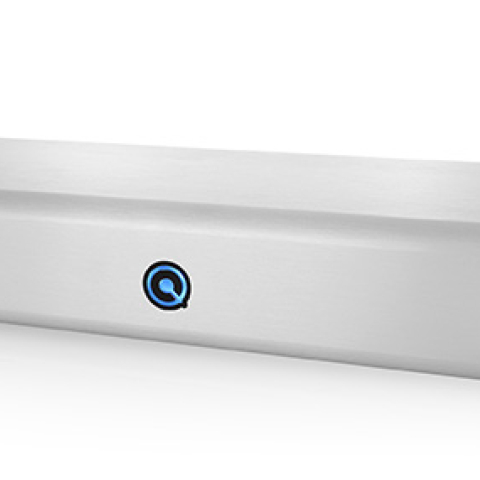
Forced to choose among listening through headphones to the LG V30 or to the Bel Canto Design Black ACI 600 all-in-one integrated amplifier I reviewed in April ($24,900), or through loudspeakers to the Aurender A10 network music player/server ($5500) in my main system, I'd choose the LG V30. Musically speaking, the LG V30 phone doesn't qualify as merely smart; LG's implementation of its Hi-Fi Quad DAC is a work of genius. If ever there were a device that could bring the experience of high-end sound to millions of music lovers, the hi-rez V30 with MQA is it. It's more than a game-changer. For its audiophile sound quality and its smartphone portability—a combination that may prove unbeatable—it belongs in Stereophile's "Recommended Components," in a Class A category all its own. Now, if only Apple could see the light and release a similar product.
Footnote 1: The LG V30's measured performance will be published in the July 2018 issue.—Ed.
As of mid-February, 4000 MQA albums were available for download from 2L, onkyomusic.com, nugs.net, highresaudio.com, and the Japan-based e-onkyo.com/music. The last site offered the most MQA files, but neither it nor highresaudio.com was licensed to sell to the US. Up to now, to stream MQA, music lovers equipped for either computer audio or network streaming have accessed Tidal Masters, which they played using the Tidal computer app or Audirvana, Amarra, Roon, Foobar, or other software. (I was told that by publication time, Roon will likely be able to unfold MQA in systems with non–MQA-decoding DACs.) While the Tidal app for Android and iOS devices did not yet support MQA at press time, I was told that MQA streaming via the Tidal app would be available by the time this is printed.
In the Reference SystemWhat blew me away was the sound of the LG V30 through my reference system. I invited my audiophile physician, Gary Forbes, to take it a listen. "With MQA, the dynamic range from the little phone was startling," he reported. "I thought the separation of instruments was better with MQA, although the horns sounded a little thin. The soundstage certainly widened with the Rossini DAC [$24,000], and there was more midrange information, and clearly more control and realistic decay of the bass. But for a phone, for Chrissakes, that's amazing sound to come out of such a little piece! How much did you say it costs?"
John Atkinson has reviewed two portable music players for Stereophile that are based on an Android phone chassis: Questyle Audio Technology's QP1R (now $1030 on Amazon), with 5" screen and 32GB of internal storage, expandable to 288GB; and Acoustic Research's AR-M2 ($1119 on Amazon), with 5" screen and 64GB of internal storage, expandable to 192GB. While I had neither on hand for comparison, I noted that, during his auditions, John also used Audeze LCD-X headphones, and listened to tracks from David Abel and Julie Steinberg and Daft Punk. The Questyle QP1R, which John reviewed in December 2015, has two 3.5mm jacks: one for headphones, and the other for analog and digital outputs; the latter can be set for fixed- or variable-level output. The battery life is estimated at 10 hours; charging is only by host computer, and can take up to eight hours. Although not equipped for MQA, the QP1R's Cirrus Logic CS4398 chip handled PCM up to 24/192 and DSD up to 128. JA felt he could "confidently recommend it," citing the ease and clarity of its sound. He also noted how it dug deep into recorded acoustics, and got the tonalities of instruments correct. John reviewed the Acoustic Research AR-M2 in March 2016, and it looks as if the LG V30 uses the same AR-M2 Music Player app. Like the V30, the AR-M2 runs the Android OS; offers Android apps and widgets, apps for Tidal and Spotify, and WiFi connectivity; and copies files the same way. It offers separate 3.5mm jacks for headphone and line output, and claims to be biased into class-A. Its estimated battery life is nine hours. Not equipped for MQA, its 24-bit Burr-Brown PCM1794A handles PCM up to 24/192. While the AR-M2 handled DSD up to at least 128, JA surmised that it first converted it to PCM. He praised the player's "rich, extended low frequencies" and "airy-sounding highs," and felt it would be hard to choose between it and the twice-as-expensive Astell&Kern AK240 ($2500).
Forced to choose among listening through headphones to the LG V30 or to the Bel Canto Design Black ACI 600 all-in-one integrated amplifier I reviewed in April ($24,900), or through loudspeakers to the Aurender A10 network music player/server ($5500) in my main system, I'd choose the LG V30. Musically speaking, the LG V30 phone doesn't qualify as merely smart; LG's implementation of its Hi-Fi Quad DAC is a work of genius. If ever there were a device that could bring the experience of high-end sound to millions of music lovers, the hi-rez V30 with MQA is it. It's more than a game-changer. For its audiophile sound quality and its smartphone portability—a combination that may prove unbeatable—it belongs in Stereophile's "Recommended Components," in a Class A category all its own. Now, if only Apple could see the light and release a similar product.
Footnote 1: The LG V30's measured performance will be published in the July 2018 issue.—Ed.