


Once upon a time, manufacturers and distributors of high-end-audio gear were at least minimally respectful of one another. Yes, there was that whole stupid Linn vs. SOTA thing in the 1980s, fueled primarily by one writer and one editor at one magazine. And, yes, there was a period of time during which the owners of Magnepan and Apogee Acoustics stopped making friendship bracelets for each other. Still, people got along well enough. From time to time one could even hear the smartest designers—Nelson Pass, J.C. Morrison, Denis Morecroft, Bruce Thigpen, and Touraj Moghaddam stand out in my memory—offering praise for the work of their competitors. Imagine!
More to the point, and with two notable exceptions—an American manufacturer, now deceased, who boasted that he had either designed or "discovered" all of the world's great loudspeakers, and a Scottish company well known for dividing all competing products between those that are "shite" and those that merely "lack merit"—I don't recall any equipment suppliers from our industry's salad days who tried to enhance my opinion of their gear simply by insulting everyone else's.
As Mick Jagger has sagely observed, things are different today. Now I don't get complaints only when I give a bad or mixed review: I get complaints when I give a good review, said complaints coming not from the reviewee but from his competitors.
In a related story, America's park rangers and amateur videographers report a near-epidemic of wild animals getting their heads stuck in carelessly discarded food containers. In one such instance, a six-month-old black bear cub in Florida scarcely avoided death when a glass jar was removed from his head, after being stuck there for nearly two weeks. Employees of the Florida Fish and Wildlife Conservation Commission, who saved the cub, named him Jarhead, for all the obvious reasons.
Are we living in middle times?
In high-end audio as in Jellystone Park, the problem is obvious: Shrinking habitats make for dwindling food supplies. Dwindling food supplies make for erratic behavior. Erratic behavior means you should stay in the car and wait for help to arrive. The locking of horns among equipment suppliers isn't a terrible thing in and of itself, but it can lead to unpleasant complications. Left unchecked, rutting designers will battle not only for food, but for the attention of potential mates, on whom they depend for the survival of their genetic information. Even that wouldn't be such a problem, except that the mates they seek are audio reviewers, and it appears we are always in estrus. Ouch.
Thus we come to the ages-old problem: As in virtually every other field of commercial endeavor, a good review can and often does enhance a manufacturer's shot at success. Whether or not it's my job to promote the financial health of our industry's most visible participants—and I believe it is not—this sort of thing happens all the damn time. Some critics—you know who they are—relish their roles as "kingmakers"; others of us are simply trying to write well, and to pass along whatever it is we learn from year to year, and to entertain by playing the artist's game of encouraging the audience to change its point of view from time to time. The job has its rewards, even if the things we set out to do and the things at which we enjoy our greatest success have nothing to do with one another. Harry Smith and Christopher Columbus would have understood.
So here's the thing: When I meet an equipment supplier who begins and ends his promotional efforts by sliming and slamming and slandering his competitors, and by telling me that everything else is garbage compared to his stuff—the implication, of course, being that nothing I've praised even remotely deserved the honor—I automatically assume that he can't find anything constructive or enlightening to say about his own products. Which is a shame. And while I seldom object when someone wants to spout off in that manner—my family and friends and I probably have more fun laughing at their tirades and letters and can-headed antics than they did creating them—I must also say that, in the long run, they harm only their own cause. It will remain my professional duty to pretend that their behavior is not offensive, and to treat their products as fairly as I treat everyone else's. But, that done, I sure as hell won't go out of my way to give them more than a passing glance in The Future.
Good things can be cheap and cheap things can be good, but stupid clichés are always stupid
And make no mistake: Perfectionist audio does have a future. Stephen Mejias's column, "The Entry Level," is evidence of that. So, too, is the success of such companies as Peachtree Audio, High Resolution Technologies, and Direct Acoustics. (This former owner of a pair of EPI 100 loudspeakers was delighted when John Marks devoted his June column to the latest creation from that classic's inventor, Winslow Burhoe.) One can easily find perfectionist-quality electronics, loudspeakers, and source components that are priced to fit the budgets of students, newcomers to the workforce, and even professional audio reviewers themselves.
There is, however, one glaring absence: Where are all the really affordable cables?
Stephen has uncovered a few, including England's Giant-Killers (no, it's not a Slade tribute band) and some interesting choices from AudioQuest. But the problem, if one wishes to think of it as such, is that manufacturers who get their start as makers of budget gear are often lured into more expensive waters by the higher profits available there—not that there's anything wrong with that. But it's a shame when the affordable side of their product line gets left behind entirely, as happens from time to time.
Yet sometimes the cheap things aren't so much left behind as lost in the fray. So it goes with two products that may be familiar to Stereophile's longtime readers: Kimber Kable's erstwhile entry-level interconnect, the PBJ, and the affordable speaker cable with which Nordost got its start, the Flatline. I've had experience with both, but in the case of the Kimber it had been far too long. So I decided to reacquaint myself with these humble friends.
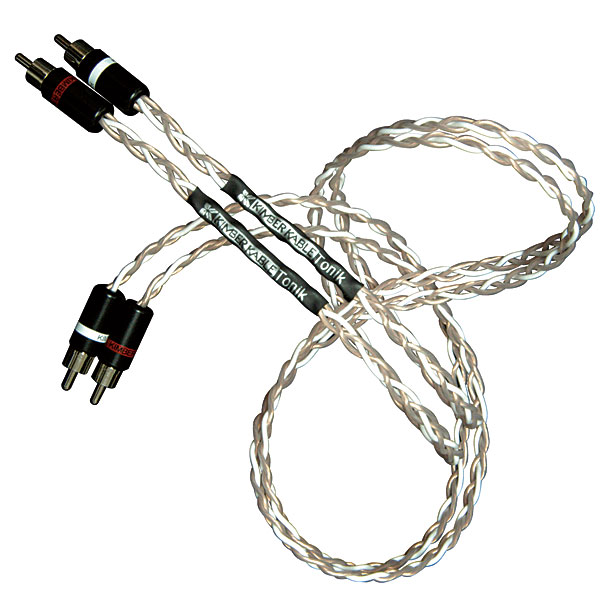 Luckily for me, versions of both models remain in the lines of their respective makers. But when I called the nice folks at Kimber Kable—no empty platitude in their case, I assure you—I learned that they now have an even cheaper interconnect: the Tonik, which sells for just $80 per 1m pair, terminated with RCA plugs.
Given that PBJ does, indeed, stand for peanut butter and jelly, I guessed that Tonik is meant to connote the poor man's version of a G&T, in which the quenching of thirst takes priority over the banishing of imagined voices. As it turns out, the name is meant to combine humility with verity: While Kimber's more expensive interconnects are proposed to deliver all the timbral color there is to hear, the Tonik aims, instead, at getting the musical fundamentals right.
Very right, it turned out. This simple product, in which three stranded copper wires are neatly braided together (think: friendship bracelets) in a presumably noise-canceling pattern, was musically and sonically fine when I tried it with my reference gear—a system that one might assume has evolved beyond the capabilities of such plebeian wire.
Luckily for me, versions of both models remain in the lines of their respective makers. But when I called the nice folks at Kimber Kable—no empty platitude in their case, I assure you—I learned that they now have an even cheaper interconnect: the Tonik, which sells for just $80 per 1m pair, terminated with RCA plugs.
Given that PBJ does, indeed, stand for peanut butter and jelly, I guessed that Tonik is meant to connote the poor man's version of a G&T, in which the quenching of thirst takes priority over the banishing of imagined voices. As it turns out, the name is meant to combine humility with verity: While Kimber's more expensive interconnects are proposed to deliver all the timbral color there is to hear, the Tonik aims, instead, at getting the musical fundamentals right.
Very right, it turned out. This simple product, in which three stranded copper wires are neatly braided together (think: friendship bracelets) in a presumably noise-canceling pattern, was musically and sonically fine when I tried it with my reference gear—a system that one might assume has evolved beyond the capabilities of such plebeian wire.
In high-end audio as in Jellystone Park, the problem is obvious: Shrinking habitats make for dwindling food supplies. Dwindling food supplies make for erratic behavior. Erratic behavior means you should stay in the car and wait for help to arrive. The locking of horns among equipment suppliers isn't a terrible thing in and of itself, but it can lead to unpleasant complications. Left unchecked, rutting designers will battle not only for food, but for the attention of potential mates, on whom they depend for the survival of their genetic information. Even that wouldn't be such a problem, except that the mates they seek are audio reviewers, and it appears we are always in estrus. Ouch.
And make no mistake: Perfectionist audio does have a future. Stephen Mejias's column, "The Entry Level," is evidence of that. So, too, is the success of such companies as Peachtree Audio, High Resolution Technologies, and Direct Acoustics. (This former owner of a pair of EPI 100 loudspeakers was delighted when John Marks devoted his June column to the latest creation from that classic's inventor, Winslow Burhoe.) One can easily find perfectionist-quality electronics, loudspeakers, and source components that are priced to fit the budgets of students, newcomers to the workforce, and even professional audio reviewers themselves.
Luckily for me, versions of both models remain in the lines of their respective makers. But when I called the nice folks at Kimber Kable—no empty platitude in their case, I assure you—I learned that they now have an even cheaper interconnect: the Tonik, which sells for just $80 per 1m pair, terminated with RCA plugs.















