

"Have you really listened to all those records?"
My guest, an occasionally nice person, didn't mean her question in a nice way. It was pointed and derisive: a needle intended to burst whatever it was that made me think filling a room with thousands of LPs was a good idea. She didn't wait for an answer—it would have been "Not quite"—but I half think she half expected me to see reason on the spot.
That would have been unlikely. And the fact that she was technically right, if rude, doesn't matter: Virtually all of us are collectors, because our crazy minds are sick with the inability to enjoy each passing pleasure as just that, and not as something we feel we must be able to revisit at will. I have seen an Honus Wagner baseball card. (Remember, I live 20 minutes from Cooperstown, New York.) It was cool. Should I wish to own it, so I can take it out and see it again and again? Some say yes, some say no, and neither answer is righter than the other.
I bought another amplifier this year: a Fi 421A ($3950), which replaces the Fi 2A3 Stereo amp that I used to own. That brings the total number of hi-fi amplifiers I own back up to three. (I'm counting a pair of monoblocks as one). Unless I'm going for some sort of Charles Ives effect—an idea that isn't completely lacking in appeal, now that I think about it—I can't listen to more than one stereo amp or stereo pair at the same time. But I do enjoy all of them.
I'm not sure I can explain this thing about amplifiers. I could be happy owning, for the rest of my life, just one turntable, one preamplifier, and one pair of speakers. But there are too many amps to ignore, some of which are both good and different: good in the sense that they all get one or more musically crucial things very right, different inasmuch as the goodness of one doesn't entirely overlap the goodness of another. Like the blind men describing the elephant, the amplifiers I own say different things, and all of them are true.
And here we are: After just 412 words, I'm on very thin ice with those who would have us think that two different-sounding components can't both be high-fidelity, because there's only one truth. I'd write [sigh] here if it weren't so unmanly.
Doffing the cap
The Fi 421A amplifier was introduced in 1996, when the manufacturing company was only two or three years old. Before then, owner Don Garber (footnote 1) operated an audio store, also named Fi, near the entrance to the Holland Tunnel, in Manhattan's Soho district. That incarnation of Fi sold vintage gear that Garber had reconditioned—"Occasionally, someone would drive up with an old McIntosh 275 or Marantz tube amp and ask 50 bucks for it," he told me—and new amplifiers by such designers as Noriyasu Komuro, Herb Reichert, J.C. Morrison, and Wavelength Audio's Gordon Rankin.
Just as important, the Fi store became an informal meeting place for those and other pioneers of the low-power movement (footnote 2). Fi was, for a time, the Algonquin Round Table of the New York audio scene, and Don Garber was its Alexander Woollcott. (So far as I know, it lacked a Dorothy Parker.)
"The idea of making my own amps hadn't occurred to me yet," Garber says today. Nonetheless, while running his store, he designed the chassis and layout for a push-pull monoblock circuit by J.C. Morrison based on the EL34 output tube. "They were very, very good push-pull amps," according to Garber—but by then, he and Morrison were both becoming more interested in single-ended designs. For Garber, the seed had been planted when a friend invited him to come hear a newly acquired pair of vintage Western Electric model 91A amplifiers. To say that he was impressed would be an understatement.
In 1993, Garber took the plunge and built his own single-ended amp, designed around the 2A3 output triode: "I was attracted by the simplicity. The lower the power of an amp, the more I seemed to like it." It was a good move: That first Fi amplifier, the Fi 2A3, sold right out of the store, literally to the first customer who walked in and heard it. "I took out an ad in Sound Practices, and before long I was selling amps all over the country. At that point the store became kind of an albatross, so that was that."
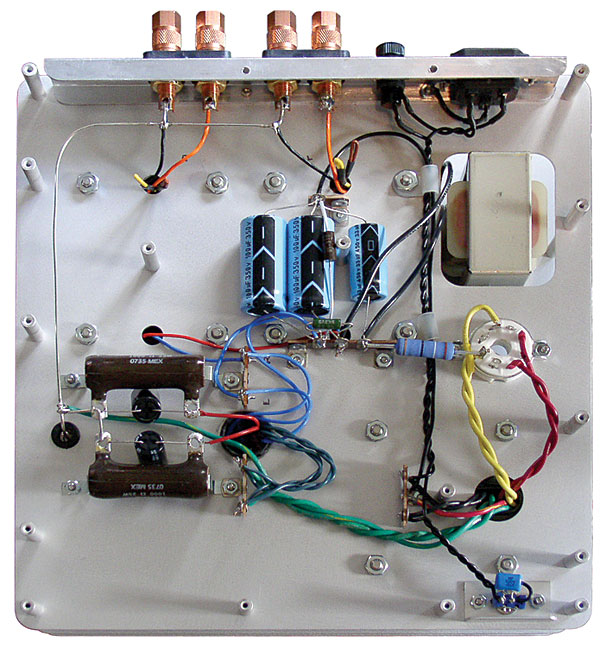 The Fi 2A3—first produced as a stereo amp, then as a monoblock—is elegantly simple: a single-ended-triode (SET) amplifier with a completely tube-rectified power supply, in which all tubes are heated by AC, straight off a secondary winding of the mains transformer. Significantly, Garber's 2A3 is direct-coupled: Rather than using a capacitor to prevent high-voltage DC going from the plate of the driver tube to the signal grid of the output tube, he raises the DC potential of the output tube's signal grid to the same level as the driver tube's plate; raises the potential of the output tube's cathode to whatever level is required for the grid to have the correct negative bias (relative to the cathode); and raises the potential at the output tube's plate, since the actual plate voltage, as seen by the tube, is that which is observed between plate and cathode, not plate and ground.
"It's easy to direct-couple a 2A3 [tube]. It's no more difficult than not doing so," Garber said. His modesty extended to the question of originality: "My amp was not the first direct-coupled 2A3 amp. I've never done anything that someone else hasn't done first!"
From Fi's first days as a manufacturing company, one or another version of Garber's direct-coupled 2A3 amp has been his biggest seller. But soon after that amp began to sell, he had an idea to try something a bit more radical.
Nothing is sacred
The Fi 2A3—first produced as a stereo amp, then as a monoblock—is elegantly simple: a single-ended-triode (SET) amplifier with a completely tube-rectified power supply, in which all tubes are heated by AC, straight off a secondary winding of the mains transformer. Significantly, Garber's 2A3 is direct-coupled: Rather than using a capacitor to prevent high-voltage DC going from the plate of the driver tube to the signal grid of the output tube, he raises the DC potential of the output tube's signal grid to the same level as the driver tube's plate; raises the potential of the output tube's cathode to whatever level is required for the grid to have the correct negative bias (relative to the cathode); and raises the potential at the output tube's plate, since the actual plate voltage, as seen by the tube, is that which is observed between plate and cathode, not plate and ground.
"It's easy to direct-couple a 2A3 [tube]. It's no more difficult than not doing so," Garber said. His modesty extended to the question of originality: "My amp was not the first direct-coupled 2A3 amp. I've never done anything that someone else hasn't done first!"
From Fi's first days as a manufacturing company, one or another version of Garber's direct-coupled 2A3 amp has been his biggest seller. But soon after that amp began to sell, he had an idea to try something a bit more radical.
Nothing is sacred
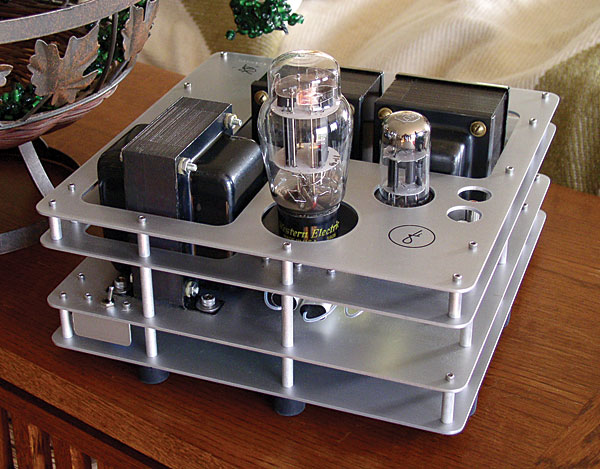
When Western Electric developed their 421A dual-triode tube, they intended it as a series regulator. In early 1996, Don Garber adapted it to a higher calling. Fi wasn't the first company to make an amplifier with a Western Electric 421A for a power tube: Shindo Laboratory offered a 10Wpc push-pull 421A amp in the early 1980s, and the tube has attracted a few DIY enthusiasts since that time. But Fi is surely the first manufacturer to use the 421A in a single-ended, nonparallel, commercial amplifier. And since the Western Electric 421A is a twin tube, that puts the Fi 421A in a class of its own: a stereo amplifier with a single power tube. Unlike the Fi 2A3, the Fi 421A is capacitor-coupled: "It could be [made direct-coupled], but then the power supply would have to be more complex," Garber said. "It would then have to be a much bigger, ungainly amp. I don't like things that are bigger than they have to be." The Fi 421A weighs a mere 20 pounds, and measures just 10" W by 8" H (including tubes) by 10.5" D. "There is nothing sacred," Garber continued. "I like direct coupling, but not everything has to be that way."
Footnote 1: Fi, 30 Veranda Place, Brooklyn, NY 11201. Tel: (718) 625-7353. Fax: (718) 875-3972. E-mail: dgfi@earthlink.net. (There is no Fi website.) Footnote 2: Art neglected to mention the address, in Manhattan's Soho district, of Garber's original tube-amplifier store: 30 Watts Street.—Robert J. Reina
The Fi 421A amplifier was introduced in 1996, when the manufacturing company was only two or three years old. Before then, owner Don Garber (footnote 1) operated an audio store, also named Fi, near the entrance to the Holland Tunnel, in Manhattan's Soho district. That incarnation of Fi sold vintage gear that Garber had reconditioned—"Occasionally, someone would drive up with an old McIntosh 275 or Marantz tube amp and ask 50 bucks for it," he told me—and new amplifiers by such designers as Noriyasu Komuro, Herb Reichert, J.C. Morrison, and Wavelength Audio's Gordon Rankin.
The Fi 2A3—first produced as a stereo amp, then as a monoblock—is elegantly simple: a single-ended-triode (SET) amplifier with a completely tube-rectified power supply, in which all tubes are heated by AC, straight off a secondary winding of the mains transformer. Significantly, Garber's 2A3 is direct-coupled: Rather than using a capacitor to prevent high-voltage DC going from the plate of the driver tube to the signal grid of the output tube, he raises the DC potential of the output tube's signal grid to the same level as the driver tube's plate; raises the potential of the output tube's cathode to whatever level is required for the grid to have the correct negative bias (relative to the cathode); and raises the potential at the output tube's plate, since the actual plate voltage, as seen by the tube, is that which is observed between plate and cathode, not plate and ground.
"It's easy to direct-couple a 2A3 [tube]. It's no more difficult than not doing so," Garber said. His modesty extended to the question of originality: "My amp was not the first direct-coupled 2A3 amp. I've never done anything that someone else hasn't done first!"
From Fi's first days as a manufacturing company, one or another version of Garber's direct-coupled 2A3 amp has been his biggest seller. But soon after that amp began to sell, he had an idea to try something a bit more radical.
When Western Electric developed their 421A dual-triode tube, they intended it as a series regulator. In early 1996, Don Garber adapted it to a higher calling. Fi wasn't the first company to make an amplifier with a Western Electric 421A for a power tube: Shindo Laboratory offered a 10Wpc push-pull 421A amp in the early 1980s, and the tube has attracted a few DIY enthusiasts since that time. But Fi is surely the first manufacturer to use the 421A in a single-ended, nonparallel, commercial amplifier. And since the Western Electric 421A is a twin tube, that puts the Fi 421A in a class of its own: a stereo amplifier with a single power tube. Unlike the Fi 2A3, the Fi 421A is capacitor-coupled: "It could be [made direct-coupled], but then the power supply would have to be more complex," Garber said. "It would then have to be a much bigger, ungainly amp. I don't like things that are bigger than they have to be." The Fi 421A weighs a mere 20 pounds, and measures just 10" W by 8" H (including tubes) by 10.5" D. "There is nothing sacred," Garber continued. "I like direct coupling, but not everything has to be that way."
Footnote 1: Fi, 30 Veranda Place, Brooklyn, NY 11201. Tel: (718) 625-7353. Fax: (718) 875-3972. E-mail: dgfi@earthlink.net. (There is no Fi website.) Footnote 2: Art neglected to mention the address, in Manhattan's Soho district, of Garber's original tube-amplifier store: 30 Watts Street.—Robert J. Reina















