


1) The Rek-O-Kut Rondine Jr.'s first day home.
For the qualities I most value in a music system—impact, substance, texture, color, and, above all, the ability to play lines of notes with a realistic sense of momentum and flow—the venerable Garrard 301 and similar well-made turntables with powerful motors and idler-wheel drive are the sources to beat. Unfortunately, good-condition samples of the Garrard 301 and 401, the Thorens TD 124, and any number of exotic EMTs have become scarce and ever more expensive.
Yet there exists an alternative that offers a great deal of the 301's forceful goodness, and more than a little of its sheer vintage coolosity, all at a fraction of the price: the Rek-O-Kut Rondine Jr., an American-made turntable that was produced in sufficient quantities that, one hopes, the extortionate effects of vintage-market greed might be kept at bay. Perhaps best of all, the Rondine Jr. is simple: so simple that its restoration, not to mention the construction of a suitable plinth for it, is well within the capabilities of most audiophiles.
Junior momentsThe products of the original Rek-O-Kut corporation of New York City (footnote 1), failed to attract my interest for a very long time—partly, I admit, because I was put off by the company's name. I treasure the records I've collected since age 10, and the idea of offering up a single one to a machine whose name contains not only the word cut but a malevolently goofy misspelling of same (cf Megadeth) was a bridge too far. By now, having researched the brand to the slim extent that fading memories and the Internet allow, I know that home record cutters were, in 1939, the first commercial products of the company's founder, a former screw-machine operator named George Silber. But today, audiophiles and broadcasters remember Rek-O-Kut for their generally high-quality turntables, sold under a model name that could have belonged to a heroine from a Roy Orbison song.
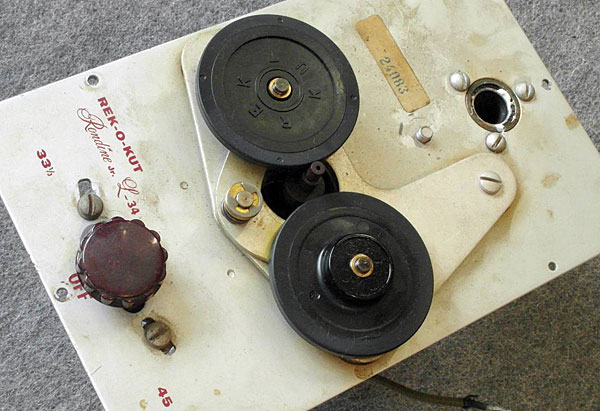
2) To stagger their heights, one of the idler wheels is installed upside down. (Each is molded with a hub on only one side.)

3) The Rondine Jr.'s generously sized motor, with upper and lower oil spouts facing the camera.

4) Removing the idlers and their spacers.
Introduced in 1956, the Rek-O-Kut Rondine turntable offered a machined-alloy platter, large-diameter bearing, powerful motor, and a three-speed (331/3, 45, and 78 rpm) idler-drive mechanism, all for the reasonable price of $74.95, tonearm and plinth not included. The upmarket Rondine Deluxe ($119.95) added a pilot light and an upgraded (Pabst) motor, while the Rondine Jr. ($49.95) offered high performance in a no-frills package.

5) Clean everything in sight. (The studs that support the big wheels need alcohol!)

6) The platter bearing, with oil groove.

7) Use alcohol—or, better still, tape-head cleaner—and lots of swabs to clean out the bearing well. And don't lose the ball.

8) The power switch—apparently one of the Jr.'s weak spots—is in the foreground, with oil spouts to the right.
There was a day in early June when I still had yet to even see an original Rek-O-Kut turntable in person; the next day, I had two of them in front of me, in pieces; a third arrived a week later. And two weeks after that, a nearby friend brought by Rek No.4, which he'd just purchased on eBay. Just lucky, I guess. I was also fortunate that two of those machines were Rondine Jrs., and was offered the chance to buy one of them, with an apparently original plinth, for $100. (I passed on the tonearm, the headshell of which screamed Pontiac.)
Footnote 1: Rek-O-Kut ceased making idler-wheel turntables in the 1960s. In 2000, with the blessings of the founder's descendants, electronics manufacturer Mike Stosich, of Esoteric Sound, acquired the rights to the name Rek-O-Kut. Esoteric Sound, 1608 Hemstock Avenue, Wheaton, IL 60189. Tel./Fax: (630) 933-9801. Web: www.esotericsound.com Footnote 2: There are actually two Jrs.: the L-34, which functions at 331/3 and 45rpm; and the L-37, which offers 331/3 and 78rpm.















