

Has it really been 30 years since an engineer named William H. Firebaugh unleashed on the audio world his radical and decidedly affordable Well Tempered Arm? (footnote 1) Indeed it has—and today, at 82, Bill Firebaugh seems busier than ever, with so many irons in the fire that he's been forced to give up the noble game of golf—an irony, as you'll see in a moment.
Firebaugh started down this road in the 1970s, while working at Ford Aerospace. "That was the time when FFT analyzers were appearing on the scene," he says. "We used a lot of Brüel & Kjaer gear in our work, so we received all of the technical papers that Brüel & Kjaer published. That was the only reason I ever saw a paper of theirs titled 'Audible Effects of Mechanical Resonances in Turntables,' by Poul Ladegaard. And that set me off. Once I read that, I knew what the issues were—and are."
The paper, which Ladegaard presented at the 1977 AES convention, in New York City, describes the audible effects of various resonances within the typical record player—including, of course, the fundamental resonance exhibited by the combination of tonearm and phono cartridge, as determined by the combined mass of both and the compliance of the latter. But Ladegaard's research went further, taking into account such variables as platter-bearing noise, record-mat compliance, and motor irregularities. Consequently, even though Firebaugh's first impulse was to make a tonearm with resonance-free bearings and correct damping, he came to see that the real goal in phonography was to design a tonearm and turntable that could function together as a system.
Firebaugh's resonance-free tonearm bearing turned out to be no bearing at all, at least not in the traditional sense: Famously, the Well Tempered Arm was suspended by two strands of nylon monofilament, thus sidestepping all concerns over bearing clearances and chatter. A coin-shaped damping paddle, fastened to the arm just below its pivot point, was horizontally submerged in a fixed tub of silicone fluid. As the arm moved laterally, the thin paddle knifed easily through the honey-thick liquid; however, it encountered a far greater degree of resistance in the vertical plane, thus introducing a desirable degree of damping.
Firebaugh's sophomore product, the Well Tempered Turntable, proved no less original, boasting a platter bearing of particular ingenuity. Unlike most of his contemporaries, Firebaugh saw the quest for an ideal bearing not as an exercise in making ever-thicker spindles or ever-more-exotic "jeweled" thrust plates to support that spindle, but one in which noise and resonant sidebands were diminished through, again, the elimination of clearances: The nylon bore of Firebaugh's bearing well was well bigger than the steel spindle that turned within it, the latter held perfectly upright only when "loaded" by the tension from the motor-drive pulley and drive belt. Thus pulled into alignment, the shaft contacted the well at only five points: one Delrin pad serving as a thrust plate, and four others describing the sleeve.
Secondarily, by lubricating his zero-clearance bearing with a bath of thick silicone, Firebaugh endowed it with some degree of rotational damping: an element of resistance that also served to maximize torque. We hadn't seen that idea here since 1957, when the last of Garrard's greased-bearing 301 motor units rolled off the assembly line.
A man of distinctive bearing
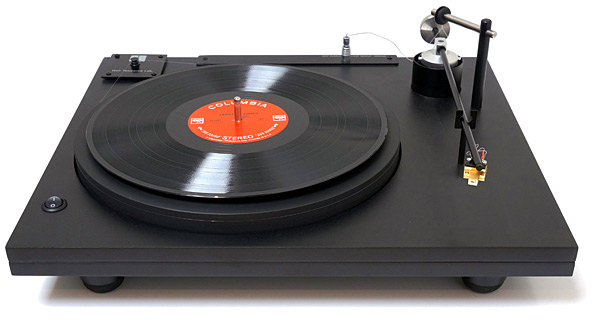
Today, most of the ideas behind the Well Tempered Arm and Turntable remain in the company's current models, but the designs are executed differently—as I recently observed while spending a few weeks with one of the latest products of Well Tempered Lab: the Amadeus Mk.II record player ($2850 for turntable with tonearm, footnote 2). The latest version of Bill Firebaugh's tonearm, the Symmetrex, retains the monofilament bearing, but adds a few twists of its own—literally, in the case of WTL's current approach to antiskating. The Symmetrex hangs by a single nylon strand, looped around a grooved steel collar that rides along a height-adjustable steel suspension rod. A rubber grommet ensures a tight fit between collar and rod, while allowing the collar to be rotated to adjust azimuth. During setup, that bearing collar is also adjusted so that the arm is suspended precisely above a height-adjustable damping cup, in which rides not a paddle but a hemispherical segment of a golf ball. Although Bill Firebaugh makes no such claims—he says, with characteristic modesty, that the golf-ball thing occurred to him early one morning during his pre-coffee "zombieness"—it seems to me that the roundness of the ball, combined with the adjustability of the damping cup's height, enables a far wider range of damping settings than was possible with earlier WTAs.
 The effective length of the tonearm is greater than average, at 10.5". Its modest aluminum cartridge mount is fixed in place at an offset angle of 19°, and there are no provisions for overhang adjustment—a fact noted in the comprehensive owner's manual: "Some alignment protractors may well disagree. However, the Well Tempered Lab stands by their convictions."
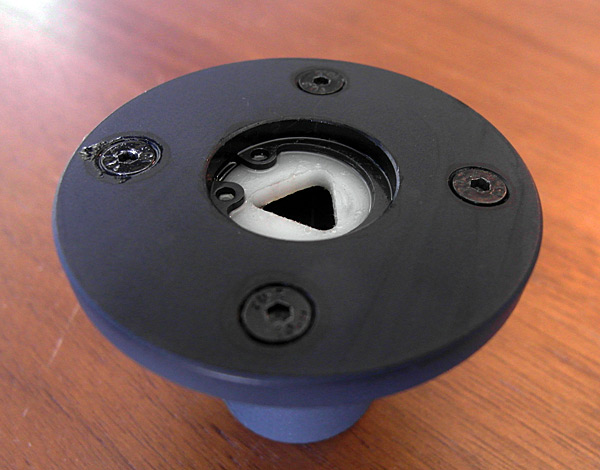
For its part, the Amadeus Mk.II turntable seems to have even less in common with its own progenitor, the original Well Tempered Turntable. In fact, the new model differs considerably from the similarly priced Well Tempered Record Player, which I wrote about in my November 2006 column. Chief among those differences is the manner in which Bill Firebaugh executes his zero-clearance main bearing: The polished-steel bearing axle is now pointed rather than flat-bottomed, and the Delrin nubs have been dispensed with. In their place is a polyethylene thrust pad with a 1/8" dimple at its center, and a Delrin collar near the top of the well, with a triangular cutout at its center. The bearing well is fastened to the plinth in such a way that one corner of the triangle points directly toward the motor pulley; for that reason, and because the bearing axle is considerably smaller than the triangular hole (the former is 0.285" in diameter, while the sides of the latter are approximately 0.4" each), the drive belt tends, under load, to pull the bearing axle upright, with its pointed bottom located in the thrust-plate dimple, and its shaft snugged into a corner of the triangular cutout. (Thus I imagine the new one could be called a three-point, zero-clearance bearing.)
For this bearing Firebaugh has dispensed with the thick oil and, with it, the old bearing's rotational damping. He says he recently discovered, more or less by accident, that the Amadeus Mk.II bearing can run for at least seven weeks, 24 hours a day, without apparent damage. "It works great without any lubricant," Firebaugh says before adding, with a laugh, "But, being kind of chicken, I recommend using oil." A generous vial of bearing oil is supplied with the Amadeus, and the owner's manual suggests that any synthetic motor oil with a viscosity of between 5W and 50W will also work just fine.
The effective length of the tonearm is greater than average, at 10.5". Its modest aluminum cartridge mount is fixed in place at an offset angle of 19°, and there are no provisions for overhang adjustment—a fact noted in the comprehensive owner's manual: "Some alignment protractors may well disagree. However, the Well Tempered Lab stands by their convictions."
For its part, the Amadeus Mk.II turntable seems to have even less in common with its own progenitor, the original Well Tempered Turntable. In fact, the new model differs considerably from the similarly priced Well Tempered Record Player, which I wrote about in my November 2006 column. Chief among those differences is the manner in which Bill Firebaugh executes his zero-clearance main bearing: The polished-steel bearing axle is now pointed rather than flat-bottomed, and the Delrin nubs have been dispensed with. In their place is a polyethylene thrust pad with a 1/8" dimple at its center, and a Delrin collar near the top of the well, with a triangular cutout at its center. The bearing well is fastened to the plinth in such a way that one corner of the triangle points directly toward the motor pulley; for that reason, and because the bearing axle is considerably smaller than the triangular hole (the former is 0.285" in diameter, while the sides of the latter are approximately 0.4" each), the drive belt tends, under load, to pull the bearing axle upright, with its pointed bottom located in the thrust-plate dimple, and its shaft snugged into a corner of the triangular cutout. (Thus I imagine the new one could be called a three-point, zero-clearance bearing.)
For this bearing Firebaugh has dispensed with the thick oil and, with it, the old bearing's rotational damping. He says he recently discovered, more or less by accident, that the Amadeus Mk.II bearing can run for at least seven weeks, 24 hours a day, without apparent damage. "It works great without any lubricant," Firebaugh says before adding, with a laugh, "But, being kind of chicken, I recommend using oil." A generous vial of bearing oil is supplied with the Amadeus, and the owner's manual suggests that any synthetic motor oil with a viscosity of between 5W and 50W will also work just fine.
 The Amadeus Mk.II's platter is considerably different from the one supplied with the Well Tempered Record Player of eight years ago. The earlier platter, designed to be used without a mat, had a screw-on clamp and a drastically concave top, the combination of which rendered the playing surfaces of LPs distinctly nonlevel. Thankfully, the new acrylic platter is as flat as Elizabeth McGovern's delivery—a commendable quality where record platters and platter mats are concerned—and is machined to a diameter of 13", presumably to enhance speed stability. An 11.25"-diameter foam mat is supplied as standard.
An even more visible difference is the Amadeus Mk.II's onboard DC motor, earlier WTL turntables having been noted for their outboard motor pods. The new motor is tiny compared to that of its WTL predecessors—its plastic body is less than 1" in diameter—and it's surrounded by a thick foam damping ring, in addition to being fastened to a compliantly isolated mounting plate. The molded pulley is also tiny, and the motor's servo-drive electronics are mounted inside the plinth, which is made of a double layer of MDF finished in textured black paint. (Also unlike the earlier Well Tempered Record Player, there appears to be no layer of compliant damping material between the layers of fiberboard.) A tiny trim pot, accessible through an opening on the plinth's back edge, allows the user to fine-tune the motor's running speed, a chore for which a nice, full-size strobe disc is supplied.
The Amadeus Mk.II's platter is considerably different from the one supplied with the Well Tempered Record Player of eight years ago. The earlier platter, designed to be used without a mat, had a screw-on clamp and a drastically concave top, the combination of which rendered the playing surfaces of LPs distinctly nonlevel. Thankfully, the new acrylic platter is as flat as Elizabeth McGovern's delivery—a commendable quality where record platters and platter mats are concerned—and is machined to a diameter of 13", presumably to enhance speed stability. An 11.25"-diameter foam mat is supplied as standard.
An even more visible difference is the Amadeus Mk.II's onboard DC motor, earlier WTL turntables having been noted for their outboard motor pods. The new motor is tiny compared to that of its WTL predecessors—its plastic body is less than 1" in diameter—and it's surrounded by a thick foam damping ring, in addition to being fastened to a compliantly isolated mounting plate. The molded pulley is also tiny, and the motor's servo-drive electronics are mounted inside the plinth, which is made of a double layer of MDF finished in textured black paint. (Also unlike the earlier Well Tempered Record Player, there appears to be no layer of compliant damping material between the layers of fiberboard.) A tiny trim pot, accessible through an opening on the plinth's back edge, allows the user to fine-tune the motor's running speed, a chore for which a nice, full-size strobe disc is supplied.
Footnote 1: The Well Tempered Tonearm was first reviewed in Stereophile by J. Gordon Holt, in 1984 (Vol.7 No.8). An interview with Bill Firebaugh can be found here.
Footnote 2: Well Tempered Lab, PO Box 2650, Christchurch, New Zealand. Tel: (64) 3-379-0743. Web: www.welltemperedlab.net. US distributor: Mike Pranka/Toffco, Tel: (314) 454-9966.
Today, most of the ideas behind the Well Tempered Arm and Turntable remain in the company's current models, but the designs are executed differently—as I recently observed while spending a few weeks with one of the latest products of Well Tempered Lab: the Amadeus Mk.II record player ($2850 for turntable with tonearm, footnote 2). The latest version of Bill Firebaugh's tonearm, the Symmetrex, retains the monofilament bearing, but adds a few twists of its own—literally, in the case of WTL's current approach to antiskating. The Symmetrex hangs by a single nylon strand, looped around a grooved steel collar that rides along a height-adjustable steel suspension rod. A rubber grommet ensures a tight fit between collar and rod, while allowing the collar to be rotated to adjust azimuth. During setup, that bearing collar is also adjusted so that the arm is suspended precisely above a height-adjustable damping cup, in which rides not a paddle but a hemispherical segment of a golf ball. Although Bill Firebaugh makes no such claims—he says, with characteristic modesty, that the golf-ball thing occurred to him early one morning during his pre-coffee "zombieness"—it seems to me that the roundness of the ball, combined with the adjustability of the damping cup's height, enables a far wider range of damping settings than was possible with earlier WTAs.
The effective length of the tonearm is greater than average, at 10.5". Its modest aluminum cartridge mount is fixed in place at an offset angle of 19°, and there are no provisions for overhang adjustment—a fact noted in the comprehensive owner's manual: "Some alignment protractors may well disagree. However, the Well Tempered Lab stands by their convictions."
For its part, the Amadeus Mk.II turntable seems to have even less in common with its own progenitor, the original Well Tempered Turntable. In fact, the new model differs considerably from the similarly priced Well Tempered Record Player, which I wrote about in my November 2006 column. Chief among those differences is the manner in which Bill Firebaugh executes his zero-clearance main bearing: The polished-steel bearing axle is now pointed rather than flat-bottomed, and the Delrin nubs have been dispensed with. In their place is a polyethylene thrust pad with a 1/8" dimple at its center, and a Delrin collar near the top of the well, with a triangular cutout at its center. The bearing well is fastened to the plinth in such a way that one corner of the triangle points directly toward the motor pulley; for that reason, and because the bearing axle is considerably smaller than the triangular hole (the former is 0.285" in diameter, while the sides of the latter are approximately 0.4" each), the drive belt tends, under load, to pull the bearing axle upright, with its pointed bottom located in the thrust-plate dimple, and its shaft snugged into a corner of the triangular cutout. (Thus I imagine the new one could be called a three-point, zero-clearance bearing.)
For this bearing Firebaugh has dispensed with the thick oil and, with it, the old bearing's rotational damping. He says he recently discovered, more or less by accident, that the Amadeus Mk.II bearing can run for at least seven weeks, 24 hours a day, without apparent damage. "It works great without any lubricant," Firebaugh says before adding, with a laugh, "But, being kind of chicken, I recommend using oil." A generous vial of bearing oil is supplied with the Amadeus, and the owner's manual suggests that any synthetic motor oil with a viscosity of between 5W and 50W will also work just fine.
The Amadeus Mk.II's platter is considerably different from the one supplied with the Well Tempered Record Player of eight years ago. The earlier platter, designed to be used without a mat, had a screw-on clamp and a drastically concave top, the combination of which rendered the playing surfaces of LPs distinctly nonlevel. Thankfully, the new acrylic platter is as flat as Elizabeth McGovern's delivery—a commendable quality where record platters and platter mats are concerned—and is machined to a diameter of 13", presumably to enhance speed stability. An 11.25"-diameter foam mat is supplied as standard.
An even more visible difference is the Amadeus Mk.II's onboard DC motor, earlier WTL turntables having been noted for their outboard motor pods. The new motor is tiny compared to that of its WTL predecessors—its plastic body is less than 1" in diameter—and it's surrounded by a thick foam damping ring, in addition to being fastened to a compliantly isolated mounting plate. The molded pulley is also tiny, and the motor's servo-drive electronics are mounted inside the plinth, which is made of a double layer of MDF finished in textured black paint. (Also unlike the earlier Well Tempered Record Player, there appears to be no layer of compliant damping material between the layers of fiberboard.) A tiny trim pot, accessible through an opening on the plinth's back edge, allows the user to fine-tune the motor's running speed, a chore for which a nice, full-size strobe disc is supplied.
Footnote 1: The Well Tempered Tonearm was first reviewed in Stereophile by J. Gordon Holt, in 1984 (Vol.7 No.8). An interview with Bill Firebaugh can be found here.















