

All three of us were delighted. Not only do we love that song; it was one of the numbers performed this year by my clarinet-playing daughter's high school marching band (really!). But afterward, when the deejay had moved on to the usual Mötley Leppard junk, I thought: We own that Led Zep album. Why didn't we just think to put it on—and get equally excited?
That's the thing about listening to music on the radio: Someone thought of it for us. It's exciting when someone else plays music that you know and enjoy. It's like when your father says he's going to take you out for ice cream—it's 1000 times better than just walking into the kitchen and taking a carton out of the freezer. Even if the stuff in the freezer is HÑagen-Dazs and the stuff at the drive-in is full of chemicals and air, the latter is a special kind of good.
So on one level, to write about radio is to write about the psychology of listening—an idea that applies equally well to every other playback medium. Yet on another level, radio enjoys a distinction that virtually no other recorded-music medium can boast: the potential to expose the listener to new material, and to coax the collector into coveting it. Here, broadcasting has surpassed even the printed word: It's one thing to read about an obscure recording—Charlie Parker's 1946 "Lover Man," the young John Coltrane's "Hot House" of the same year, John Lennon's first demo of the decidedly profane song that would become "Sexy Sadie," Jascha Heifetz's recording of Arthur Benjamin's Romantic Fantasy—and perhaps come away with a distorted idea of its worth. It's another thing entirely to hear it.
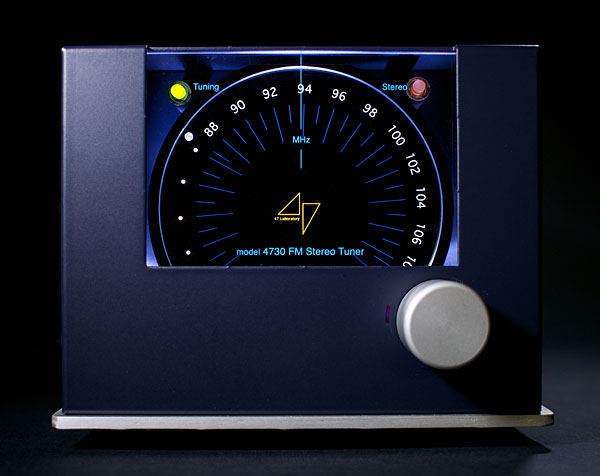 Broadcast stations on which one can rely for such revelations are thin on the ground. I have, more than once, used this space to declare my love for Columbia University's WKCR—but the only way this country boy can regularly hear that New York City station is via the Internet. That's a shame, because decent-quality broadcasts sounded better through the 47 Laboratory Midnight Blue than MP3-quality Internet radio does through any USB digital-to-analog converter of my experience. The 4730 was clear and believably crisp without undue brightness, and while it didn't have the sweetness of, say, a McIntosh MR-65, it performed admirably with weak signals, ultimately pulling usably clean sound from a greater number of stations than the Tivoli Model One I normally use. And the 4730 looks a lot better, and was more fun to use.
Yoshi Segoshi of Sakura Systems, the company that distributes 47 Laboratory's products in the US, says that availability of the Model 4730 tuner is limited, given the relatively small number of variable capacitors ordered for its construction. Since I can think of no other currently manufactured tuner that is equally desirable—and, yes, my reckoning includes a notoriously expensive beast whose famous designer fails to inspire my confidence—perhaps Junji Kimura can be persuaded to order another batch.
Loving distortions
Broadcast stations on which one can rely for such revelations are thin on the ground. I have, more than once, used this space to declare my love for Columbia University's WKCR—but the only way this country boy can regularly hear that New York City station is via the Internet. That's a shame, because decent-quality broadcasts sounded better through the 47 Laboratory Midnight Blue than MP3-quality Internet radio does through any USB digital-to-analog converter of my experience. The 4730 was clear and believably crisp without undue brightness, and while it didn't have the sweetness of, say, a McIntosh MR-65, it performed admirably with weak signals, ultimately pulling usably clean sound from a greater number of stations than the Tivoli Model One I normally use. And the 4730 looks a lot better, and was more fun to use.
Yoshi Segoshi of Sakura Systems, the company that distributes 47 Laboratory's products in the US, says that availability of the Model 4730 tuner is limited, given the relatively small number of variable capacitors ordered for its construction. Since I can think of no other currently manufactured tuner that is equally desirable—and, yes, my reckoning includes a notoriously expensive beast whose famous designer fails to inspire my confidence—perhaps Junji Kimura can be persuaded to order another batch.
Loving distortions
Here's something I used to know: I used to know that photographs of old people in their youth always look like old photographs. Baby pictures of old people are always black-and-white photos, often printed on paper with a scalloped edge. They tend to be little photos, too: For most people in those days, big prints were too expensive.
After that, every age has its own look, and every look has its own age. Undersaturated, hue-challenged color photos are from the 1950s. Oversaturated, ill-lit Polaroids are from the '60s. Those crazy-ass textured prints are from the '70s. Each look had its own distortions, and each had its charms.
But time doesn't linger as long as it used to. Recently I spent time visiting a family member at a senior living facility—one of the nicer ones, intended for people who are more or less independent. Everyone who lives there has his or her own apartment, and next to everyone's apartment door is a small bulletin board, whereon residents post photos of themselves, wedding photos being especially common. When I last wandered those halls, something made a lasting impression on me (I promise, this won't be one of those awful Family Circus–style ghost-grandma things): Some of the wedding photos looked jarringly modern to me. As it turns out, I am now old enough, and the technology of photography has sufficiently leveled out, that inter-era distinctions are narrower than before. I suppose the day will come when it will be difficult for the layperson to date an image based solely on the idiosyncrasies of the medium.
Then it occurred to me: In domestic audio, this sort of leveling-out happened longer ago. Every week, I hear a new-to-me music recording that was made in the 1940s or '50s, the realism of which has never been bettered.
A few weeks ago, my record-collecting friend Jeff Friedman brought over some LPs and 78s for one of our semiregular monopaloozas. About an hour into our listening session, he asked me to close my eyes while he put on a record that would, he believed, astonish me from here to next Sunday. I did as he asked, and within a few seconds I heard the familiar "One, two, three, four" that kicks off the Beatles' "I Saw Her Standing There"—but it had never sounded so forceful, present, and downright real. I opened my eyes to see that Jeff had, indeed, brought to my home an early UK copy of the Parlophone LP Please Please Me—in mono, of course. It sounded about three times as convincing, exciting, tactile, impactful, colorful, and engaging as the CD version from the collection The Beatles in Mono; the stereo version on my Capitol Meet the Beatles LP of the same album isn't even on the same planet.
Some folks would proclaim that, in comparison with any CD version of Please Please Me, Jeff's mono LP is distorted. Although it's an unusually clean copy, one can, at times, hear a trace of surface noise alongside the music. Its monaural mix—pressings of which sold, in their day, for up to a dollar less than stereo albums!—deprives the listener of the exciting spatial effects that some audio mavens consider the most important goal of a high-end audio system. It is also subject to wow, warp-wow, flutter, and varying degrees of tracing-error distortion—and if Stereo Review still existed, its writers would warn Jeff and me that Please Please Me and every other vinyl record in our possession will suffer drastic physical damage with each successive play (never mind that our decades of experience as record collectors and phonophiles have shown that that is horseshit). None of those distortions affect today's modern stereo CDs, which are perfect—except, of course, for the jitter, the inadequate word length, the inadequate sampling rate, the digital-filter–induced phase shift, the ineffectual error-correction, the delamination, the susceptibility to minor scratches and swirlmarks, and the polycarbonate cases that splinter when you look at them. Oh well.
Yes, everything distorts, and different things present different kinds of distortion. To accept or even embrace distortion is not to love it, but rather to understand that the technology of music recording and playback is a continuum—and a nonlinear one at that. Some find beauty in every bead on that string, while others pitch camp where they are happiest; either approach is fine.
Broadcast stations on which one can rely for such revelations are thin on the ground. I have, more than once, used this space to declare my love for Columbia University's WKCR—but the only way this country boy can regularly hear that New York City station is via the Internet. That's a shame, because decent-quality broadcasts sounded better through the 47 Laboratory Midnight Blue than MP3-quality Internet radio does through any USB digital-to-analog converter of my experience. The 4730 was clear and believably crisp without undue brightness, and while it didn't have the sweetness of, say, a McIntosh MR-65, it performed admirably with weak signals, ultimately pulling usably clean sound from a greater number of stations than the Tivoli Model One I normally use. And the 4730 looks a lot better, and was more fun to use.
Yoshi Segoshi of Sakura Systems, the company that distributes 47 Laboratory's products in the US, says that availability of the Model 4730 tuner is limited, given the relatively small number of variable capacitors ordered for its construction. Since I can think of no other currently manufactured tuner that is equally desirable—and, yes, my reckoning includes a notoriously expensive beast whose famous designer fails to inspire my confidence—perhaps Junji Kimura can be persuaded to order another batch.
Loving distortionsHere's something I used to know: I used to know that photographs of old people in their youth always look like old photographs. Baby pictures of old people are always black-and-white photos, often printed on paper with a scalloped edge. They tend to be little photos, too: For most people in those days, big prints were too expensive.















