

Early in their existence as a manufacturer of amplification separates, Naim took that concept a step deeper into Audioland and designated the ground point within an outboard preamplifier power supply as the central signal-ground point for a complete Naim-based system—hence the company's famous insistence on driving the power amp with a signal picked up at that power supply instead of at the preamp itself (footnote 3). Similar attention has been given to the obviously related matter of mains grounding within a Naim system: In the late 1980s, some of Naim's UK dealers began experimenting with a modification that earned the informal and unabashedly Ian Fleming–esque name Hydra. They gathered up the AC cords in an exemplary Naim-based LP-playing system—turntable power supply, preamplifier power supply, and power amp(s)—then cut off their plugs and connected all those cords to a single and presumably hefty AC plug. VoilÖ: instant, system-wide, mains star ground.
 The Hydra met with success among the UK faithful—but reportedly, for whatever reason, it didn't sound so hot over here. Consequently, Naim's then US distributor, Naim North America, began searching for the next best thing: a high-quality, non–current-limiting power strip with low electrical froufrou factor. In about 1995 they found such a thing in Wiremold's L10320: a nine-outlet, 15-amp power strip that came complete with nothing: no switch, no light, no circuit-breaker, no metal-oxide varistor, no fuse. Naim NA actually began distributing Wiremold L10320s to their dealers, and Naim enthusiasts on this side of the Atlantic embraced them. So, too, did many of us who appreciate the musical and sonic hallmarks for which Naim is known, but who use electronics from other manufacturers.
Although it appears the Wiremold L10320 is no longer in production (Wiremold was acquired by the French manufacturer Legrand in 2000), some claim that stocks remain plentiful, and similarly simple products can be found—all for under $100, and most for considerably less. These products work! Put one at the heart of your system and you'll hear subtle but real reductions of noise: Music will seem more present and colorful, and the silences between notes will seem less like something and more like nothing. I'm less certain about the benefits, often claimed by the faithful, of imposing on one's components a particular order of plug-in, typically giving pride of place—at the end of the strip nearest the strip's own AC cable—to products presumed to draw the most current. I've experimented along those lines without reliably hearing a difference, but I nevertheless go along with the game, if only because it's easy and free.
Stripped of all noise
Universal Tweak No.1 can cost as little as nothing, though I suppose there are hobbyists who, lacking a perfect piece of furniture on which to place their hi-fi gear, will feel compelled to buy something new. (I suggest plywood or hardwood—but never softwood, such as pine.) Universal Tweak No.2 might compel the audiophile to spend a few dollars on felt pads, though he or she might also show a profit on the scrap value of all those spikes. Universal Tweak No.3 will cost under $100.
Yet I'm reminded that there are people—not only here in the West, and certainly not only audio enthusiasts—whose nature it is to disregard products or procedures that cost too little. To those hobbyists I recommend, sincerely and without cynicism, a variation on Universal Tweak No.3 that requires a bit more money and delivers on its promise.
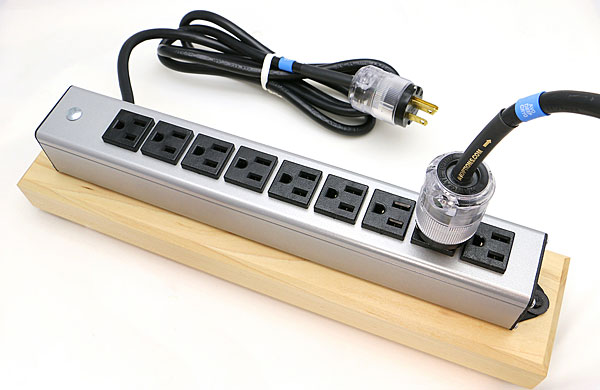
From AV Options—which sprang from the ashes of Naim North America and is the authorized US service center for all Naim Audio products—comes the SuperWiremold Deep-Cryo power strip ($399), which is precisely what its name describes: a Wiremold L10320 to which a few enhancements have been applied. According to Chris West of AVO, the SuperWiremold begins life as a stock L10320 strip, then is subjected to deep-cryogenic treatments at –320°F—"fundamentally for improved conductivity," West says. "The deep cryo is done here in the US. And it's not just a matter of getting something to a deep temp: It's doing it under very controlled circumstances. This process brings [the strip] back up in stages, taking 36 hours altogether."
Additionally, the Wiremold's AC cord is retrofitted with a Wattgate 5266i AC plug—both cable and plug also get the deep-cryo treatment—and its aluminum case is mounted on a plinth of solid, hand-finished maple that's 16" long by 3.5" wide by 1.75" high, fitted with four silicone-rubber AcoustiFeet from Acousti Products. The wooden base, according to West, "isolates the unit, gets it away from the floor, and damps it a little, too."
The very first recording I listened to with the AV Options strip in place was a limited-edition (1982) MoFi UHQR LP of the Beatles' Sgt. Pepper's Lonely Hearts Club Band (Capitol/Mobile Fidelity Sound Lab MFQR 1-100): a mint copy of a virtually perfect stereo mastering of an Åberfamiliar landmark recording, elements of which suffer the dulling and compression effects of the Ping-Pong-ing of individual tracks. As I recently observed of another hardware upgrade, replacing my stock Wiremold L10320 with AVO's SuperWiremold Deep-Cryo strip was very much on a par with going from incorrect to correct absolute polarity for a given recording: Blurring of which I hadn't been consciously aware was lessened, voices and solo instruments stepped forward in the mix, and the sound as a whole seemed just a tad louder.
In the days since installing the AVO strip, I've heard it make the same refinements in other recordings: the changes are always subtle, but always unambiguously for the better, in terms of both musical qualities and sheer sound. Not bad for a $399 tweak that takes less than five minutes to install. Incidentally, the folks at AV Options point out that Wiremold's original outlet spacing is geared more toward traditional North American AC plugs than the extra-large, hospital-grade plugs from Wattgate et al; in systems in which all the AC cords are terminated with the latter, the nine-outlet AVO strip can accommodate a maximum of five plugs.
Rural fun delivery
In announcing three summerly new vinyl releases, Bob Irwin, of the LP- and CD-reissue company Sundazed Music, also introduced a brand-new imprint: Sundazed RFD will specialize in 7", 45rpm releases of original pop music from Irwin's new home base of Nashville, Tennessee. All Sundazed RFD releases will be packaged in full-color, collector-friendly picture sleeves, and Irwin, who may be the music industry's nicest, most earnest inhabitant since Ahmet Ertegun, suggests that all RFD records will be released on colored vinyl. These first three are gold—actually, a deep shade of translucent yellow reminiscent of Bono's sunglasses.
The Hydra met with success among the UK faithful—but reportedly, for whatever reason, it didn't sound so hot over here. Consequently, Naim's then US distributor, Naim North America, began searching for the next best thing: a high-quality, non–current-limiting power strip with low electrical froufrou factor. In about 1995 they found such a thing in Wiremold's L10320: a nine-outlet, 15-amp power strip that came complete with nothing: no switch, no light, no circuit-breaker, no metal-oxide varistor, no fuse. Naim NA actually began distributing Wiremold L10320s to their dealers, and Naim enthusiasts on this side of the Atlantic embraced them. So, too, did many of us who appreciate the musical and sonic hallmarks for which Naim is known, but who use electronics from other manufacturers.
Although it appears the Wiremold L10320 is no longer in production (Wiremold was acquired by the French manufacturer Legrand in 2000), some claim that stocks remain plentiful, and similarly simple products can be found—all for under $100, and most for considerably less. These products work! Put one at the heart of your system and you'll hear subtle but real reductions of noise: Music will seem more present and colorful, and the silences between notes will seem less like something and more like nothing. I'm less certain about the benefits, often claimed by the faithful, of imposing on one's components a particular order of plug-in, typically giving pride of place—at the end of the strip nearest the strip's own AC cable—to products presumed to draw the most current. I've experimented along those lines without reliably hearing a difference, but I nevertheless go along with the game, if only because it's easy and free.
Stripped of all noise
Universal Tweak No.1 can cost as little as nothing, though I suppose there are hobbyists who, lacking a perfect piece of furniture on which to place their hi-fi gear, will feel compelled to buy something new. (I suggest plywood or hardwood—but never softwood, such as pine.) Universal Tweak No.2 might compel the audiophile to spend a few dollars on felt pads, though he or she might also show a profit on the scrap value of all those spikes. Universal Tweak No.3 will cost under $100.
Yet I'm reminded that there are people—not only here in the West, and certainly not only audio enthusiasts—whose nature it is to disregard products or procedures that cost too little. To those hobbyists I recommend, sincerely and without cynicism, a variation on Universal Tweak No.3 that requires a bit more money and delivers on its promise.
From AV Options—which sprang from the ashes of Naim North America and is the authorized US service center for all Naim Audio products—comes the SuperWiremold Deep-Cryo power strip ($399), which is precisely what its name describes: a Wiremold L10320 to which a few enhancements have been applied. According to Chris West of AVO, the SuperWiremold begins life as a stock L10320 strip, then is subjected to deep-cryogenic treatments at –320°F—"fundamentally for improved conductivity," West says. "The deep cryo is done here in the US. And it's not just a matter of getting something to a deep temp: It's doing it under very controlled circumstances. This process brings [the strip] back up in stages, taking 36 hours altogether."
Additionally, the Wiremold's AC cord is retrofitted with a Wattgate 5266i AC plug—both cable and plug also get the deep-cryo treatment—and its aluminum case is mounted on a plinth of solid, hand-finished maple that's 16" long by 3.5" wide by 1.75" high, fitted with four silicone-rubber AcoustiFeet from Acousti Products. The wooden base, according to West, "isolates the unit, gets it away from the floor, and damps it a little, too."
The very first recording I listened to with the AV Options strip in place was a limited-edition (1982) MoFi UHQR LP of the Beatles' Sgt. Pepper's Lonely Hearts Club Band (Capitol/Mobile Fidelity Sound Lab MFQR 1-100): a mint copy of a virtually perfect stereo mastering of an Åberfamiliar landmark recording, elements of which suffer the dulling and compression effects of the Ping-Pong-ing of individual tracks. As I recently observed of another hardware upgrade, replacing my stock Wiremold L10320 with AVO's SuperWiremold Deep-Cryo strip was very much on a par with going from incorrect to correct absolute polarity for a given recording: Blurring of which I hadn't been consciously aware was lessened, voices and solo instruments stepped forward in the mix, and the sound as a whole seemed just a tad louder.
In the days since installing the AVO strip, I've heard it make the same refinements in other recordings: the changes are always subtle, but always unambiguously for the better, in terms of both musical qualities and sheer sound. Not bad for a $399 tweak that takes less than five minutes to install. Incidentally, the folks at AV Options point out that Wiremold's original outlet spacing is geared more toward traditional North American AC plugs than the extra-large, hospital-grade plugs from Wattgate et al; in systems in which all the AC cords are terminated with the latter, the nine-outlet AVO strip can accommodate a maximum of five plugs.
Rural fun delivery
In announcing three summerly new vinyl releases, Bob Irwin, of the LP- and CD-reissue company Sundazed Music, also introduced a brand-new imprint: Sundazed RFD will specialize in 7", 45rpm releases of original pop music from Irwin's new home base of Nashville, Tennessee. All Sundazed RFD releases will be packaged in full-color, collector-friendly picture sleeves, and Irwin, who may be the music industry's nicest, most earnest inhabitant since Ahmet Ertegun, suggests that all RFD records will be released on colored vinyl. These first three are gold—actually, a deep shade of translucent yellow reminiscent of Bono's sunglasses.
 The first three Sundazed RFD singles are: the Greg Martin Group's "Groovy Grubworm" (b/w "Scratchy"), bandleader Martin being of Kentucky Headhunters fame (mono, RFD 2014); an up-to-date cover of the Herb Alpert hit "The Lonely Bull" (b/w "Bullseye!"), played with warmth, skill, and verve by Bob Irwin's own East Nashville Teens, featuring members of the Pluto Walkers and Los Straitjackets (mono, RFD 2015); and "Shark Country" (b/w "Burton's Move"), by the SloBeats, led by guitarist extraordinaire Kenny Vaughan, of Marty Stuart's Fabulous Superlatives (stereo, RFD 2016). All three are spirited guitar romps of the highest caliber, and each is captured in colorful, high-impact sound that leaps from the speakers like little else. Typical of Sundazed, the surfaces are gloriously free from noise.
My favorite of the three is "Shark Country": a punchy, surfy instrumental fueled by the clean but snarly sounds of Vaughan's Fender Jaguar, with beautifully deep, colorful, dexterous bass lines and the kind of retro-inspired drumming for which so few modern players have the right feel—served up in sound that's best described as purposeful stereo: the spaciousness and depth of two-channel with the punch and substance of mono. But "Groovy Grubworm" is not to be missed, with its dangerous bottom end—heft and impact in equal measures—and its more modern, sustain-y guitar work, while the East Nashville Teens' reworking of "The Lonely Bull" is the sort of beautiful, poppy instrumental one might expect Marshall Crenshaw to cover, with a few unexpected twists and thoroughly great picking by all. Clearly, you need all three—eminently doable, given that each single costs only $8.98. And because Sundazed has a better distribution network than most US-based vinyl specialists, all three should be at your local record store by the time you read this.
The first three Sundazed RFD singles are: the Greg Martin Group's "Groovy Grubworm" (b/w "Scratchy"), bandleader Martin being of Kentucky Headhunters fame (mono, RFD 2014); an up-to-date cover of the Herb Alpert hit "The Lonely Bull" (b/w "Bullseye!"), played with warmth, skill, and verve by Bob Irwin's own East Nashville Teens, featuring members of the Pluto Walkers and Los Straitjackets (mono, RFD 2015); and "Shark Country" (b/w "Burton's Move"), by the SloBeats, led by guitarist extraordinaire Kenny Vaughan, of Marty Stuart's Fabulous Superlatives (stereo, RFD 2016). All three are spirited guitar romps of the highest caliber, and each is captured in colorful, high-impact sound that leaps from the speakers like little else. Typical of Sundazed, the surfaces are gloriously free from noise.
My favorite of the three is "Shark Country": a punchy, surfy instrumental fueled by the clean but snarly sounds of Vaughan's Fender Jaguar, with beautifully deep, colorful, dexterous bass lines and the kind of retro-inspired drumming for which so few modern players have the right feel—served up in sound that's best described as purposeful stereo: the spaciousness and depth of two-channel with the punch and substance of mono. But "Groovy Grubworm" is not to be missed, with its dangerous bottom end—heft and impact in equal measures—and its more modern, sustain-y guitar work, while the East Nashville Teens' reworking of "The Lonely Bull" is the sort of beautiful, poppy instrumental one might expect Marshall Crenshaw to cover, with a few unexpected twists and thoroughly great picking by all. Clearly, you need all three—eminently doable, given that each single costs only $8.98. And because Sundazed has a better distribution network than most US-based vinyl specialists, all three should be at your local record store by the time you read this.
Footnote 3: Of course, this arrangement required special Naim-made interconnects that carried both AC and DC, which itself served a secondary purpose: Those cables, included free with Naim's preamps and otherwise unabashedly affordable, shield the user from the temptation of jumping on the megabuck-cable merry-go-round.
The Hydra met with success among the UK faithful—but reportedly, for whatever reason, it didn't sound so hot over here. Consequently, Naim's then US distributor, Naim North America, began searching for the next best thing: a high-quality, non–current-limiting power strip with low electrical froufrou factor. In about 1995 they found such a thing in Wiremold's L10320: a nine-outlet, 15-amp power strip that came complete with nothing: no switch, no light, no circuit-breaker, no metal-oxide varistor, no fuse. Naim NA actually began distributing Wiremold L10320s to their dealers, and Naim enthusiasts on this side of the Atlantic embraced them. So, too, did many of us who appreciate the musical and sonic hallmarks for which Naim is known, but who use electronics from other manufacturers.
Although it appears the Wiremold L10320 is no longer in production (Wiremold was acquired by the French manufacturer Legrand in 2000), some claim that stocks remain plentiful, and similarly simple products can be found—all for under $100, and most for considerably less. These products work! Put one at the heart of your system and you'll hear subtle but real reductions of noise: Music will seem more present and colorful, and the silences between notes will seem less like something and more like nothing. I'm less certain about the benefits, often claimed by the faithful, of imposing on one's components a particular order of plug-in, typically giving pride of place—at the end of the strip nearest the strip's own AC cable—to products presumed to draw the most current. I've experimented along those lines without reliably hearing a difference, but I nevertheless go along with the game, if only because it's easy and free.
The first three Sundazed RFD singles are: the Greg Martin Group's "Groovy Grubworm" (b/w "Scratchy"), bandleader Martin being of Kentucky Headhunters fame (mono, RFD 2014); an up-to-date cover of the Herb Alpert hit "The Lonely Bull" (b/w "Bullseye!"), played with warmth, skill, and verve by Bob Irwin's own East Nashville Teens, featuring members of the Pluto Walkers and Los Straitjackets (mono, RFD 2015); and "Shark Country" (b/w "Burton's Move"), by the SloBeats, led by guitarist extraordinaire Kenny Vaughan, of Marty Stuart's Fabulous Superlatives (stereo, RFD 2016). All three are spirited guitar romps of the highest caliber, and each is captured in colorful, high-impact sound that leaps from the speakers like little else. Typical of Sundazed, the surfaces are gloriously free from noise.
My favorite of the three is "Shark Country": a punchy, surfy instrumental fueled by the clean but snarly sounds of Vaughan's Fender Jaguar, with beautifully deep, colorful, dexterous bass lines and the kind of retro-inspired drumming for which so few modern players have the right feel—served up in sound that's best described as purposeful stereo: the spaciousness and depth of two-channel with the punch and substance of mono. But "Groovy Grubworm" is not to be missed, with its dangerous bottom end—heft and impact in equal measures—and its more modern, sustain-y guitar work, while the East Nashville Teens' reworking of "The Lonely Bull" is the sort of beautiful, poppy instrumental one might expect Marshall Crenshaw to cover, with a few unexpected twists and thoroughly great picking by all. Clearly, you need all three—eminently doable, given that each single costs only $8.98. And because Sundazed has a better distribution network than most US-based vinyl specialists, all three should be at your local record store by the time you read this.
Footnote 3: Of course, this arrangement required special Naim-made interconnects that carried both AC and DC, which itself served a secondary purpose: Those cables, included free with Naim's preamps and otherwise unabashedly affordable, shield the user from the temptation of jumping on the megabuck-cable merry-go-round.















