

And when my career in the audio press began—in 1985, when I became the managing editor of The Abso!ute Sound—I came to know some of the loveliest people in audio: reviewers such as Arthur S. Pfeffer, Sid Marks, John Nork, Tom Miiller, and Enid Lumley; manufacturers including Jim Thiel, Bill Conrad, Lew Johnson, and Harry Weisfeld; and a great many generous-spirited readers. Yes, I also met journalists who acted on the assumption that they had certain equipment suppliers by the balls, and equipment suppliers who had a pretty good idea it was the other way around. Happily, most of the folks I met, on both sides of that fence, were aghast that anyone should look at things that way at all.
From the desperate city
Of course, that was all before the World Wide Web: a communications sea change that brought with it the impression that audio assholery—bullying, haranguing, insulting, and the general acting-out of alpha-male fantasies under cover of anonymity by men who otherwise lead lives of loud desperation—had suddenly exploded in popularity. But that's all it was: an impression. Introducing the Internet to audiophilia was the same as introducing a contrast stain to a drop of pond water: It makes the microbes easier to see, but they were there all along. Yes, the Web makes it easier for bullies to attract toadies, and for one individual to pretend to be many. (I still smart at the memory of my introduction to AudioAsylum.com, where the sole retailer for an awful loudspeaker that had been harshly reviewed in Listener pretended to be two different people, apparently to increase his influence—a practice in which, remarkably, he persists to this day.) But since movable type also made possible the careers of Ayn Rand and Harold Robbins, I'm inclined to forgive and forget.
There have always been and will always be contemptible people in audio, just as there have always been and will always be contemptible people in motoring and art collecting and windsurfing and yoga and, so I'm told, the cultivation of aquatic plants. Our interests are best served when the many of us ignore the few of them—a job at which, of late, I've been very poor: To my great shame, I have too often allowed myself to be goaded into being miserable to other audiophiles (footnote 2).
Pablo Picasso famously said, "Every child is an artist; the problem is how to remain an artist once we grow up." Art lovers, too, should keep that in mind: a childlike sense of wonder at the world goes hand in hand with a childlike sense of wonder at each other. Perhaps because ours is a somewhat solitary pastime—headphone enthusiasts, I'm looking at you!—we have to work harder than most at encouraging fraternity over divisiveness. The latter is not an option if our hobby and our industry are going to last. And if the manufacturers and the retailers and the shows all go away, our petty arguments over LPs vs downloads, PCM vs MQA, tubes vs transistors, print vs Web, and even Stereophile vs The Abso!ute Sound, are all going to look pathetic.
The majority of people in audio are good, and it is our job to watch out for them—every one of us, each for each. Please.
The key to the pizzeria
Every spring, usually around Memorial Day, our village library sponsors a book sale, and library patrons are encouraged to donate their own surplus books to the cause. This is the first year in memory that someone also donated a box of LPs—something I knew about only because my wife is on the library's board of directors, and because she and our daughter have been spending evenings sorting inventory in the shuttered pizzeria where the sale is held. On a quiet Sunday before the sale, when no one else was around, Janet slipped me the key to the pizzeria and quietly suggested that I go down and have a look before the sale. You know: just in case. I did so, and at first was disheartened. There were only a few dozen records, of which half were children's titles: early-1960s Disney singles and albums in ratty condition, Sesame Street LPs from the '70s, and so forth. Among the remainder were a few very common titles—Vaughn Meader's The First Family topped that list—but one LP caught my eye, if only because its jacket was in exceptionally good condition: the Ventures' Walk Don't Run (Dolton BST 8003). I left it where I found it, went home to look it up on Popsike.com, and discovered that good-condition copies of that album have sold at auction for nearly $200.
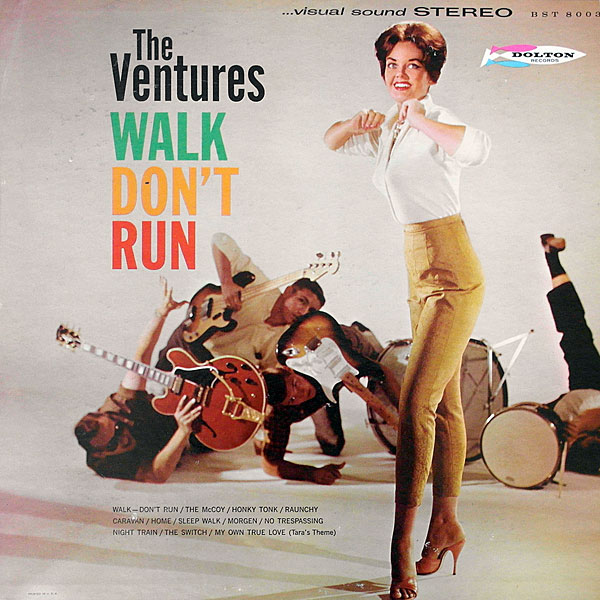 Within minutes I'd high-tailed it back to the pizzeria, snapped up the Ventures LP, and washed it in my Audiodesksysteme Gläss Vinyl Cleaner: I'm not overly fond of surf-era guitar instrumentals, so it seemed that I'd finally found a record of value that I could sell without the slightest regret. I decided I'd give some of the money to the library. Yeah, that's it: the library.
But I couldn't sell it without an honest description, so I warmed up the system and sat down for what I assumed would be a surfari of simpleminded instrumentals.
Technically, the recording was well above average, and although I doubt it would hold the attention of those who think that high-end audio is all about "reproducing the soundstage"—in this stereo recording, some instruments were panned hard left or hard right, in a manner not heard in the real world—the LP was punchy, present, clear, and colorful. Someone had cared: 56 years ago, a recording engineer (footnote 3) had tried to make this record sound good, and succeeded.
Care was also evident in the playing: Even the presence of Duke Ellington's "Caravan" can't lift the album's compositional average above the level of meh, but the musicianship is fine, and the band is tight without being faceless. I guess I'd expected the sort of uncommitted performances associated with studio hacks—West Coast studio hacks, at that—but it was clear from the first measures that the Ventures were, in fact, a band.
I walked out on the deck, where Janet was relaxing with a book and a drink. "I can't do it," I announced.
"Can't do what?"
"I can't sell that Ventures record" (footnote 4). Her expression betrayed equal amounts of surprise and mild annoyance, and I set about trying to dispel the latter: "It's actually a lot of fun. They were a great band. The recording is really good. There's a picture of an old Strat on the cover. We should put this on the next time the Newmans come over—Neal will love it. Holy shit, this is a great record!"
Janet gave me the same smile she smiled when I told her I thought I would have made a good psychiatrist: "I'm sure it is."
Within minutes I'd high-tailed it back to the pizzeria, snapped up the Ventures LP, and washed it in my Audiodesksysteme Gläss Vinyl Cleaner: I'm not overly fond of surf-era guitar instrumentals, so it seemed that I'd finally found a record of value that I could sell without the slightest regret. I decided I'd give some of the money to the library. Yeah, that's it: the library.
But I couldn't sell it without an honest description, so I warmed up the system and sat down for what I assumed would be a surfari of simpleminded instrumentals.
Technically, the recording was well above average, and although I doubt it would hold the attention of those who think that high-end audio is all about "reproducing the soundstage"—in this stereo recording, some instruments were panned hard left or hard right, in a manner not heard in the real world—the LP was punchy, present, clear, and colorful. Someone had cared: 56 years ago, a recording engineer (footnote 3) had tried to make this record sound good, and succeeded.
Care was also evident in the playing: Even the presence of Duke Ellington's "Caravan" can't lift the album's compositional average above the level of meh, but the musicianship is fine, and the band is tight without being faceless. I guess I'd expected the sort of uncommitted performances associated with studio hacks—West Coast studio hacks, at that—but it was clear from the first measures that the Ventures were, in fact, a band.
I walked out on the deck, where Janet was relaxing with a book and a drink. "I can't do it," I announced.
"Can't do what?"
"I can't sell that Ventures record" (footnote 4). Her expression betrayed equal amounts of surprise and mild annoyance, and I set about trying to dispel the latter: "It's actually a lot of fun. They were a great band. The recording is really good. There's a picture of an old Strat on the cover. We should put this on the next time the Newmans come over—Neal will love it. Holy shit, this is a great record!"
Janet gave me the same smile she smiled when I told her I thought I would have made a good psychiatrist: "I'm sure it is."
Footnote 2: But they started it! Footnote 3: That would be Joe Boles (1904–1962), an audiophile turned recording engineer who, beginning in the mid-1950s, became Seattle's first pop-music recordist of note. Footnote 4: We went ahead and made an appropriate donation to the library.
Of course, that was all before the World Wide Web: a communications sea change that brought with it the impression that audio assholery—bullying, haranguing, insulting, and the general acting-out of alpha-male fantasies under cover of anonymity by men who otherwise lead lives of loud desperation—had suddenly exploded in popularity. But that's all it was: an impression. Introducing the Internet to audiophilia was the same as introducing a contrast stain to a drop of pond water: It makes the microbes easier to see, but they were there all along. Yes, the Web makes it easier for bullies to attract toadies, and for one individual to pretend to be many. (I still smart at the memory of my introduction to AudioAsylum.com, where the sole retailer for an awful loudspeaker that had been harshly reviewed in Listener pretended to be two different people, apparently to increase his influence—a practice in which, remarkably, he persists to this day.) But since movable type also made possible the careers of Ayn Rand and Harold Robbins, I'm inclined to forgive and forget.
Every spring, usually around Memorial Day, our village library sponsors a book sale, and library patrons are encouraged to donate their own surplus books to the cause. This is the first year in memory that someone also donated a box of LPs—something I knew about only because my wife is on the library's board of directors, and because she and our daughter have been spending evenings sorting inventory in the shuttered pizzeria where the sale is held. On a quiet Sunday before the sale, when no one else was around, Janet slipped me the key to the pizzeria and quietly suggested that I go down and have a look before the sale. You know: just in case. I did so, and at first was disheartened. There were only a few dozen records, of which half were children's titles: early-1960s Disney singles and albums in ratty condition, Sesame Street LPs from the '70s, and so forth. Among the remainder were a few very common titles—Vaughn Meader's The First Family topped that list—but one LP caught my eye, if only because its jacket was in exceptionally good condition: the Ventures' Walk Don't Run (Dolton BST 8003). I left it where I found it, went home to look it up on Popsike.com, and discovered that good-condition copies of that album have sold at auction for nearly $200.
Within minutes I'd high-tailed it back to the pizzeria, snapped up the Ventures LP, and washed it in my Audiodesksysteme Gläss Vinyl Cleaner: I'm not overly fond of surf-era guitar instrumentals, so it seemed that I'd finally found a record of value that I could sell without the slightest regret. I decided I'd give some of the money to the library. Yeah, that's it: the library.
But I couldn't sell it without an honest description, so I warmed up the system and sat down for what I assumed would be a surfari of simpleminded instrumentals.
Technically, the recording was well above average, and although I doubt it would hold the attention of those who think that high-end audio is all about "reproducing the soundstage"—in this stereo recording, some instruments were panned hard left or hard right, in a manner not heard in the real world—the LP was punchy, present, clear, and colorful. Someone had cared: 56 years ago, a recording engineer (footnote 3) had tried to make this record sound good, and succeeded.
Footnote 2: But they started it! Footnote 3: That would be Joe Boles (1904–1962), an audiophile turned recording engineer who, beginning in the mid-1950s, became Seattle's first pop-music recordist of note. Footnote 4: We went ahead and made an appropriate donation to the library.















