

At the end of the day, I preferred the SPU #1S, but by a smaller margin than I might have expected: The SPU #1E still satisfied, and did so for a crazy-low price. Indeed, both of these new SPUs offer exceptional value for the money, and either would make an excellent starting point for the shopper who's curious about vintage gear. To anyone whose record player includes an easily adjusted tonearm that can be fitted with an SME-standard pickup head, these new Ortofons are very highly recommended.
Motor trends
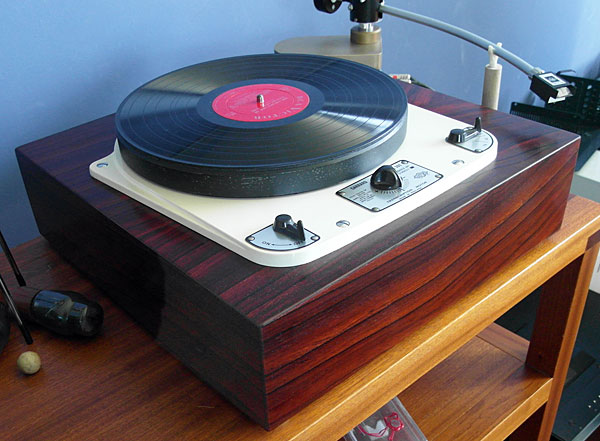
Before leaving the subject of quasi-vintage phonography: During the months when the Woodsong Audio plinth for the Garrard 301 was in for review, I took advantage of the downtime afforded my own, homemade plinth to complete the task of applying cocobolo veneer to it, selecting a synthetic oil finish recommended to me by Woodsong Audio's Chris Harban. It came out all right, although I don't suppose I would ever again work with cocobolo: The sanding dust it produces is a serious irritant—for which reason some luthiers refuse to even consider using cocobolo as a tonewood—and every surface in my workshop now seems covered with a brick-red film. As opera fans in Berlin used to say, blech. But in recent weeks a more serious problem raised its head: Occasionally but not consistently, when I switched on my Garrard 301, it responded by doing nothing at all. Giving the platter a little nudge, as one would with an underpowered player (pace Nottingham Analogue), did nothing to help. But removing the platter, physically spinning the motor pulley, then replacing the platter and switching the turntable back on usually did the trick. Weird.
 I consulted Dr. Google, who said too much to be useful. (Just as the Internet is wonderful for allowing everyone their say, with no one person assigned greater or lesser credibility than the next, so too is the Internet dismissible for allowing everyone their say, with no one person assigned greater or lesser credibility than the next.) Then I started calling friends whose experience is greater than mine—and received especially useful advice from Neal Newman, Jonathan Halpern of Tone Imports, and, again, Chris Harban of Woodsong Audio. Finally, the time came for me to visit the 2016 Capital Audiofest, where I received more advice from my friend and colleague Herb Reichert, Joe Roberts of Sound Practices fame, and Aldo D'Urso, who builds vintage-inspired playback gear for Deja Vu Audio, of McLean, Virginia, and Miami, Florida.
 In the weeks leading up to CAF, I'd tried everything that might possibly be germane. I added oil to the 301's idler-wheel bushings, and when that didn't work, I replaced the bushings with new ones from the British supplier Perfect Sound, a division of the Garrard specialty company Loricraft—and when that didn't work, I cleaned the edge of the idler wheel with solvent. (According to my Dr. Feickert Analogue PlatterSpeed software, that last trick actually improved the Garrard's already good speed stability, even if it didn't solve the problem at hand.) I sanded and reinstalled the power-switch contacts. I tried bypassing the switch's suppressor capacitor. And, of course, I attended to the most obvious culprit, opening up the motor and adding oil to its upper and lower bearings, which are made of sintered bronze. I did everything shy of a major motor-bearing rebuild, all without luck.
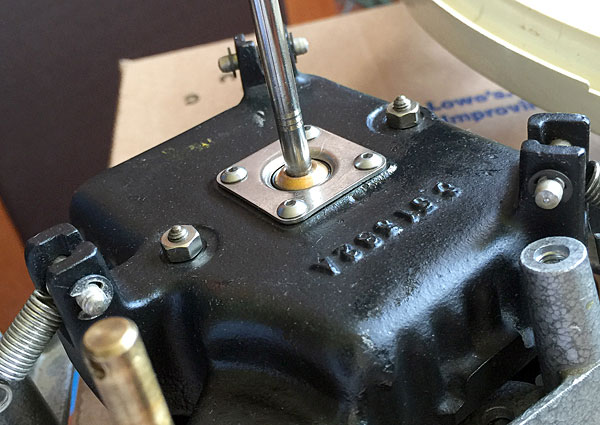
 I then had no alternative but to press ahead by removing and completely disassembling the motor, a chore that requires drilling out the rivets—four top, four bottom—that hold in place the bearing-retainer plates, then tapping those rivet holes to accept new, 0.25"-long 4-40 stainless-steel screws. I spent about $10 on a decent-quality 4-40 tap—and surprised myself with how easy it is to drill out a rivet, a skill also required for replacing the Garrard's idler-wheel bushings. My self-esteem went through the roof.
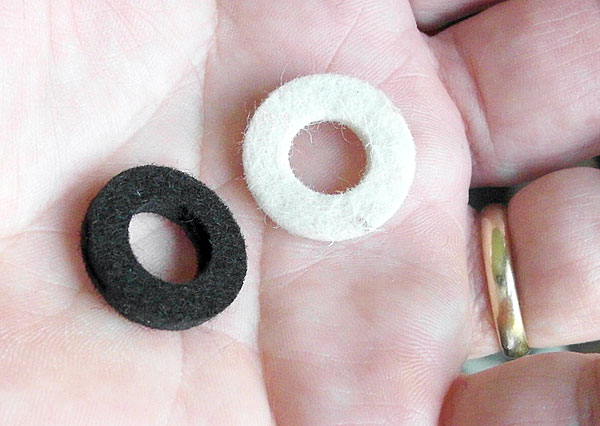
The motor now in pieces, I examined the felt washers adjacent to the upper and lower bearings. When new, these are saturated with oil and pressed, by means of circular leaf springs, against the porous bronze bearings, with the idea of keeping the bearings lubricated for at least a decade or so. These washers are white when new, but mine were black with a substance both gummy and flaky. Replacement washers are available from Perfect Sound, but a pair of them costs £8 ($10.50 at the time of writing), plus another £5.25 for shipping—and, with respect, previous experience with the company suggests that orders are seldom shipped right away, a situation made all the worse by the unpredictability of overseas mail. I wanted new washers right then and there, if only because I needed to put the motor back together while the memory of how it had come apart was still fresh in my mind. So I searched the Web and found, from an American wind-instrument supply house called J.L. Smith & Company, washers of nearly identical size, apparently intended for trombones and costing only 42õ each. I ordered enough to see me through the rest of my life.
I also noted that the bores of my motor's bronze bearings looked a little scratchy—one of them felt that way, too—so I ordered new bearings from the only company I'm aware of that offers such things: AudioSilente, of Rome, Italy—as opposed to Rome, New York, which is about one hour from my house. The bearings cost a little over $30/pair, were mailed out the day I placed my order, and appear to be of very high quality. The steel ball used as a thrust surface for the bottommost motor bearing had a single wear spot, visible under 40x magnification; since this ball remains immobile in use, I solved the problem by ensuring, during reassembly, that a fresh, unworn spot was presented to the bottom of the rotor shaft. The bottom of the shaft was dimpled, but I failed to find a local machinist equipped to lap it to the requisite mirror finish. Perhaps during my next rebuild . . .
I then had no alternative but to press ahead by removing and completely disassembling the motor, a chore that requires drilling out the rivets—four top, four bottom—that hold in place the bearing-retainer plates, then tapping those rivet holes to accept new, 0.25"-long 4-40 stainless-steel screws. I spent about $10 on a decent-quality 4-40 tap—and surprised myself with how easy it is to drill out a rivet, a skill also required for replacing the Garrard's idler-wheel bushings. My self-esteem went through the roof.
The motor now in pieces, I examined the felt washers adjacent to the upper and lower bearings. When new, these are saturated with oil and pressed, by means of circular leaf springs, against the porous bronze bearings, with the idea of keeping the bearings lubricated for at least a decade or so. These washers are white when new, but mine were black with a substance both gummy and flaky. Replacement washers are available from Perfect Sound, but a pair of them costs £8 ($10.50 at the time of writing), plus another £5.25 for shipping—and, with respect, previous experience with the company suggests that orders are seldom shipped right away, a situation made all the worse by the unpredictability of overseas mail. I wanted new washers right then and there, if only because I needed to put the motor back together while the memory of how it had come apart was still fresh in my mind. So I searched the Web and found, from an American wind-instrument supply house called J.L. Smith & Company, washers of nearly identical size, apparently intended for trombones and costing only 42õ each. I ordered enough to see me through the rest of my life.
I also noted that the bores of my motor's bronze bearings looked a little scratchy—one of them felt that way, too—so I ordered new bearings from the only company I'm aware of that offers such things: AudioSilente, of Rome, Italy—as opposed to Rome, New York, which is about one hour from my house. The bearings cost a little over $30/pair, were mailed out the day I placed my order, and appear to be of very high quality. The steel ball used as a thrust surface for the bottommost motor bearing had a single wear spot, visible under 40x magnification; since this ball remains immobile in use, I solved the problem by ensuring, during reassembly, that a fresh, unworn spot was presented to the bottom of the rotor shaft. The bottom of the shaft was dimpled, but I failed to find a local machinist equipped to lap it to the requisite mirror finish. Perhaps during my next rebuild . . .
 Finally, in the interests of meticulousness and martyrdom (see this column's first sentence), I removed the Bakelite cover from the motor's wiring block and remade every connection, in some instances exposing and tinning fresh wire. (I'd already used my digital multitester to confirm the integrity of the coils.) That was by far the most difficult task of this sad, sorry saga.
I reassembled the motor, reassembled the turntable, reassembled the player as a whole, and listened to some music. With the fourth or fifth record, when I flipped the Garrard 301's power-on switch, nothing happened. I was too sad even to curse.
That was just before I left for Capital Audiofest. On my second day there, while visiting one of Deja Vu Audio's rooms, I told my tale of woe to Aldo D'Urso, a sharp-minded thirtysomething whose passion for vintage audio runs deep. He considered for a moment, then asked: "When you reassembled the motor, how tight did you make the two bolts that hold the top half and bottom half of the case together?"
"Very tight," I proudly replied, holding out both fists, palms down, and making a twisting motion with one of them.
Aldo shook his head. "That is too tight. Make them finger-tight instead, maybe just a little more."
When I got home, I again removed the motor from my 301, disassembled its case, and loosened but did not remove the stainless-steel screws that now held in place the bearing retainers. I moved the rotor shaft this way and that, to make sure the bronze bearings were in perfect alignment, then retightened the bearing-retainer screws and reassembled the motor case. Finger tight, maybe just a little more.
That was two months ago. Every day since, my Garrard 301 has performed brilliantly. As supporting evidence, I offer fig.1, a screen grab from the Dr. Feickert Analogue PlatterSpeed software. It documents not just superb performance for a 60-year-old, idler-drive, grease-bearing turntable with its original, unresurfaced idler wheel. This is superb performance, period.
Finally, in the interests of meticulousness and martyrdom (see this column's first sentence), I removed the Bakelite cover from the motor's wiring block and remade every connection, in some instances exposing and tinning fresh wire. (I'd already used my digital multitester to confirm the integrity of the coils.) That was by far the most difficult task of this sad, sorry saga.
I reassembled the motor, reassembled the turntable, reassembled the player as a whole, and listened to some music. With the fourth or fifth record, when I flipped the Garrard 301's power-on switch, nothing happened. I was too sad even to curse.
That was just before I left for Capital Audiofest. On my second day there, while visiting one of Deja Vu Audio's rooms, I told my tale of woe to Aldo D'Urso, a sharp-minded thirtysomething whose passion for vintage audio runs deep. He considered for a moment, then asked: "When you reassembled the motor, how tight did you make the two bolts that hold the top half and bottom half of the case together?"
"Very tight," I proudly replied, holding out both fists, palms down, and making a twisting motion with one of them.
Aldo shook his head. "That is too tight. Make them finger-tight instead, maybe just a little more."
When I got home, I again removed the motor from my 301, disassembled its case, and loosened but did not remove the stainless-steel screws that now held in place the bearing retainers. I moved the rotor shaft this way and that, to make sure the bronze bearings were in perfect alignment, then retightened the bearing-retainer screws and reassembled the motor case. Finger tight, maybe just a little more.
That was two months ago. Every day since, my Garrard 301 has performed brilliantly. As supporting evidence, I offer fig.1, a screen grab from the Dr. Feickert Analogue PlatterSpeed software. It documents not just superb performance for a 60-year-old, idler-drive, grease-bearing turntable with its original, unresurfaced idler wheel. This is superb performance, period.

Before leaving the subject of quasi-vintage phonography: During the months when the Woodsong Audio plinth for the Garrard 301 was in for review, I took advantage of the downtime afforded my own, homemade plinth to complete the task of applying cocobolo veneer to it, selecting a synthetic oil finish recommended to me by Woodsong Audio's Chris Harban. It came out all right, although I don't suppose I would ever again work with cocobolo: The sanding dust it produces is a serious irritant—for which reason some luthiers refuse to even consider using cocobolo as a tonewood—and every surface in my workshop now seems covered with a brick-red film. As opera fans in Berlin used to say, blech. But in recent weeks a more serious problem raised its head: Occasionally but not consistently, when I switched on my Garrard 301, it responded by doing nothing at all. Giving the platter a little nudge, as one would with an underpowered player (pace Nottingham Analogue), did nothing to help. But removing the platter, physically spinning the motor pulley, then replacing the platter and switching the turntable back on usually did the trick. Weird.
I consulted Dr. Google, who said too much to be useful. (Just as the Internet is wonderful for allowing everyone their say, with no one person assigned greater or lesser credibility than the next, so too is the Internet dismissible for allowing everyone their say, with no one person assigned greater or lesser credibility than the next.) Then I started calling friends whose experience is greater than mine—and received especially useful advice from Neal Newman, Jonathan Halpern of Tone Imports, and, again, Chris Harban of Woodsong Audio. Finally, the time came for me to visit the 2016 Capital Audiofest, where I received more advice from my friend and colleague Herb Reichert, Joe Roberts of Sound Practices fame, and Aldo D'Urso, who builds vintage-inspired playback gear for Deja Vu Audio, of McLean, Virginia, and Miami, Florida.
In the weeks leading up to CAF, I'd tried everything that might possibly be germane. I added oil to the 301's idler-wheel bushings, and when that didn't work, I replaced the bushings with new ones from the British supplier Perfect Sound, a division of the Garrard specialty company Loricraft—and when that didn't work, I cleaned the edge of the idler wheel with solvent. (According to my Dr. Feickert Analogue PlatterSpeed software, that last trick actually improved the Garrard's already good speed stability, even if it didn't solve the problem at hand.) I sanded and reinstalled the power-switch contacts. I tried bypassing the switch's suppressor capacitor. And, of course, I attended to the most obvious culprit, opening up the motor and adding oil to its upper and lower bearings, which are made of sintered bronze. I did everything shy of a major motor-bearing rebuild, all without luck.
I then had no alternative but to press ahead by removing and completely disassembling the motor, a chore that requires drilling out the rivets—four top, four bottom—that hold in place the bearing-retainer plates, then tapping those rivet holes to accept new, 0.25"-long 4-40 stainless-steel screws. I spent about $10 on a decent-quality 4-40 tap—and surprised myself with how easy it is to drill out a rivet, a skill also required for replacing the Garrard's idler-wheel bushings. My self-esteem went through the roof.
Finally, in the interests of meticulousness and martyrdom (see this column's first sentence), I removed the Bakelite cover from the motor's wiring block and remade every connection, in some instances exposing and tinning fresh wire. (I'd already used my digital multitester to confirm the integrity of the coils.) That was by far the most difficult task of this sad, sorry saga.
Fig.1 AD's rebuilt Garrard 301, speed stability data.
Your takeaway: When servicing your Garrard 301 motor—or the shaded-pole, induction-type motor of any other turntable—triple-check your rotor-bearing alignment, be generous in oiling your bearing washers, don't overtorque the bolts when you reassemble the motor, and don't be afraid of drilling out and throwing away those stupid rivets.















