

Second, and in a more general sense, it increased my sense of wonder at the provenance of every record I've bought secondhand, many of which appear to have been cherished. And really: when you have in your possession an object that has been loved, how can you not wonder about the people who did the loving?
ah but gee!
In the years since buying those records that had once belonged to John Alan Hunt I've bought literally thousands more used LPs, and in doing so have made some other discoveries. The names of a few other collectors have appeared on multiple titles purchased in the same part of the world (though not always at the same store), and although I haven't found any more old obituaries, I've found clipped-out reviews of some albums tucked into their LP jackets by the original owners. A copy of what turned out to be a very early UK pressing of Paul McCartney's first solo album, McCartney, came with a contemporaneous article about its making, clipped from some British Sunday supplement. A copy of an album whose cover art was painted by Marc Chagall came with an autograph: Marc Chagall's. I even found a few very-well-cared-for classical LPs stamped with the name of a man who was the chief engineer at the radio station that hired me, fresh out of college, as a copywriter. More remarkable was the fact that I found those records a hundred miles away from the city where we both worked.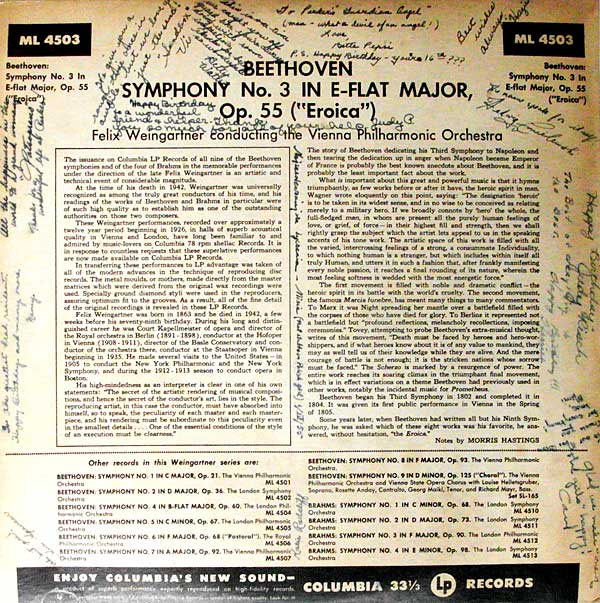 But none of my finds has been as distinctive, or as touching, as an LP I bought not long ago of Felix Weingartner and the Vienna Philharmonic's recording of Beethoven's Symphony 3, on Columbia. Apparently a birthday present to a woman from her coworkers, its sleeve was inscribed with no fewer than 15 greetings:
At the end of the day, as with so many things, it all comes down to a simple matter of what we like and what we don't like—and I'm thankful for the choices that are still open to me. At this time in my life, I still think of collecting LPs as akin to fly fishing with a Hardy reel and an elk-hair caddis fly I tied myself, howsoever badly. Downloading recordings, even rare recordings, is Mrs. Paul's. No offense intended: Mrs. Paul's has its place.
I still believe that a collection of music recordings, in whatever format, is a reasonable thing to have. Just as I believe it's no less reasonable for each of us to have, or at least attempt to have, a playback system that he or she thinks is good.
I don't believe that our hobby is destined to attract significant numbers of new adherents between now and the end of time. I believe that, as with pipe-smoking and fondue parties and Sammy Davis Jr., there existed a period during which hi-fi was almost universally regarded as cool. That time is now over, and is unlikely to return. I believe that to struggle against the quicksand of consumer indifference is to vanish sooner and more surely, and to make our bones more difficult to find.
I don't believe that we're fossils quite yet. I do believe that that's where we're headed, and that's okay with me. I would much rather we be a pile of interesting fossils than a big pile of nothing at all.
I believe that domestic hi-fi will go on for quite some time, if perhaps only in the sense that pipe-smoking and tweed suits and the tying of one's own trout flies and the reading of poetry for pleasure have gone on. In the culture at large, the enthusiasm for it that lives on in you and me has lost most of its potency—its jizz—and will reproduce only well enough to guarantee its scant survival, but will never again flourish. I don't believe there's anything we can do about that.
I believe that writing well about collecting records and assembling playback systems will continue to be a few of the things it is today. Most notably, it will go on being worthwhile and rare. The one thing it won't be is remunerative: Twenty years from now—maybe ten—I don't believe it will any longer be possible to write about domestic audio for a living. But I believe I'll have enough time to tidy up my résumé before the wolf is at the door.
In the years since buying those records that had once belonged to John Alan Hunt I've bought literally thousands more used LPs, and in doing so have made some other discoveries. The names of a few other collectors have appeared on multiple titles purchased in the same part of the world (though not always at the same store), and although I haven't found any more old obituaries, I've found clipped-out reviews of some albums tucked into their LP jackets by the original owners. A copy of what turned out to be a very early UK pressing of Paul McCartney's first solo album, McCartney, came with a contemporaneous article about its making, clipped from some British Sunday supplement. A copy of an album whose cover art was painted by Marc Chagall came with an autograph: Marc Chagall's. I even found a few very-well-cared-for classical LPs stamped with the name of a man who was the chief engineer at the radio station that hired me, fresh out of college, as a copywriter. More remarkable was the fact that I found those records a hundred miles away from the city where we both worked.
But none of my finds has been as distinctive, or as touching, as an LP I bought not long ago of Felix Weingartner and the Vienna Philharmonic's recording of Beethoven's Symphony 3, on Columbia. Apparently a birthday present to a woman from her coworkers, its sleeve was inscribed with no fewer than 15 greetings:
We give you a rough time once in awhile, but we love you just the same!—"Sandbox" Vi Happy Birthday to a wonderful friend and helper. Thank you so much for all your help.—Judy P. This is one time we caught you off guard like you're always doing with room inspections. Thanks for being so wonderful.—Betty WatersParker? Room inspections? Might these people have worked in Boston, at the famed Parker House Hotel? Curiosity got the better of me, and I poked around on the Internet but came up empty-handed. Likewise, the name John Alan Hunt didn't turn up much of anything. Just as well: Like tube amps, things imagined look nicer in the dark. Incidentally, that 62-year-old mono LP was in fine shape. Weingartner's interpretation was unsubtle but intense, the orchestra's playing overloaded with portamento (especially in the funeral march) and marked with the occasional clam. I loved every minute. Between the warsTo Parker's "Guardian Angel" (man—what a devil of an angel!) Love, Bette Pepsi. P.S. Happy Birthday—your 16th??? Best wishes always—"Hazie" The name speaks for itself!—Hedwig Imuilewski [The name might actually be Hedwig I. Muilewski, or perhaps something else; Hedwig's penmanship, though impressive, is opaque.—AD] Happy Birthday—Judy Risch The best of everything to the best. Happy Birthday!!!—Harriet To our Miss Bish—Thank you for everything! love, Mimi Glad we made "one of the girls" happy!—Carl Nojserolecruij zre zyczenia—Misie (that stubborn Polish Girl) I/IV/55 Katie Radcliff ah but gee!—Sue Spencer To the greatest head resident. Happy birthday and many more.—Nancy All the happiness in the world to a grand woman!—"Patsoprano" Thanks for a wonderful life at Parker!
At the end of the day, as with so many things, it all comes down to a simple matter of what we like and what we don't like—and I'm thankful for the choices that are still open to me. At this time in my life, I still think of collecting LPs as akin to fly fishing with a Hardy reel and an elk-hair caddis fly I tied myself, howsoever badly. Downloading recordings, even rare recordings, is Mrs. Paul's. No offense intended: Mrs. Paul's has its place.















