

And so we circle back to the question of the permanent storage of LPs. If my money holds out, I'll ask the man who built my present shelves—a cabinetmaker who's also made some fine loudspeaker enclosures—to build shelves for my next house. Of course, that will depend on how much cash I have left after down payments, property taxes in escrow, closing fees, and moving expenses. If my savings are devoured by the above and if time allows, I may have to go it on my own. Or I might turn to IKEA, whose Expedit line of shelving units—their "cubbies" are, intentionally or not, the perfect size for LPs—were for many years the favorites of record collectors throughout North America and Europe. When IKEA discontinued the Expedits, in 2014, the reaction online was on a par with what I imagine NBC TV heard in 1969, when they canceled Star Trek.
IKEA corrected that situation earlier this year with the announcement of their new Kallax series of shelving units, with nearly the same LP-friendly dimensions as the Expedits. In 2017, a Kallax unit comprising eight cubbies arranged in two rows of four each, and which can be installed horizontally or vertically (footnote 1), holds about 600 LPs and sells for $64.99 plus shipping. But hold on to your hat: Shipping one $64.99 Kallax to my part of upstate New York costs $349. Add that to the price of the product itself, and the sum is more or less what I'd pay a local tradesman to build me something as good, and in a better color than IKEA's white or black/brown or Birch Effect. And that's not to mention the Brooklyn-built record cabinets from Urbangreen Furniture, also mentioned in RB's August article. Urbangreen's two-shelf record cabinets start at just $239, with a really lovely five-shelf, 15-cubbie unit selling for $999 in premium finishes, including such high-caffeine choices as Cherry Mocha and Maple Espresso.
Of course, if you live near an IKEA store and have a big enough car, the prices of their $64.99 eight-cubbie unit and their very nice $199 25-cubbie unit—the latter holds over 1800 LPs—revert to just $64.99 and $199. Food for thought.
An imperfect storm
We don't review prototypes. There are two reasons for this Stereophile policy, the first being simple: a one-of-a kind product is a product no one can buy—and since there exist so many available products we'd like to review but can't, owing to limitations of space and time, we are extremely reluctant to devote our efforts and resources to those you can't get. What would be the point? "The point is," some might reply, "we like reading about interesting designs—especially if there's a chance they'll go into production." I do, too, but it brings me to the second reason for our policy, which is slightly more complex: When we write about a prototype, we unwittingly become unpaid publicists for the company that's made it. And if our review contains specific, addressable criticisms, then Stereophile becomes an unpaid consultant to that company. That's a leg up for one manufacturer over hundreds of others—and if that company thrives, then every time we review its subsequent products, our efforts will be suspect: Readers will wonder if we've laid a thumb on the scales in that manufacturer's favor (think: the DNC and Hillary Clinton)—and however pure our motivations, they'd have every right to think just that.
We're pretty good at policing this sort of thing, but once in a great while something slips through. So it was this past summer, when a pair of prototypes—of Burwell & Sons' horn-loaded Mother of Burl loudspeaker—wound up in the hands of reviewer Ken Micallef (footnote 2). It was a perfect storm of a reviewer's enthusiasm, a manufacturer's inexperience, and a publicist's eagerness to get his client's product into print (footnote 3). It was only after designer Gordon Burwell had installed the Mother of Burls in Ken's system that the penny dropped: because this product is not available in stores (footnote 4), and because the company has yet to sell even one, it is not yet a commercial product.
"The point is," some might reply, "we like reading about interesting designs—especially if there's a chance they'll go into production." I do, too, but it brings me to the second reason for our policy, which is slightly more complex: When we write about a prototype, we unwittingly become unpaid publicists for the company that's made it. And if our review contains specific, addressable criticisms, then Stereophile becomes an unpaid consultant to that company. That's a leg up for one manufacturer over hundreds of others—and if that company thrives, then every time we review its subsequent products, our efforts will be suspect: Readers will wonder if we've laid a thumb on the scales in that manufacturer's favor (think: the DNC and Hillary Clinton)—and however pure our motivations, they'd have every right to think just that.
We're pretty good at policing this sort of thing, but once in a great while something slips through. So it was this past summer, when a pair of prototypes—of Burwell & Sons' horn-loaded Mother of Burl loudspeaker—wound up in the hands of reviewer Ken Micallef (footnote 2). It was a perfect storm of a reviewer's enthusiasm, a manufacturer's inexperience, and a publicist's eagerness to get his client's product into print (footnote 3). It was only after designer Gordon Burwell had installed the Mother of Burls in Ken's system that the penny dropped: because this product is not available in stores (footnote 4), and because the company has yet to sell even one, it is not yet a commercial product.
 It is, however, a heavy product: Burwell & Sons publish no specs at all, let alone weight, but each Mother of Burl appears to weigh at least a couple hundred pounds. For that reason, and because Ken lives in a seventh-floor walk-up and had already invested considerable time and effort in the review by the time the speaker's disqualifying status of prototype came to light, we gave him the go-ahead to write and submit a brief review, which follows.
I spent a few hours in Ken's apartment, listening to the Mother of Burls for myself. They're based on Altec A-7 horn loudspeakers; Gordon Burwell even seeks out and fits vintage Altec compression drive-units to his own midrange horns, which makes his speakers . . . well, more or less right up my alley.
It is, however, a heavy product: Burwell & Sons publish no specs at all, let alone weight, but each Mother of Burl appears to weigh at least a couple hundred pounds. For that reason, and because Ken lives in a seventh-floor walk-up and had already invested considerable time and effort in the review by the time the speaker's disqualifying status of prototype came to light, we gave him the go-ahead to write and submit a brief review, which follows.
I spent a few hours in Ken's apartment, listening to the Mother of Burls for myself. They're based on Altec A-7 horn loudspeakers; Gordon Burwell even seeks out and fits vintage Altec compression drive-units to his own midrange horns, which makes his speakers . . . well, more or less right up my alley.
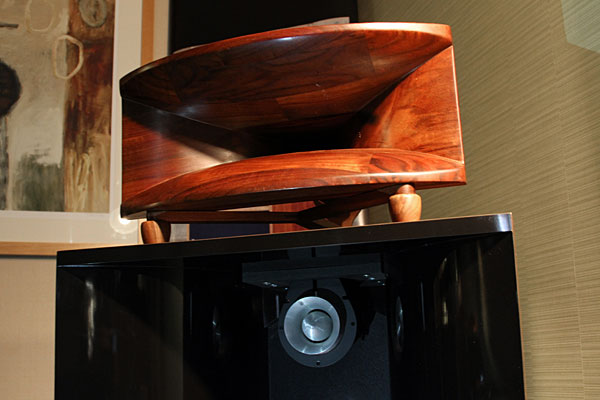
 During a previous visit, I'd listened to Ken's system, which then included DeVore Fidelity Orangutan O/93 speakers, and he and I both own samples of the same 20Wpc power amp (Shindo Laboratory's Haut-Brion), so it wasn't difficult for me to get a handle on the Burwells' contribution to his system's sound. That sound was now a strong, rich reminder of many of the things I love about horn speakers. With "She's Leaving Home," from the new reissue of the Beatles' Sgt. Pepper's Lonely Hearts Club Band (LP, Parlophone PCS 7027), Paul McCartney's lead vocal was lifelike and present: The Burwells drew my attention right to it. Attack components of notes in that vocal and the strings were crisply good, contributing to a believable sense of musical timing. The downside was a bit too much crispness in some sounds—for example, the snare-drum roll early in the next number, "Being for the Benefit of Mr. Kite"—and while notes in the upper bass were taut enough, the timing of lower bass notes was indistinct. And, yes, I blamed the separately enclosed powered subwoofers that Burwell uses to supplement the Mother of Burls' own horn-loaded woofers. (The other drivers are a JBL 075 tweeter and a beautifully laminated carved wooden midrange-treble horn, which sits atop the bass cabinet and is driven by the compression driver, an Altec 802D.)
 And so it went. In "Midnight Sun," from Ella Fitzgerald's Like Someone in Love (LP, Verve MG VS-6000), Ella was Ella—and Stan Getz's tenor sax was Stan Getz's tenor sax: rich and beautifully textured. In "Remember," from a reissue of tenor saxophonist Hank Mobley's Soul Station (LP, Blue Note/Music Matters 84031), Mobley's tone was, again, brilliant, with a fantastic leaning-into-it momentum in his lines. Art Blakey's drums, likewise, sounded propulsive if a little too crisp, and Paul Chambers's double bass, though better served than McCartney's electric bass on the Beatles album, was a little rubbery, timing-wise. Still . . . the sax! On this record, the Burwells could have been mistaken for 50-gallon barrels of tone.
For the next Mobley number, "This I Dig of You," Ken turned off the subwoofers. A minute later, I noticed that my foot was tapping—finally. The sound of Chambers's bass, though now diminished in level, had snap, and his lines moved. And now the Burwells reproduced percussion the way the best horns do: with real impact. The sounds of a high-tuned tom on Black Orchid, by Gene Harris's group The 3 Sounds (LP, Blue Note ST-84155), were downright thrilling. And on the Johnny Smith Foursome's Volume II (LP, Royal Roost RLP-2228), Smith's guitar in "Laura" was insanely lifelike, the Burwells putting across every nuance of the feel of Smith's plectrum on strings.
And so it went. In "Midnight Sun," from Ella Fitzgerald's Like Someone in Love (LP, Verve MG VS-6000), Ella was Ella—and Stan Getz's tenor sax was Stan Getz's tenor sax: rich and beautifully textured. In "Remember," from a reissue of tenor saxophonist Hank Mobley's Soul Station (LP, Blue Note/Music Matters 84031), Mobley's tone was, again, brilliant, with a fantastic leaning-into-it momentum in his lines. Art Blakey's drums, likewise, sounded propulsive if a little too crisp, and Paul Chambers's double bass, though better served than McCartney's electric bass on the Beatles album, was a little rubbery, timing-wise. Still . . . the sax! On this record, the Burwells could have been mistaken for 50-gallon barrels of tone.
For the next Mobley number, "This I Dig of You," Ken turned off the subwoofers. A minute later, I noticed that my foot was tapping—finally. The sound of Chambers's bass, though now diminished in level, had snap, and his lines moved. And now the Burwells reproduced percussion the way the best horns do: with real impact. The sounds of a high-tuned tom on Black Orchid, by Gene Harris's group The 3 Sounds (LP, Blue Note ST-84155), were downright thrilling. And on the Johnny Smith Foursome's Volume II (LP, Royal Roost RLP-2228), Smith's guitar in "Laura" was insanely lifelike, the Burwells putting across every nuance of the feel of Smith's plectrum on strings.
 Even after just a couple of hours, it was evident that the Burwell Mother of Burls have a great deal of promise. Do they have $97,000/pair worth of promise? Well, I could do without the subwoofer, so there's a $9500 savings right there . . . and even so, I came away from the Burwell experience thinking that my 51-year-old Altec Flamencos do everything I heard from the Burwells and more—more coherence from top to bottom, and even tauter, snappier bass—for a lot less. But it's worth bearing in mind that, in my room, I listen to the Altecs from a considerably greater distance than the one between us and the Burwells—and with horns, up to a point, the greater the distance, the more the sound can jell and cohere.
That said, it's a pretty safe bet: In my next listening room, something as large and bone-crunchingly heavy as the Burwell & Sons Mother of Burl simply won't fit. Color me off the hook.
Even after just a couple of hours, it was evident that the Burwell Mother of Burls have a great deal of promise. Do they have $97,000/pair worth of promise? Well, I could do without the subwoofer, so there's a $9500 savings right there . . . and even so, I came away from the Burwell experience thinking that my 51-year-old Altec Flamencos do everything I heard from the Burwells and more—more coherence from top to bottom, and even tauter, snappier bass—for a lot less. But it's worth bearing in mind that, in my room, I listen to the Altecs from a considerably greater distance than the one between us and the Burwells—and with horns, up to a point, the greater the distance, the more the sound can jell and cohere.
That said, it's a pretty safe bet: In my next listening room, something as large and bone-crunchingly heavy as the Burwell & Sons Mother of Burl simply won't fit. Color me off the hook.
Footnote 1: When the Kallax is set upright on one end, its top must be anchored to the wall behind it, to avoid tipping—which can be hazardous in homes with young children. Footnote 2: Burwell & Sons Loudspeakers. Tel: (650) 532-5046. Web: www.burwellspeakers.com. Footnote 3: We also don't publish full reviews of one-off or bespoke products, though our regular columnists are allowed freer rein in this regard. You can find our review policies here.—John Atkinson
Footnote 4: For products that are sold through conventional retail distribution, we require for a full review that the product be available from at least five US dealers. For products that the manufacturer sells direct, the criteria for qualifying for full review coverage are more fluid, but we still have to be convinced that the company is established. (In this respect, I admit to not performing sufficient due diligence when I agreed to what was originally intended to be a full review of the Burwell speaker.) For more on this subject, click here.—John Atkinson
We don't review prototypes. There are two reasons for this Stereophile policy, the first being simple: a one-of-a kind product is a product no one can buy—and since there exist so many available products we'd like to review but can't, owing to limitations of space and time, we are extremely reluctant to devote our efforts and resources to those you can't get. What would be the point?
"The point is," some might reply, "we like reading about interesting designs—especially if there's a chance they'll go into production." I do, too, but it brings me to the second reason for our policy, which is slightly more complex: When we write about a prototype, we unwittingly become unpaid publicists for the company that's made it. And if our review contains specific, addressable criticisms, then Stereophile becomes an unpaid consultant to that company. That's a leg up for one manufacturer over hundreds of others—and if that company thrives, then every time we review its subsequent products, our efforts will be suspect: Readers will wonder if we've laid a thumb on the scales in that manufacturer's favor (think: the DNC and Hillary Clinton)—and however pure our motivations, they'd have every right to think just that.
We're pretty good at policing this sort of thing, but once in a great while something slips through. So it was this past summer, when a pair of prototypes—of Burwell & Sons' horn-loaded Mother of Burl loudspeaker—wound up in the hands of reviewer Ken Micallef (footnote 2). It was a perfect storm of a reviewer's enthusiasm, a manufacturer's inexperience, and a publicist's eagerness to get his client's product into print (footnote 3). It was only after designer Gordon Burwell had installed the Mother of Burls in Ken's system that the penny dropped: because this product is not available in stores (footnote 4), and because the company has yet to sell even one, it is not yet a commercial product.
It is, however, a heavy product: Burwell & Sons publish no specs at all, let alone weight, but each Mother of Burl appears to weigh at least a couple hundred pounds. For that reason, and because Ken lives in a seventh-floor walk-up and had already invested considerable time and effort in the review by the time the speaker's disqualifying status of prototype came to light, we gave him the go-ahead to write and submit a brief review, which follows.
I spent a few hours in Ken's apartment, listening to the Mother of Burls for myself. They're based on Altec A-7 horn loudspeakers; Gordon Burwell even seeks out and fits vintage Altec compression drive-units to his own midrange horns, which makes his speakers . . . well, more or less right up my alley.
During a previous visit, I'd listened to Ken's system, which then included DeVore Fidelity Orangutan O/93 speakers, and he and I both own samples of the same 20Wpc power amp (Shindo Laboratory's Haut-Brion), so it wasn't difficult for me to get a handle on the Burwells' contribution to his system's sound. That sound was now a strong, rich reminder of many of the things I love about horn speakers. With "She's Leaving Home," from the new reissue of the Beatles' Sgt. Pepper's Lonely Hearts Club Band (LP, Parlophone PCS 7027), Paul McCartney's lead vocal was lifelike and present: The Burwells drew my attention right to it. Attack components of notes in that vocal and the strings were crisply good, contributing to a believable sense of musical timing. The downside was a bit too much crispness in some sounds—for example, the snare-drum roll early in the next number, "Being for the Benefit of Mr. Kite"—and while notes in the upper bass were taut enough, the timing of lower bass notes was indistinct. And, yes, I blamed the separately enclosed powered subwoofers that Burwell uses to supplement the Mother of Burls' own horn-loaded woofers. (The other drivers are a JBL 075 tweeter and a beautifully laminated carved wooden midrange-treble horn, which sits atop the bass cabinet and is driven by the compression driver, an Altec 802D.)
And so it went. In "Midnight Sun," from Ella Fitzgerald's Like Someone in Love (LP, Verve MG VS-6000), Ella was Ella—and Stan Getz's tenor sax was Stan Getz's tenor sax: rich and beautifully textured. In "Remember," from a reissue of tenor saxophonist Hank Mobley's Soul Station (LP, Blue Note/Music Matters 84031), Mobley's tone was, again, brilliant, with a fantastic leaning-into-it momentum in his lines. Art Blakey's drums, likewise, sounded propulsive if a little too crisp, and Paul Chambers's double bass, though better served than McCartney's electric bass on the Beatles album, was a little rubbery, timing-wise. Still . . . the sax! On this record, the Burwells could have been mistaken for 50-gallon barrels of tone.
For the next Mobley number, "This I Dig of You," Ken turned off the subwoofers. A minute later, I noticed that my foot was tapping—finally. The sound of Chambers's bass, though now diminished in level, had snap, and his lines moved. And now the Burwells reproduced percussion the way the best horns do: with real impact. The sounds of a high-tuned tom on Black Orchid, by Gene Harris's group The 3 Sounds (LP, Blue Note ST-84155), were downright thrilling. And on the Johnny Smith Foursome's Volume II (LP, Royal Roost RLP-2228), Smith's guitar in "Laura" was insanely lifelike, the Burwells putting across every nuance of the feel of Smith's plectrum on strings.
Even after just a couple of hours, it was evident that the Burwell Mother of Burls have a great deal of promise. Do they have $97,000/pair worth of promise? Well, I could do without the subwoofer, so there's a $9500 savings right there . . . and even so, I came away from the Burwell experience thinking that my 51-year-old Altec Flamencos do everything I heard from the Burwells and more—more coherence from top to bottom, and even tauter, snappier bass—for a lot less. But it's worth bearing in mind that, in my room, I listen to the Altecs from a considerably greater distance than the one between us and the Burwells—and with horns, up to a point, the greater the distance, the more the sound can jell and cohere.
Footnote 1: When the Kallax is set upright on one end, its top must be anchored to the wall behind it, to avoid tipping—which can be hazardous in homes with young children. Footnote 2: Burwell & Sons Loudspeakers. Tel: (650) 532-5046. Web: www.burwellspeakers.com. Footnote 3: We also don't publish full reviews of one-off or bespoke products, though our regular columnists are allowed freer rein in this regard. You can find our review policies here.—John Atkinson















