

Once again, the reviewing assembly line shut down (and I rushed into production a different November-issue "Listening" column, about coffee). I contacted the head of Swissonor, Urs Frei, who agreed that something was amiss. His wife, Anne-Marie, mailed out a different sample the next day.
When this second sample arrived, I noted that its container—which arrived in perfect shape—was marked TA10 2.09. Only then did I take a closer look at the first box, which I now saw was marked TA10 2.06. The two arms looked outwardly identical.
But they weren't. The vertical bearings were definitely better in the second sample. Still, when I floated the armtube of the new sample, though it wasn't egregiously sticky, it was a teensy bit slow in returning to its zero-downforce position. Given my hope that the TA10 would prove to be, in essence, a vintage tonearm with modern, ultra-high-quality bearings—my own hope, not Swissonor's claim—I was slightly disappointed. Nonetheless, I pressed on.
I was glad I did: The first few records I listened to with the second sample sounded magical—a word I don't use lightly, and meant to suggest that the TA10's three greatest sonic strengths were among those aspects of playback most important to me. To wit:
1) Spatially, with mono and stereo records alike, the Swissonor TA10 brought forward things that needed to be brought forward—voices, instrumental solos, and the like. Not only did it bring those elements forward, the Swissonor arm seemed to enhance their presence in ways that weren't entirely spatial: there was a little extra kick to the attack components of notes from Tim O'Brien's fiddle in "Durham Reel," and in banjoist Pete Wernick's kickoff to "Midnight on the Highway," both from Hot Rize's first, eponymous album (Flying Fish FF206).
2) Trebles were meaty and substantial, not phasey and excessively, unrealistically airy. Flutes and violins in Lorin Maazel and the Vienna Philharmonic's recording of Sibelius's Symphony 7 (Decca SXL 6236) really dug into every note—never in a harsh or screechy way, but with a great deal of human physicality.
3) Musical lines had momentum and drive. To illustrate this I could name almost any record I played with the Swissonor arm, but "Gloria's Step," from the remarkable new reissue, on a MoFi Ultradisc one-step pressing, of the Bill Evans Trio's Sunday at the Village Vanguard (Riverside/Mobile Fidelity Sound Lab UD1S 2-002), deserves special mention. It's always instructive to hear how a piano recording can come alive through gear that doesn't blunt or distort the music's forward momentum, and I can think of no better example than this.
On top of all that, this arm sounded huge. (Okay, so that's four.) Ruggiero Ricci's solo violin in the Sibelius Violin Concerto, with Matthias Kuntzsch leading the Bochum Symphony Orchestra (Turnabout QTV 34722), had the sort of scale I associate with hearing the performance from a front-row seat: The instrument was almost breathtakingly resonant, present—and big. And the sheer orchestral expanse, for lack of a better word, on the above-mentioned Sibelius Seventh (August was Sibelius month around here) was astonishingly wide, high, and deep.
The Swissonor TA10 delighted me with every record I played—and not once during its time in my system did I hear any of the sorts of distortion associated with a misbehaving tonearm.
 It never lost its Lustre
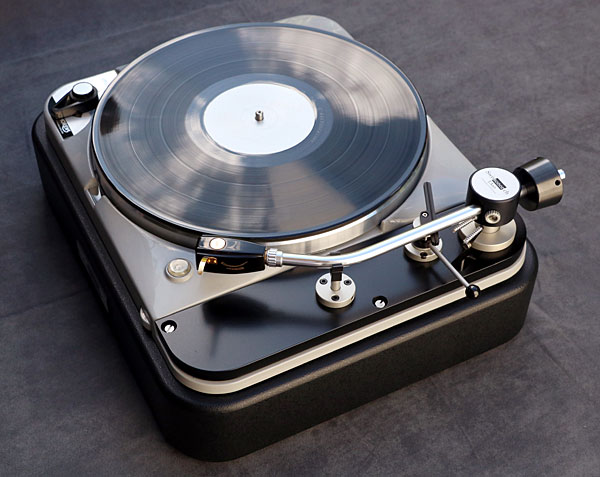
Let's back up for a moment and return to the topic of installation—a small matter, inasmuch as Swissonor does most of the work for the TD 124 owner, but also a large matter, in that the user still has some control over the minutiae of installing and aligning a cartridge. The TA10 is supplied with a detachable headshell of the usual sort that appears to be an off-the-shelf OEM item, the likes of which are supplied with any number of arms from other manufacturers. Most photos on Swissonor's website and elsewhere online show TA10s being used with an Ortofon G-style SPU pickup head—the longer of the two SPU varieties, and far more common today than the shorter, A-style SPU. While I won't reopen here the whole snoozy subject of variations in stylus-to-mounting-flange dimensions, I must mention that a number of sources have, over the years, stated that those measurements should read 50mm for a G-style SPU, and 32mm for an A-style. My own measurements suggest that that is incorrect, and that the actual dimensions are 52mm for G-style and 30mm for A-style. I have found some G-styles with stylus-to-flange dimensions of as little as 51.5 and as great as 52.5mm; that said, I admit that I ceased making those measurements a while back, if only because I was starting to bore myself. There are two points to this little side trip: First, as noted in their instructions, Swissonor has apparently made the same observations as I, and has designed the TA10's geometry for a pickup head with a stylus-to-flange dimension of 52.5mm—which, of course, I think is very wise. Second, also as mentioned in Swissonor's instructions, the arm-mount hole in the TA10's armboard is very slightly oversized, thus making it possible for the user to loosen the main mounting nut (the appropriate wrench is included) and fine-tune the arm's spindle-to-pivot distance and thus precise cartridge alignment.
Other adjustments are possible. Antiskating force, though uncalibrated, can be fine-tuned by moving a weighted thread to any of 10 ridges along the rod that supports it, with positions closer to the bearing housing resulting in lesser degrees of anti-skating force. By loosening and then retightening two setscrews on the arm pillar's mounting collet, the TA10's armtube can be raised or lowered relative to the armboard, thus offering the chance to fine-tune the vertical tracking angle (VTA). But the TA10 and the headshell supplied with it lack any means of adjusting cartridge azimuth. That, too, disappointed me, as the azimuth of my second sample was notably off: Viewed head-on, every pickup head and headshell I connected to the TA10 was tilted counterclockwise, to 11:59 instead of 12:00.
Noticing two tiny setscrews on the underside of the TA10's armtube, just behind the headshell-locking collet, I wrote to Urs Frei and asked if the arm could be adjusted for azimuth. He replied that it could not, and that "SPUs with azimuth assembly error cannot be compensated." Then he added the following:
"Philosophically spoken, you can get two kinds of listening experience: A) You are a high-ender. You fear all these and many more imperfections in sound reproduction. You finally will listen with high concentration to find out any kind of issue. It will crisp you . . . You will become a frustrated, paranoiac, high-ender. High-end hell. B) You love life and music. You enjoy listening to Sinatra singing in your home . . . You will become a happy man. Music heaven."
It's pretty much the same argument used by that Rega salesman of 35 years ago. This is not to equate Swissonor with the dealership that pulled a fast one on me, but I would point out to Urs Frei that there exists a third category of record lover: C) You are a music lover, not a frustrated paranoiac, but you nevertheless chafe at paying healthy prices for products with avoidable defects.
Forced compliance
While looking for an explanation for that azimuth anomaly, and before concluding that it was the fault of the TA10 tonearm itself, I took a long, squinty look at the Swissonor armboard and wondered: Could those rubber grommets be tilting the board relative to the turntable, and thus be causing the error? Because that seemed possible, and because I wanted to try the Swissonor gear without those grommets anyway, I decided to uninstall tonearm and armboard, remove the grommets, then reinstall arm and board—carefully, with all due care taken in the even tightening of the three armboard bolts. Before doing so, I settled in with a great new LP: a reissue of Michel Legrand's Legrand Jazz (Columbia/Impex CS 8079), featuring Miles Davis, John Coltrane, Paul Chambers, and 28 other jazz giants. As I wrote to Michael Fremer the evening after first hearing this very impressive record, "Holy shit!" (I can say those sorts of things to Mikey. He doesn't get offended.) "Vivid, tactile, colorful, and surfaces so quiet that the loudness of the opening notes was shocking. One of the most technically accomplished reissues I have heard." He wrote back saying that he agreed.
This is when I removed the grommets from the armboard. Then I listened again to "Wild Man Blues," from the Legrand album. It was good—but not as magical as when the grommets were fitted. Eddie Costa's vibraphone no longer popped out of the mix as before, Paul Chambers's bass was a bit anemic, and Herbie Mann's flute wasn't as meaty. (You there, in the back of the classroom—stop sniggering!)
I reinstalled the grommets—not as easy as taking them out. Every little bit of the lost magic returned. And the performance was no less tuneful, nor was it lacking in anything else. The sound was incontrovertibly better when armboard and arm were compliantly—some would say loosely—mounted.
Finally: All of the above observations were made with my mostly original TD 124, which I rebuilt perhaps 11 years ago, cleaning and lubricating as I went and replacing worn parts with new and NOS parts from Schopper AG. This turntable departs from stock in only one regard: I retrofitted its motor-mount bracket with the superior double-grommet isolation kit that Thorens introduced in 1966, in the TD 124 Mk.II.
But in correspondence after shipping me TA10 sample two, Urs Frei asked if I'd tried the arm with 1) his company's new #2.0 main platter bearing, which, along with TA10 sample one, had been sent to me by Swissonor's US distributor, Fidelis Music Systems; and with 2) Swissonor's nonmagnetic replacement platter, one of which I long ago purchased from Schopper AG but until recently had been mounted on my daughter's TD 124.
I look forward to trying the new Swissonor bearing, in which elements originally made of polymer are replaced with parts precision-machined from bronze, but I haven't yet had time to install it—something I intend to do in the latter half of September, when I've settled in to my new listening room. But after my daughter returned to college, I swapped my turntable's iron platter for her Swissonor platter. After readjusting the tracking force—all else being equal, one observes a decrease in downforce with the nonmagnetic platter, owing to the decrease in magnetic attraction—I listened again to some of the tracks described above. The differences were slight—slighter, by far, than when I compared the TA10 armboard with and without grommets. But with the Swissonor platter I heard better definition: note attacks, and thus playing and singing techniques, seemed clearer; and with double bass in particular, there was greater clarity of pitch.
Of course, even if a TD 124 equipped with a nonmagnetic platter sounded the same as one equipped with an original, iron platter, there are those who would consider the Swissonor alternative worth every penny, simply for offering freedom from worry that one's phono signal is being modulated or compressed or otherwise dicked with by the proximity of a large, magnetically friendly thing under the cartridge. I don't disagree. I guess paranoiac high-enders aren't the only ones who worry, after all.
If you own a Thorens TD 124 and are looking for a vintage-friendly tonearm whose sound will complement rather than counter your turntable's best characteristics—and one that looks the part, and is pleasant to use—I think the Swissonor TA10 is an excellent choice. I'm not too put off by the azimuth discrepancies—there's plenty of evidence that this company has some serious engineering cred, and they've made a name for themselves by serving a small but passionate vintage-audio niche. But buy it through a dealer you trust and that offers a liberal returns policy, just in case.
It never lost its LustreLet's back up for a moment and return to the topic of installation—a small matter, inasmuch as Swissonor does most of the work for the TD 124 owner, but also a large matter, in that the user still has some control over the minutiae of installing and aligning a cartridge. The TA10 is supplied with a detachable headshell of the usual sort that appears to be an off-the-shelf OEM item, the likes of which are supplied with any number of arms from other manufacturers. Most photos on Swissonor's website and elsewhere online show TA10s being used with an Ortofon G-style SPU pickup head—the longer of the two SPU varieties, and far more common today than the shorter, A-style SPU. While I won't reopen here the whole snoozy subject of variations in stylus-to-mounting-flange dimensions, I must mention that a number of sources have, over the years, stated that those measurements should read 50mm for a G-style SPU, and 32mm for an A-style. My own measurements suggest that that is incorrect, and that the actual dimensions are 52mm for G-style and 30mm for A-style. I have found some G-styles with stylus-to-flange dimensions of as little as 51.5 and as great as 52.5mm; that said, I admit that I ceased making those measurements a while back, if only because I was starting to bore myself. There are two points to this little side trip: First, as noted in their instructions, Swissonor has apparently made the same observations as I, and has designed the TA10's geometry for a pickup head with a stylus-to-flange dimension of 52.5mm—which, of course, I think is very wise. Second, also as mentioned in Swissonor's instructions, the arm-mount hole in the TA10's armboard is very slightly oversized, thus making it possible for the user to loosen the main mounting nut (the appropriate wrench is included) and fine-tune the arm's spindle-to-pivot distance and thus precise cartridge alignment.
While looking for an explanation for that azimuth anomaly, and before concluding that it was the fault of the TA10 tonearm itself, I took a long, squinty look at the Swissonor armboard and wondered: Could those rubber grommets be tilting the board relative to the turntable, and thus be causing the error? Because that seemed possible, and because I wanted to try the Swissonor gear without those grommets anyway, I decided to uninstall tonearm and armboard, remove the grommets, then reinstall arm and board—carefully, with all due care taken in the even tightening of the three armboard bolts. Before doing so, I settled in with a great new LP: a reissue of Michel Legrand's Legrand Jazz (Columbia/Impex CS 8079), featuring Miles Davis, John Coltrane, Paul Chambers, and 28 other jazz giants. As I wrote to Michael Fremer the evening after first hearing this very impressive record, "Holy shit!" (I can say those sorts of things to Mikey. He doesn't get offended.) "Vivid, tactile, colorful, and surfaces so quiet that the loudness of the opening notes was shocking. One of the most technically accomplished reissues I have heard." He wrote back saying that he agreed.















