

My house is 35 minutes from the Arkell Museum of Canajoharie, New York, home to key works by Winslow Homer, Andrew Wyeth, Georgia O'Keeffe, John Singer Sargent, and William Merritt Chase. The Arkell also contains a favorite of mine: The Rainbow, by the New York State landscape artist George Inness. In that 1878 painting (footnote 1), one sees a few cows being driven along a hillside path, while a steepled village sleeps in the background. The quality of light that Inness captured or created in The Rainbow is enchanting: It brings more depth, complexity, and sheer autumnal longing to the scene than one usually associates with pictures of livestock.
 My home is one minute from Glensfoot Farm, employer of a small crew of farmhands and home to several dozen nice-looking cattle. Glensfoot Farm is itself one minute from the center of Cherry Valley, where at least one 19th-century church still stands, steeple and all. My house has two decks and six windows that afford a grand view of all that.
I love the Arkell's collection of American art, and I love looking out my window at the farm and the village below. The two experiences persist in having little to do with one another.
An artist, I suppose, is one of a few who are blessed with the ability to change the perspective of the many, if only for an instant, in much the same way that a good story compels us to consider the effects of things that never happened. We need only enter a space where a work of art is on display and open our eyes: Inspiration, enlightenment, and entertainment are virtually guaranteed. Even if some galleries and museums are better or worse than others.
How to distinguish between good spaces and bad? Comfort matters, as do convenience and freedom from distraction. But, as I learned during the years when I worked for the lamp designer and industrialist Edison Price, who was once described as having illuminated more great art than anyone else in modern times, it's a simple matter of good lighting. To fully appreciate a work of art in the manner intended by its creator does not require precisely the same quality of light as shone on Inness's cows when he painted them in the first place—that sort of nutty, quixotic literalism seems limited to a subset of my own profession—but rather that the light simply be abundant, clear, and steady.
The zeros in the stream
My home is one minute from Glensfoot Farm, employer of a small crew of farmhands and home to several dozen nice-looking cattle. Glensfoot Farm is itself one minute from the center of Cherry Valley, where at least one 19th-century church still stands, steeple and all. My house has two decks and six windows that afford a grand view of all that.
I love the Arkell's collection of American art, and I love looking out my window at the farm and the village below. The two experiences persist in having little to do with one another.
An artist, I suppose, is one of a few who are blessed with the ability to change the perspective of the many, if only for an instant, in much the same way that a good story compels us to consider the effects of things that never happened. We need only enter a space where a work of art is on display and open our eyes: Inspiration, enlightenment, and entertainment are virtually guaranteed. Even if some galleries and museums are better or worse than others.
How to distinguish between good spaces and bad? Comfort matters, as do convenience and freedom from distraction. But, as I learned during the years when I worked for the lamp designer and industrialist Edison Price, who was once described as having illuminated more great art than anyone else in modern times, it's a simple matter of good lighting. To fully appreciate a work of art in the manner intended by its creator does not require precisely the same quality of light as shone on Inness's cows when he painted them in the first place—that sort of nutty, quixotic literalism seems limited to a subset of my own profession—but rather that the light simply be abundant, clear, and steady.
The zeros in the stream
When you play recorded music, you have before you a work of art with almost no physical existence at all; reconstituting it requires electricity, which will itself imitate the musical continuum represented by the bumps in the groove or the zeros in the datastream. When you listen to recorded music, you are listening to your household AC, and better AC equals better playback. That sounds obvious to me and you, even as it sends the technocodgers into paroxysms of puritanical indignation.
Goodness in AC is not unlike goodness in light: It must be abundant, clear, and steady. Improving or at least maintaining that quality is something that can be accomplished in a variety of ways. Strictures or gaps in power's path can be corrected with surer connections and more consistent conductors. Filters can be introduced, to prevent or correct deviations in voltage or frequency. (The metal-oxide varistor, or MOV, which sacrifices itself by stepping into the path of destructive voltage spikes, occupies an interesting subset of the filter group; the isolation transformer, wherein AC on the primary conjures within the secondary its identical twin, albeit without distortive harmonics—Brundle without The Fly—has another subset virtually to itself.) Most extremely of all, AC can be regenerated altogether, on the spot.
As audio reviewers go, I've remained less current than most with products that promise better AC, having sampled relatively few such things: PS Audio outlets made a teensy improvement in my system's sound, but their lack of mechanical durability disappointed. Power cords from JPS Labs have made startling improvements—small improvements, but startling in that they should exist at all—especially their expensive Aluminata line, although their much cheaper Digital AC cords remain a genuinely good value. A recent test of Nordost's decidedly holistic approach to cabling (see "Listening," December 2009), including some of their own exotic power cords, proved rewarding.
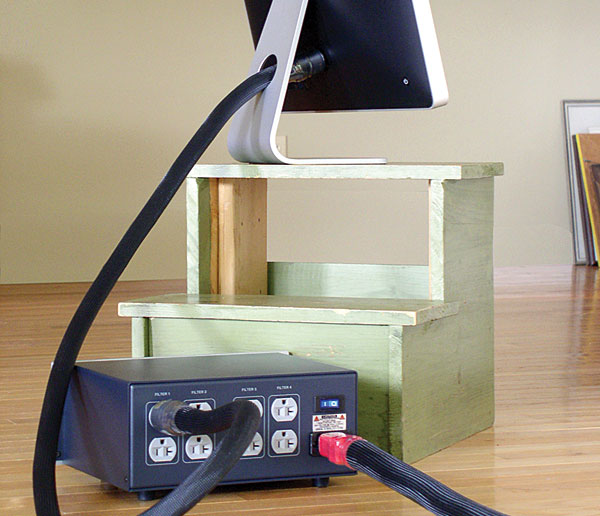
The latest party at which I've shown up late is that held by the storied Shunyata Research (footnote 2), whose gear was recommended to me by two company reps whom I consider good friends. Eventually, Shunyata's Grant Samuelsen and I spoke on the telephone, and I received a loan of four Shunyata Black Mamba CX Power Snake AC cords ($595 each), a Hydra V-Ray eight-outlet power distributor ($4995), and a specially terminated Black Mamba HC ($750), by which the Hydra itself is connected to the household current.
I followed Shunyata's recommendation and began by replacing my stock Shindo AC cords—one for the Masseto preamplifier, one each for the two Corton-Charlemagne mono amplifiers (footnote 3)—with the Shunyatas. Each Black Mamba Power Snake, which is among the company's least expensive power cords, incorporates 140 individual conductors, all drawn from CDA-101 copper. (According to the website of one alloy vendor, CDA 101 copper is prized for its resistance to embrittlement, which sounds like a word that Springfield's Mayor Quimby might have invented.) Those conductors are said to be wound in a patented counter-rotating, RFI-canceling helix pattern. Shunyata's own SR-ZP plugs, precision machined and cryogenically treated at the factory, complete the picture.
Footnote 1: George Inness: The Rainbow, 1878. Oil on canvas, 28¼" H by 38" W, object; 35½" H x 44½" W, framed. Gift of Bartlett Arkell, Courtesy of the Arkell Museum at Canajoharie. Footnote 2: Shunyata Research, 26273 Twelve Trees Lane, Suite D, Poulsbo, WA 98370. Tel: (360) 598-9935. Fax: (360) 598-9936. Web: www.shunyata.com.
Footnote 3: The AC cords of the two Thorens TD 124 turntables that I use in my main playback system, and those of my Linn LP12 and Rega Planar 3 turntables, aren't easily replaced. And during the time when the Black Mambas were here, my review sample of the Ayre Acoustics QB-9 USB D/A converter was summoned back to the factory for a firmware update.
My home is one minute from Glensfoot Farm, employer of a small crew of farmhands and home to several dozen nice-looking cattle. Glensfoot Farm is itself one minute from the center of Cherry Valley, where at least one 19th-century church still stands, steeple and all. My house has two decks and six windows that afford a grand view of all that.
I love the Arkell's collection of American art, and I love looking out my window at the farm and the village below. The two experiences persist in having little to do with one another.
When you play recorded music, you have before you a work of art with almost no physical existence at all; reconstituting it requires electricity, which will itself imitate the musical continuum represented by the bumps in the groove or the zeros in the datastream. When you listen to recorded music, you are listening to your household AC, and better AC equals better playback. That sounds obvious to me and you, even as it sends the technocodgers into paroxysms of puritanical indignation.
Footnote 1: George Inness: The Rainbow, 1878. Oil on canvas, 28¼" H by 38" W, object; 35½" H x 44½" W, framed. Gift of Bartlett Arkell, Courtesy of the Arkell Museum at Canajoharie. Footnote 2: Shunyata Research, 26273 Twelve Trees Lane, Suite D, Poulsbo, WA 98370. Tel: (360) 598-9935. Fax: (360) 598-9936. Web: www.shunyata.com.















