

Last June, Jim Austin briefly discussed the operation of MQA in his review of the Meridian Explorer2 USB DAC, but you can find a more detailed explanation on Stereophile's website here and here. MQA involves two fundamental concepts, discussed in a paper presented to the Audio Engineering Society in October 2014 (footnote 1). The first is responsible for a large reduction in the bandwidth required to store and stream high-resolution files, the second for a potential improvement in sound quality:
With files sampled at 2x, 4x, or 8x the baseband rate of 44.1 or 48kHz, the information in the one, two, or three ultrasonic octaves can be encoded and packed below the music's baseband noise floor in a 24-bit container. This "music origami" results in a much smaller file size than the hi-rez PCM equivalent, yet when the file is unfolded, the resolution and bandwidth of the original file are preserved. If an MQA file is played without MQA decoding, the sound quality will be that of the baseband file—ie, at least as good as a CD.
MQA is claimed to be able to compensate for the time-domain errors of both the original A/D converter used to make a recording and the D/A converter used to play it back. This results in the complete recording/playback chain having an impulse response equivalent to a few feet of air, and temporal resolution of the same form and order as that of the temporal sensitivity of the ear-brain.
I examined the first of these claims in an article in the June issue. MQA encoding did indeed reduce the size of a hi-rez file: While the 24/88.2 WAV master file for my recording of the Portland State Chamber Choir's performance of "Amazing Grace" is 169.5MB, the MQA-encoded FLAC version is just 51.5MB—30% of the original size, smaller even than the 16/44.1 version on the CD release, which was 55.7MB (footnote 2).
My analyses comparing the spectrum of the original WAV file with that of the decoded MQA version did indeed prove that MQA's "music origami" worked, the spectra of the original WAV file and the decoded MQA version overlaying one another exactly up to the 44.1kHz Nyquist frequency of the original recording. The ultrasonic 2Fs data that were embedded in the baseband to achieve a dramatic reduction in file size/streaming bandwidth lay well below the recording's analog noise floor (footnote 3) (see "Amazing Grace' Spectral Analysis").
Some critics have complained that the limited word length used to encode data above the baseband Nyquist frequency of 22.05kHz or 24kHz is equivalent to lossy compression of those data. But as I explained in my 2014 website article, if you look at the spectra of music recordings, they all follow a self-similar characteristic with respect to increasing frequency, the content decreasing in amplitude up to 60kHz or so, when it blends into the analog noise floor. So if you remove the baseband data, the remaining ultrasonic content can be encoded with fewer bits. Only if you then decode the limited-word-length data at the full-scale baseband level could you consider the encoding lossy. But if the peak amplitude of the limited-word-length ultrasonic data is reduced to that in the original recording, you do preserve those data's full resolution above the original analog noise floor.
Case proved for the music origami aspect of MQA, I feel. However, the only way of testing the second claim—of MQA's correction of time-domain errors—is through listening.
Comparisons
I had sent MQA's Bob Stuart the 24/88.2 masters of some of my recordings, for him to produce MQA versions. When he DropBoxed the MQA versions to me, Stuart also loaned me some MQA-encoded hi-rez files that had been used in MQA's demonstrations at the 2016 Consumer Electronics Show, as well as a number of MQA-encoded FLAC files accompanied by the original PCM versions. I began by listening to the MQA files without any comparisons, with the Meridian Prime, its firmware updated to decode MQA files, driving headphones or with its line outputs feeding the Pass Labs monoblocks. In his review of the Meridian Explorer2, Jim Austin wrote about what he heard when listening to MQA files: "that sense of intimacy and closeness—of almost exaggerated texture and timbre (exaggerated because recordings rarely capture it, and we rarely sit close enough to hear it in concert)—is apparently just what one would expect MQA's technical advantages to convey. . . . MQA has me excited about the future of recorded music."
The MQA files were varied in content—as well as Steely Dan's "Babylon Sisters," they covered a wide range of musics, ranging from Muddy Water's "My Home Is in the Delta" through Ella Fitzgerald and Louis Armstrong singing "They Can't Take That Away from Me," Van Morrison's original "Moondance," Dire Straits' "Sultans of Swing," some early 2L recordings of Carl Nielsen's piano music, Keith Jarrett's The Köln Concert and the Doors' "Riders on the Storm," to Britten's Hymn to the Virgin performed by Schola Cantorum, the second movement from the Guarneri String Quartet's performance of the Ravel Quartet, and Eiji Oue and the Minnesota Orchestra's Rite of Spring from Reference Recordings. Most had originally been recorded or transferred from the analog master at 96kHz, but the Ravel and Rite were originally sampled at 176.4kHz, the Britten at 352.8kHz, the Nielsen pieces at 44.1kHz.
Whatever the provenance, a consistent factor in my auditioning of the decoded MQA files was a sense of ease to the sound. High frequencies were in no way dulled, but the treble was consistently sweet. And there was a good sense of image depth even with the mono Ella and Louis recording.
My conclusion from these uncontrolled listening sessions was that MQA certainly doesn't damage the sound. Quite the opposite—the Prime sounded consistently sweeter than it had in the comparisons with the Ayre and Simaudio headphone amplifiers with regular PCM files. But comparisons of MQA files and the PCM originals would tell the complete story:
Ella and Louis: Fitzgerald's voice in the original had a slightly phlegmy edge; this edge was still there in the MQA version, but now I more readily marveled at what a great instrument she had.
Babylon Sisters: Comparing the MQA and PCM versions of this recording, I had difficulty coming to a conclusion. While the top octaves sounded sweeter with MQA, the bass was a little less well defined than with the 24/96 original. Though the metallic sound at the left of the stage in the intro was more generically clangy with the original, overall the track sounded a little less exciting with the MQA-encoded file. Interestingly, the MQA version of "Babylon Sisters" sounded pretty much identical to the DSD version, transcoded to 24/176.4 PCM, on the Prime.
The Rite of Spring: Although this has always been a reference-quality classical orchestral recording, comparisons were made difficult by the very varied nature of the scoring and the work's length. But in some places, such as the woodwind passage that starts around 1:20, the hall acoustic seemed better integrated with the images of the instruments with the MQA file.
The Köln Concert: The close-miked piano on this classic recording has always had a clangy quality. The clanginess was diminished with the MQA version, the piano's tonality sounding more believably that of a real instrument.
Amazing Grace: The first of two recordings of mine I used for my comparisons and for which Bob Stuart had prepared MQA versions, this arrangement by Eriks Esenvalds opens and closes with solo soprano, set against a choral vocalise. I've always been happy with the sound of the original 24/88.2 WAV file, but with the MQA version, Genna McAllister's angelic vocal line stands a little more forward from the choral halo, which itself sounds a little farther back than I'm used to. Overall, there was simply less ambiguity in the spatial relationships between the singers and the surrounding acoustic with the MQA version.
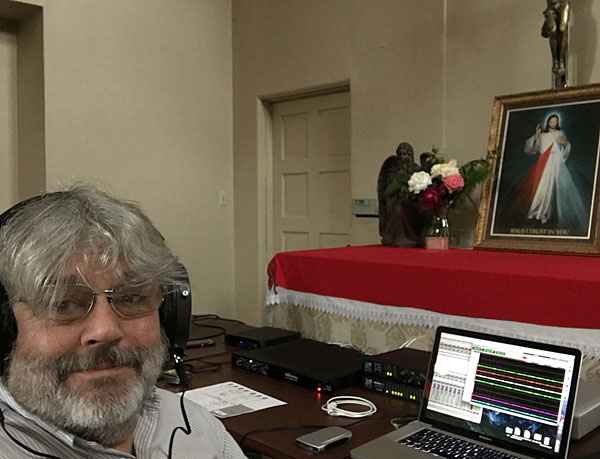
 Water Night: The scoring of this choral work by contemporary composer Eric Whitacre is complex and occasionally dense. But with the MQA version, the inner voices were better differentiated. And as with "Amazing Grace," the relationships of each of the singers to each other and the surrounding space seemed better defined. The reverberation tails in the warmly supportive acoustic of St. Stephen's Catholic Church, in Portland, Oregon, faded cleanly into the room tone in both cases, but at one place in the recording the MQA version just sounded more real: About two seconds before the singers start, there is a very quiet noise toward the back of the choir. It sounds somewhat like a generic tick on the original WAV file, more like a sound made by a human being in a real space in the MQA version.
 This reminded me of a comparison between an MQA-encoded recording and the original file that I'd heard at the 2016 CES. It was a live recording, and I'd been impressed at the very start of the track, even before the music began, by how the MQA version presented the sound of the hall with less ambiguity. It was as if my brain were having to do less work making sense of the stereo information to construct an internal model of the recorded acoustic.
Summing Up
This reminded me of a comparison between an MQA-encoded recording and the original file that I'd heard at the 2016 CES. It was a live recording, and I'd been impressed at the very start of the track, even before the music began, by how the MQA version presented the sound of the hall with less ambiguity. It was as if my brain were having to do less work making sense of the stereo information to construct an internal model of the recorded acoustic.
Summing Up
After doing all of my formal comparisons, I subjected myself to a sort-of-blind test. I created an Audirvana playlist that randomly mixed MQA and non-MQA files, and pressed Play. I then went into my test lab, which is in the room next to the listening room, to begin measuring some of the products in the review queue. At irregular intervals I returned to the listening room and made a decision, MQA or non-MQA, before looking at the Prime's front panel to see what was playing. I scored four out of seven correct; though this is insufficient to prove formal identification, I feel that it is relevant information. As well as the claim that MQA reduces file size while preserving the original hi-rez recording's ultrasonic spectrum, which my earlier work had shown to be correct, my comparisons of MQA-encoded hi-rez files with the PCM originals indicate that the improvement in sound quality conferred by the time-domain optimization of the entire ADC–storage–transmission–DAC chain is real. And third, despite the reduction in file size, MQA files, when decoded, tend to sound excellent (footnote 4). Will that be enough to ensure the format's success? Only if the record industry embraces it—and for more on that subject, see Jim Austin's interview with MQA's Spencer Chrislu, elsewhere in this issue.—John Atkinson
Footnote 1: See J. Robert Stuart and Peter Craven, "A Hierarchical Approach to Archiving and Distribution." Footnote 2: Into Unknown Worlds. Footnote 3: In his "Manufacturer's Comment" in the June issue, Bob Stuart wrote that the level at which MQA buries information from higher octaves "is not predetermined; it's responsive to the content. However, the burying level is completely stationary throughout every song or work. In JA's recording of 'Amazing Grace,' MQA buries the top-octave information (as broadly white noise) below the 20-bit level in the majority of the audioband. This does not mean that the channel is limited to 20 bits—the DAC still receives a 24-bit signal. It simply means, in this case, that MQA's effective noise floor is more than 5 bits below the (minimum 15-bit) noise floor of the original signal—a very healthy margin, and on a par with the very best converters." Footnote 4: For more about MQA, including listening comments, see www.audiostream.com/content/mqa-reviewed. Note that I didn't read Michael Lavorgna's review before performing all my own auditioning and writing this report.
I had sent MQA's Bob Stuart the 24/88.2 masters of some of my recordings, for him to produce MQA versions. When he DropBoxed the MQA versions to me, Stuart also loaned me some MQA-encoded hi-rez files that had been used in MQA's demonstrations at the 2016 Consumer Electronics Show, as well as a number of MQA-encoded FLAC files accompanied by the original PCM versions. I began by listening to the MQA files without any comparisons, with the Meridian Prime, its firmware updated to decode MQA files, driving headphones or with its line outputs feeding the Pass Labs monoblocks. In his review of the Meridian Explorer2, Jim Austin wrote about what he heard when listening to MQA files: "that sense of intimacy and closeness—of almost exaggerated texture and timbre (exaggerated because recordings rarely capture it, and we rarely sit close enough to hear it in concert)—is apparently just what one would expect MQA's technical advantages to convey. . . . MQA has me excited about the future of recorded music."
Water Night: The scoring of this choral work by contemporary composer Eric Whitacre is complex and occasionally dense. But with the MQA version, the inner voices were better differentiated. And as with "Amazing Grace," the relationships of each of the singers to each other and the surrounding space seemed better defined. The reverberation tails in the warmly supportive acoustic of St. Stephen's Catholic Church, in Portland, Oregon, faded cleanly into the room tone in both cases, but at one place in the recording the MQA version just sounded more real: About two seconds before the singers start, there is a very quiet noise toward the back of the choir. It sounds somewhat like a generic tick on the original WAV file, more like a sound made by a human being in a real space in the MQA version.
This reminded me of a comparison between an MQA-encoded recording and the original file that I'd heard at the 2016 CES. It was a live recording, and I'd been impressed at the very start of the track, even before the music began, by how the MQA version presented the sound of the hall with less ambiguity. It was as if my brain were having to do less work making sense of the stereo information to construct an internal model of the recorded acoustic.
Summing UpAfter doing all of my formal comparisons, I subjected myself to a sort-of-blind test. I created an Audirvana playlist that randomly mixed MQA and non-MQA files, and pressed Play. I then went into my test lab, which is in the room next to the listening room, to begin measuring some of the products in the review queue. At irregular intervals I returned to the listening room and made a decision, MQA or non-MQA, before looking at the Prime's front panel to see what was playing. I scored four out of seven correct; though this is insufficient to prove formal identification, I feel that it is relevant information. As well as the claim that MQA reduces file size while preserving the original hi-rez recording's ultrasonic spectrum, which my earlier work had shown to be correct, my comparisons of MQA-encoded hi-rez files with the PCM originals indicate that the improvement in sound quality conferred by the time-domain optimization of the entire ADC–storage–transmission–DAC chain is real. And third, despite the reduction in file size, MQA files, when decoded, tend to sound excellent (footnote 4). Will that be enough to ensure the format's success? Only if the record industry embraces it—and for more on that subject, see Jim Austin's interview with MQA's Spencer Chrislu, elsewhere in this issue.—John Atkinson
Footnote 1: See J. Robert Stuart and Peter Craven, "A Hierarchical Approach to Archiving and Distribution." Footnote 2: Into Unknown Worlds. Footnote 3: In his "Manufacturer's Comment" in the June issue, Bob Stuart wrote that the level at which MQA buries information from higher octaves "is not predetermined; it's responsive to the content. However, the burying level is completely stationary throughout every song or work. In JA's recording of 'Amazing Grace,' MQA buries the top-octave information (as broadly white noise) below the 20-bit level in the majority of the audioband. This does not mean that the channel is limited to 20 bits—the DAC still receives a 24-bit signal. It simply means, in this case, that MQA's effective noise floor is more than 5 bits below the (minimum 15-bit) noise floor of the original signal—a very healthy margin, and on a par with the very best converters." Footnote 4: For more about MQA, including listening comments, see www.audiostream.com/content/mqa-reviewed. Note that I didn't read Michael Lavorgna's review before performing all my own auditioning and writing this report.















