

Sidebar 3: Measurements
I measured the Luxman Classic CL-38u's electrical performance with my Audio Precision SYS2722 system (see www.ap.com and the January 2008 "As We See It").
Looking first at the phono stage, I examined the output at the Rec Out jacks, to ensure that I was not including the performance of the line stage in the measured results. The three settings of this input offered voltage gains (into 100k ohms) of 41.2dB (MM), 57.6dB (MC High), and 67.5dB (MC Low). The latter two gains were affected somewhat by the 20 ohm output impedance of the AP generator, but all three are appropriate for the type of phono cartridge used. As Art Dudley suspected, the MM setting preserved absolute polarity (ie, was non-inverting), but the two MC settings did invert polarity. The MM input impedance was suitably high, at 46k ohms at low and middle frequencies, dropping slightly to 40k ohms at 20kHz. MC High varied from 314 ohms at 20kHz and 470 ohms at 20Hz to 905 ohms at 1kHz, while I got anomalous readings for MC Low.
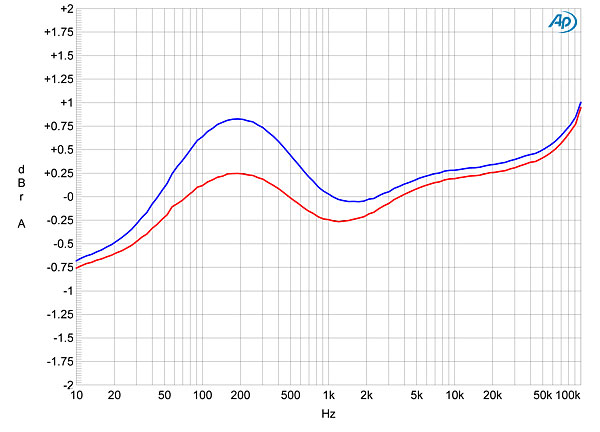
The CL-38u's RIAA error is shown in fig.1. The two channels don't match as closely as I have found with other preamps, but the general trend is the same: small excesses of energy in the midrange and high treble. Despite its use of tubes, the Luxman's phono stage is very quiet. The unweighted, wideband signal/noise ratios, taken with the input shorted and ref. 1kHz at 5mV (MM) or 500µV (MC High and Low), were 66dB (MM), 56.1dB (MC High), and 55.5dB (MC Low), these respectively improving to 79.5, 71, and 72.6dB when A-weighted.
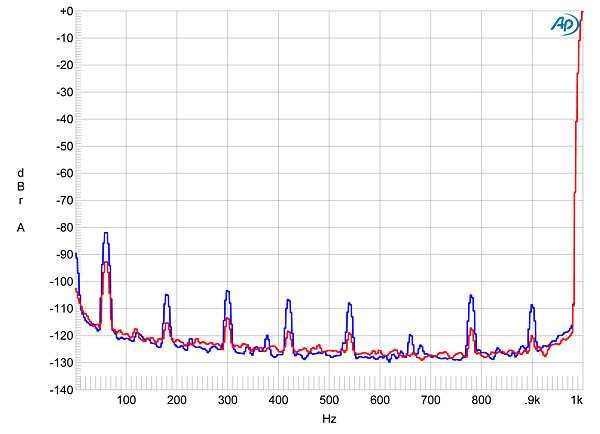
 Channel separation was excellent, at >90dB in both directions in the midrange and bass, though this decreased to 60dB at the top of the audioband. The line stage's wideband, unweighted S/N ratio, ref. 1V output and taken with the inputs shorted but the volume control set to its maximum, was 78dB, this improving to 94dB when the measurement bandwidth was restricted to the audioband and to 98dB when A-weighted. Spectral analysis of the Luxman's output while it reproduced a 1kHz tone at 2V into 100k ohms (fig.4) revealed that the primary source of noise was some slight magnetic leakage from the AC transformer of 60Hz and its odd harmonics.

 These days, full-function preamplifiers such as this one, offering MM and MC phono inputs as well as versatile tone controls, are rare—but the measured performance of Luxman's Classic CL-38u doesn't appear to be compromised in any way, either by its versatility or by its exclusive use of tubes.—John Atkinson
Fig.1 Luxman CL-38u, phono input, response with RIAA correction (left channel blue, right red) (0.5dB/vertical div.).
The phono-stage overload margins were simply superb at low and middle frequencies, at 30–37dB, depending on setting, and were still 20–23dB at 20kHz. Set to MM, the phono stage clipped with a 1kHz signal at 223mV, which is 33dB higher than the standard MM level of 5mV and equivalent to an output voltage of 24.75V! This is a high-dynamic-range circuit that also offered low levels of harmonic distortion. Fed 1kHz at 1mV, the MC High setting produced second-harmonic distortion of just –84dB (0.006%). Fed an equal mix of 19 and 20kHz tones at the same equivalent level, the 1kHz intermodulation product lay at –58dB, just above 0.1%, which is good.
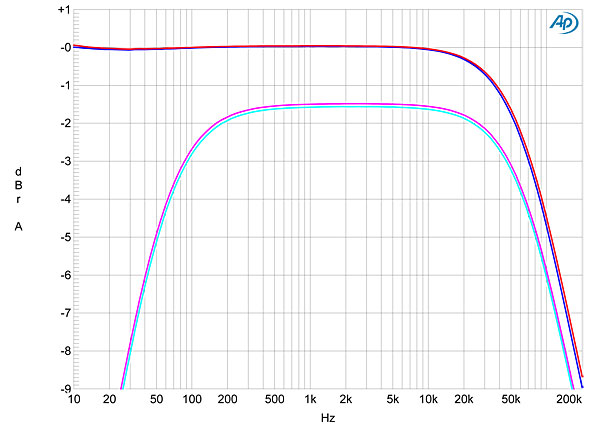
Turning to the Luxman's line stage, line-level signals appeared at the Rec Out jacks with zero gain; and it appears that there is no buffer stage for these outputs. At the main outputs, the line stage offered a maximum gain of 15.6dB and was non-inverting. The input impedance was usefully high, at 43k ohms at 20Hz and 1kHz, dropping inconsequentially to 30k ohms at 20kHz. The output impedance was low, at 120 ohms at high and middle frequencies, but rose to 1500 ohms at the bottom of the audioband. As a result, the bass rolled off prematurely with the demanding 600 ohm load (fig.2, cyan and magenta traces). With the more realistic 100k ohm load (fig.1, blue, red), the response was flat to 10Hz and to 20kHz, and the two channels were superbly well matched. This graph was taken with the tone controls defeated and the volume control set to its maximum. Commendably, both the channel matching and measured response didn't change at lower volume-control settings.
Fig.2 Luxman CL-38u, frequency response with volume control set to maximum gain at 1V, into: 100k ohms (left channel blue, right red), 600 ohms (left cyan, right magenta) (0.5dB/vertical div.).
AD commented on a change in the sound when he switched from tone controls defeated to tone controls active, but with the treble and bass controls set to their central, detented positions. Not only did I measure a drop in level at 1kHz of 1.7dB with the tone controls engaged, but the treble was shelved down by –1dB at 20kHz (fig.3, middle blue and gray traces). The Lo-Cut switch rolled off the bass by 3dB at 40Hz (fig.3, middle blue trace below 200Hz), while this graph indicates that the treble and bass controls apply 10–12dB of boost or cut, which is more than generally thought necessary.
Fig.3 Luxman CL-38u, frequency response with tone controls set to maximum, center, and minimum positions, and with and without Lo-Cut switched on (left channel blue, right red) (2dB/vertical div.).
Fig.4 Luxman CL-38u, spectrum of 1kHz sinewave, DC–1kHz, at 2V into 100k ohms (left channel blue, right red) (linear frequency scale).
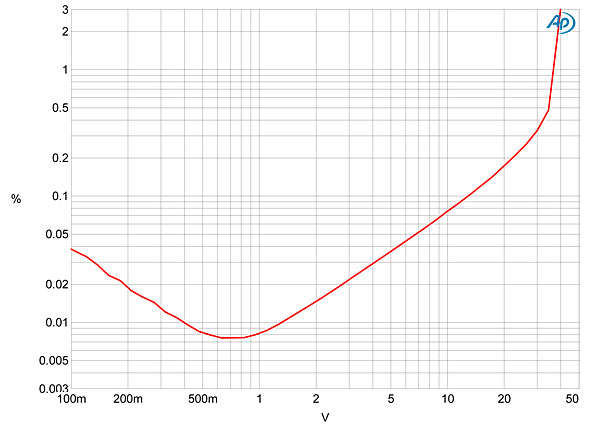
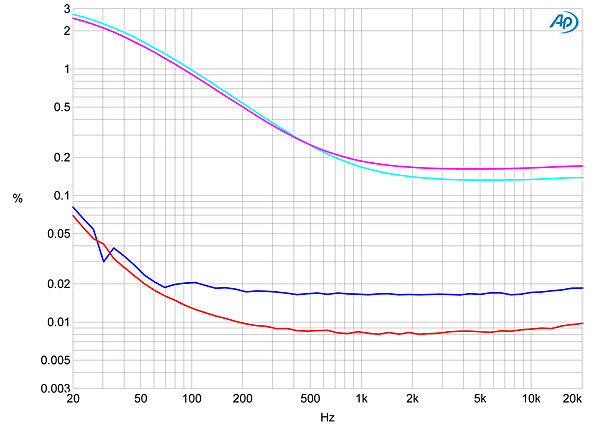
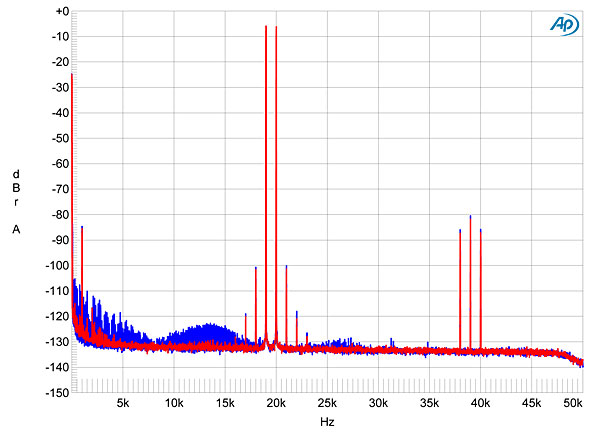
Fig.5 plots the CL-38u's percentage of THD+noise against output voltage at 1kHz into 100k ohms. The downward slope of the trace below 600mV indicates that the distortion lies below the noise up to this level, and while the THD starts to rise above 1V, it is still very low at all levels at which the Luxman preamp will be used in practice. As I said before, the CL-38u is a high-dynamic-range design—its line stage doesn't actually clip (1% THD+N) until 37V! Though the preamplifier was less happy driving low impedances (fig.6), as long as it is used to drive loads greater than 10k ohms it will offer very low distortion. The line-stage's distortion signature was primarily second harmonic (fig.7), and intermodulation distortion was also low (fig.8).
Fig.5 Luxman CL-38u, distortion (%) vs 1kHz output voltage into 100k ohms.
Fig.6 Luxman CL-38u, distortion (%) vs frequency at 1V into: 100k ohms (left channel blue, right red), 600 ohms (left cyan, right magenta).
Fig.7 Luxman CL-38u, spectrum of 50Hz sinewave, DC–1kHz, at 2V into 100k ohms (left channel blue, right red) (linear frequency scale).
Fig.8 Luxman CL-38u, HF intermodulation spectrum, DC–50kHz, 19+20kHz at 2V peak into 100k ohms (left channel blue, right red) (linear frequency scale).















