

The Luxman pulled off similar feats on Tower of Power's "Ebony Jam," from 1975's In the Slot (LP, Warner Bros. Records BS 2880). Near the track's end, organist Chester Thompson holds a long bass pedal note, radiating what should be massive, Leslie speaker–generated bass frequency swells. Though lacking definition, the SQ-N150 recreated the bass pedal fundamentals with appropriate color, warmth, impressive weight, and low-end growl. This recording also played to the Luxman's spatial strengths, again producing a soundstage that was wider than it was deep.
An acoustic bass-centric track I often use for evaluation is from the eponymous bluegrass release by Norman Blake, Tut Taylor, Sam Bush, Butch Robins, Vassar Clements, David Holland, and Jethro Burns (LP, HDS Records 701, 1975). Jazz bassist Holland is the album's wild card. He introduces "Sauerkraut 'N Solar Energy" with a lengthy solo. Through the SQ-N150, Holland's double bass stood practically naked before me, recreated with excellent touch, liquid midrange body, and glowing, woody tone, though lacking the last word in low-frequency extension and realistic weight of the instrument. The Luxman created ample air around the upright bass—I could almost see the fingers of Holland's left hand sliding vertically over the neck of the instrument. When the other instruments entered, I heard pinpoint imaging on a wide soundstage.
 The spatial qualities revealed on the Blake, Taylor, Bush, et al bluegrass bonanza were also apparent when listening to ECM Records' reissue of Tunisian oud player Anouar Brahem's 1990 debut, Barzakh (LP, ECM 1432), on which he is accompanied by Bechir Selmi on violin and Lassad Hosni on percussion. Brahem's compositions are beautiful and mysterious, evoking some long-lost time. As a former drummer, I veer toward percussion in all forms and thus return often to Barzakh's "Souga" and its prominently featured tabla drum solo. The Luxman did an impressive job of recreating the color and texture of Hosni's tabla drum, and, most surprisingly, the solo's microdynamic nuances. Though it's often hard to hear myriad dynamic levels of a tabla drum when performed within an ensemble, here the instrument's dynamic layers were reproduced cleanly and precisely. The Luxman replicated Hosni's sizzling 16th-note drumming stream, as well as his boisterous slaps and pops struck on the hand drum's rim, which were well-defined above and beyond the basic rhythm. Tonality was rich and dynamics forceful.
For an amplifier of limited power, when mated with the DeVore Fidelity O/93s, the SQ-N150 consistently wowed me with its dynamic range when appropriate to the recording. By comparison, my far more expensive Shindo Haut-Brion amplifier and Allegro preamplifier ratchet up the color and weight captured in this disc, while sacrificing nothing in terms of dynamics.
Miles Davis's Workin' with the Miles Davis Quintet (mono LP, Prestige PRLP 7166) revealed the SQ-N150's means of reconstructing natural air and space within its uniformly wide soundstage. I've heard this album hundreds of times through various systems, and it's different every time. On systems that tilt toward the treble, Philly Joe Jones's ride cymbal can sound thin, dry, and overly "pingy." Through the Luxman SQ-N150, Jones's cymbal was portrayed with clarity and full body, free of grit or grain, surrounded by a halo of natural-sounding air, endowed with the correct spatial relationship to Paul Chambers's double bass—which, although lacking the ultimate weight and some presence, had good touch.
The spatial qualities revealed on the Blake, Taylor, Bush, et al bluegrass bonanza were also apparent when listening to ECM Records' reissue of Tunisian oud player Anouar Brahem's 1990 debut, Barzakh (LP, ECM 1432), on which he is accompanied by Bechir Selmi on violin and Lassad Hosni on percussion. Brahem's compositions are beautiful and mysterious, evoking some long-lost time. As a former drummer, I veer toward percussion in all forms and thus return often to Barzakh's "Souga" and its prominently featured tabla drum solo. The Luxman did an impressive job of recreating the color and texture of Hosni's tabla drum, and, most surprisingly, the solo's microdynamic nuances. Though it's often hard to hear myriad dynamic levels of a tabla drum when performed within an ensemble, here the instrument's dynamic layers were reproduced cleanly and precisely. The Luxman replicated Hosni's sizzling 16th-note drumming stream, as well as his boisterous slaps and pops struck on the hand drum's rim, which were well-defined above and beyond the basic rhythm. Tonality was rich and dynamics forceful.
For an amplifier of limited power, when mated with the DeVore Fidelity O/93s, the SQ-N150 consistently wowed me with its dynamic range when appropriate to the recording. By comparison, my far more expensive Shindo Haut-Brion amplifier and Allegro preamplifier ratchet up the color and weight captured in this disc, while sacrificing nothing in terms of dynamics.
Miles Davis's Workin' with the Miles Davis Quintet (mono LP, Prestige PRLP 7166) revealed the SQ-N150's means of reconstructing natural air and space within its uniformly wide soundstage. I've heard this album hundreds of times through various systems, and it's different every time. On systems that tilt toward the treble, Philly Joe Jones's ride cymbal can sound thin, dry, and overly "pingy." Through the Luxman SQ-N150, Jones's cymbal was portrayed with clarity and full body, free of grit or grain, surrounded by a halo of natural-sounding air, endowed with the correct spatial relationship to Paul Chambers's double bass—which, although lacking the ultimate weight and some presence, had good touch.
 This original LP's soundstage was pleasingly wide via the SQ-N150's MC input, though images were smaller than the biggest ones I've heard in my system. My Shindo gear makes this track come alive more forcefully with topnotch color, vibrant texture, and large images; the Luxman couldn't equal the Shindos' weight and color, but it matched their dynamics and was the faster amplifier.
Enter Thorens/Jelco/Denon
This original LP's soundstage was pleasingly wide via the SQ-N150's MC input, though images were smaller than the biggest ones I've heard in my system. My Shindo gear makes this track come alive more forcefully with topnotch color, vibrant texture, and large images; the Luxman couldn't equal the Shindos' weight and color, but it matched their dynamics and was the faster amplifier.
Enter Thorens/Jelco/Denon
Up to this point, I'd been using the Kuzma Stabi R turntable/4Point tonearm/Hana ML cartridge, a strong combination that creates outstanding instrumental weight, dynamics, and definition. But for reasons I couldn't put my finger on, the Thorens TD 124 turntable/Jelco TS-350S tonearm/Denon DL-103 cartridge combination produced a greater sense of synergy than the Kuzma/Luxman pairing. Treble sparkle increased, as did midrange color and warmth, though at the loss of some definition and weight. The Thorens/Luxman pairing was more fun.
Playing Poll Winners Three! (LP, Contemporary Records S7576, 1960) with guitarist Barney Kessel, bassist Ray Brown, and drummer Shelly Manne, the music sounded intimate and warm; it swung hard and captivated me in a primal way. The Luxman's neutrality and clarity allowed the Thorens/Jelco/Denon setup and Poll Winners Three! to shine.
Klipsch Forte IIIs
Switching the O/93s for the Klipsch Forte IIIs provided further musical contrasts and revelations. Midrange clarity improved, as did imaging and bass depth and weight. The luminous tone recreated by my reference O/93s disappeared, but music became more three-dimensional and soundstage depth increased: I was gobsmacked by the soundspace size presented by the combination of Luxman amp and Forte IIIs.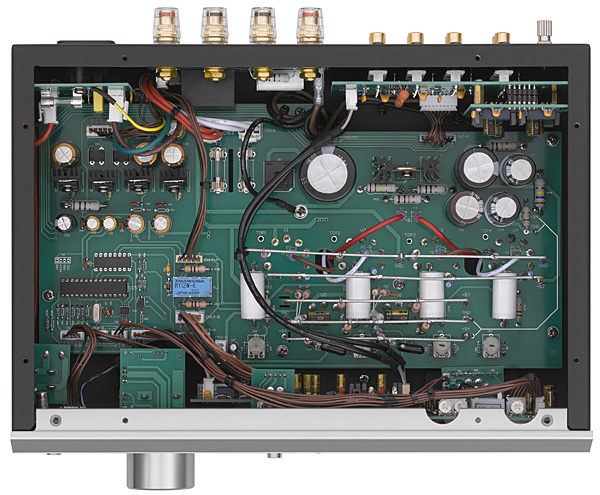 These qualities came to the fore when spinning 1963's The Concert Sinatra (LP, Reprise Records R9-1009), featuring the Hoboken belter in a grandiose set of cinema-worthy standards. In "I Have Dreamed," which was presented in a wider, deeper soundstage than through the O/93s, Sinatra's creamy voice floated in the air, bathed in Nelson Riddle's orchestra of swirling string and brass colors. Intimacy increased, as did the nearfield image of Sinatra's vocal—again as compared to the O/93s. The SQ-N150 simply got out of the way and let The Concert Sinatra shine through with good color, pronounced dynamics, and appropriately sized images in a giant soundstage.
Through the Luxman/Klipsch kombo, the Kraftwerk LP's dynamic range and spatial depth improved, the driving bass drum much larger in the soundfield; the pulsing 8th-note sequence was more pronounced, if drier, with more convincing layering of instruments within a bigger stage. Tour de France Soundtracks also showed the Luxman's unerring sense of flow; it's a king at delivering a musical line.
As further evidence of the SQ-N150's transparent presentation of components both up- and downstream, I played Makoto Aruga and Percussion Ensemble's Digital Percussion: Toccata for Percussion (LP, Seven Seas K28C-165), an album of outstanding dynamic range and percussive color. Snare drum press rolls, concert tom figures, and timpani solos were recreated with dazzling dynamics through the SQ-N150, from ppp to fff. The Luxman/Forte III combination recreated both the rhythmic fireworks and the subtler charms of this import LP as well as I've heard them. Through the Forte IIIs, the SQ-N150 revealed the spatial and dynamic extremes to be heard from this recording. Though the Forte IIIs were undoubtedly able, the Luxman couldn't reconstruct the absolute body, low-end weight, and physicality of the timpanis' large copper bowls, but snare drum and concert toms impressed with excellent physicality, good tone, and first-row immediacy. (The Forte IIIs are less capable than the DeVore Fidelity O/93s of reproducing rich, natural tone, something that the Luxman also made crystal clear.)
These qualities came to the fore when spinning 1963's The Concert Sinatra (LP, Reprise Records R9-1009), featuring the Hoboken belter in a grandiose set of cinema-worthy standards. In "I Have Dreamed," which was presented in a wider, deeper soundstage than through the O/93s, Sinatra's creamy voice floated in the air, bathed in Nelson Riddle's orchestra of swirling string and brass colors. Intimacy increased, as did the nearfield image of Sinatra's vocal—again as compared to the O/93s. The SQ-N150 simply got out of the way and let The Concert Sinatra shine through with good color, pronounced dynamics, and appropriately sized images in a giant soundstage.
Through the Luxman/Klipsch kombo, the Kraftwerk LP's dynamic range and spatial depth improved, the driving bass drum much larger in the soundfield; the pulsing 8th-note sequence was more pronounced, if drier, with more convincing layering of instruments within a bigger stage. Tour de France Soundtracks also showed the Luxman's unerring sense of flow; it's a king at delivering a musical line.
As further evidence of the SQ-N150's transparent presentation of components both up- and downstream, I played Makoto Aruga and Percussion Ensemble's Digital Percussion: Toccata for Percussion (LP, Seven Seas K28C-165), an album of outstanding dynamic range and percussive color. Snare drum press rolls, concert tom figures, and timpani solos were recreated with dazzling dynamics through the SQ-N150, from ppp to fff. The Luxman/Forte III combination recreated both the rhythmic fireworks and the subtler charms of this import LP as well as I've heard them. Through the Forte IIIs, the SQ-N150 revealed the spatial and dynamic extremes to be heard from this recording. Though the Forte IIIs were undoubtedly able, the Luxman couldn't reconstruct the absolute body, low-end weight, and physicality of the timpanis' large copper bowls, but snare drum and concert toms impressed with excellent physicality, good tone, and first-row immediacy. (The Forte IIIs are less capable than the DeVore Fidelity O/93s of reproducing rich, natural tone, something that the Luxman also made crystal clear.)
 Two turntables, a pair of headphones, and tone controls
It was 1:00am, and I knew that hammering the loudspeakers would bring the neighbor's wrath. I switched to the Master & Dynamic MH40 headphones ($249) and soon realized that the SQ-N150 has an exceptional headphone output, its overall sound creamy and rich, but transparent enough to reveal the personality of each record played through it.
I've been on an XRCD kick of late. The Luxman exposed both the intimate piano and the immersive big band sound captured on 88 Basie Street, by Count Basie & his Orchestra (XRCD, JVC/ Pablo JVCXR-0021-2), with full cream as the Brits might say. Tenor saxophonist Johnny Griffin's The Little Giant (XRCD, JVC/Riverside JVCXR-0039-2, RLP-1149) was faithfully reproduced, the sextet's instruments reverberating off the walls of Reeves Sound Studio, New York City, ca 1959. Contemporary CDs (as in now, not the record label!) also sounded true, from the slightly muted production of Emma Frank's Come Back (Justin Time JUS 262) to the glistening electronica of Air's Love 2 (CD, Astralwerks ASW 66396). I experimented with the SQ-N150's tone controls while listening to music with headphones. I wasn't impressed. While the treble control added a sliver of increased, refined treble, the bass control tended to bloat and diffuse the low end. The Line Straight button stayed pressed.
Comparison
The Cary SLI-80HS ($4495) was the only comparable tubed integrated amplifier I had in house. The Cary lacks a phono stage, so I compared the units' line-level input performance using my BorderPatrol DAC SE and Tascam CD-200iL CD player. Playing the Basie XRCD, the Luxman provided a clean, very dynamic performance. Images were well established, tonality sweet. Acoustic bass had authoritative tone and good weight. The soundstage was wide, intimate, upfront. The Cary provided more low-end grunt and gravitas, from the acoustic bass to the large brass section, which somehow sounded better unified within the orchestra as a whole. The Cary wasn't quite as tonally sweet as the Luxman playing Basie, but its larger images and powerful dynamics almost made up for the loss. Both amps sounded great. I could happily live with either.
Conclusions
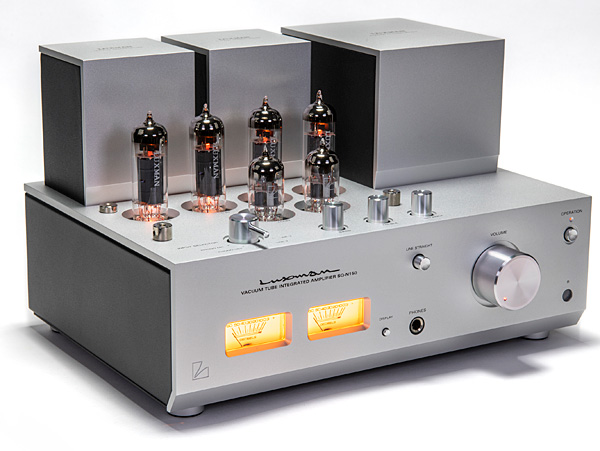
With its tone controls, backlit VU meters, and those popular EL84 power tubes in a small package, Luxman apparently hopes to capture fans of 1970s-era stereo receivers as well as owners of efficient (and horn-loaded) loudspeaker(s) and headphone users. That they may do—and then some. The SQ-N150 is one of the most transparent components I've had in my system. It exposed the sonic qualities of ancillary components both upstream and down. It was largely neutral, but when it did impose a personality on music, from vinyl or CD, it veered toward a crisp treble allied to a natural, fleshy, warm midrange. Acoustic and electric bass, bass drum, timpani, organ bass pedal notes, and lower-register string and brass instruments could sound soft with a lack of inner detail. But the Luxman could also surprise with full, rich bass notes, depending on the recording. While the Luxman didn't match the saturated tonal color or large images of my Shindo separates, or the low-end traction of a solid-state amplifier, it provided sweet upper frequency tonality and satisfying bass notes overall—especially so for its 10Wpc output power rating. And as a bonus, the Luxman obviously has a good phono stage and headphone output. And while the amp's 10Wpc may be suited only to speakers of high sensitivity, that narrowed field just makes the choice easier. This kind of quality for $2795? Highly recommended!
The spatial qualities revealed on the Blake, Taylor, Bush, et al bluegrass bonanza were also apparent when listening to ECM Records' reissue of Tunisian oud player Anouar Brahem's 1990 debut, Barzakh (LP, ECM 1432), on which he is accompanied by Bechir Selmi on violin and Lassad Hosni on percussion. Brahem's compositions are beautiful and mysterious, evoking some long-lost time. As a former drummer, I veer toward percussion in all forms and thus return often to Barzakh's "Souga" and its prominently featured tabla drum solo. The Luxman did an impressive job of recreating the color and texture of Hosni's tabla drum, and, most surprisingly, the solo's microdynamic nuances. Though it's often hard to hear myriad dynamic levels of a tabla drum when performed within an ensemble, here the instrument's dynamic layers were reproduced cleanly and precisely. The Luxman replicated Hosni's sizzling 16th-note drumming stream, as well as his boisterous slaps and pops struck on the hand drum's rim, which were well-defined above and beyond the basic rhythm. Tonality was rich and dynamics forceful.
For an amplifier of limited power, when mated with the DeVore Fidelity O/93s, the SQ-N150 consistently wowed me with its dynamic range when appropriate to the recording. By comparison, my far more expensive Shindo Haut-Brion amplifier and Allegro preamplifier ratchet up the color and weight captured in this disc, while sacrificing nothing in terms of dynamics.
This original LP's soundstage was pleasingly wide via the SQ-N150's MC input, though images were smaller than the biggest ones I've heard in my system. My Shindo gear makes this track come alive more forcefully with topnotch color, vibrant texture, and large images; the Luxman couldn't equal the Shindos' weight and color, but it matched their dynamics and was the faster amplifier.
Enter Thorens/Jelco/DenonUp to this point, I'd been using the Kuzma Stabi R turntable/4Point tonearm/Hana ML cartridge, a strong combination that creates outstanding instrumental weight, dynamics, and definition. But for reasons I couldn't put my finger on, the Thorens TD 124 turntable/Jelco TS-350S tonearm/Denon DL-103 cartridge combination produced a greater sense of synergy than the Kuzma/Luxman pairing. Treble sparkle increased, as did midrange color and warmth, though at the loss of some definition and weight. The Thorens/Luxman pairing was more fun.
Switching the O/93s for the Klipsch Forte IIIs provided further musical contrasts and revelations. Midrange clarity improved, as did imaging and bass depth and weight. The luminous tone recreated by my reference O/93s disappeared, but music became more three-dimensional and soundstage depth increased: I was gobsmacked by the soundspace size presented by the combination of Luxman amp and Forte IIIs.
These qualities came to the fore when spinning 1963's The Concert Sinatra (LP, Reprise Records R9-1009), featuring the Hoboken belter in a grandiose set of cinema-worthy standards. In "I Have Dreamed," which was presented in a wider, deeper soundstage than through the O/93s, Sinatra's creamy voice floated in the air, bathed in Nelson Riddle's orchestra of swirling string and brass colors. Intimacy increased, as did the nearfield image of Sinatra's vocal—again as compared to the O/93s. The SQ-N150 simply got out of the way and let The Concert Sinatra shine through with good color, pronounced dynamics, and appropriately sized images in a giant soundstage.
Two turntables, a pair of headphones, and tone controlsIt was 1:00am, and I knew that hammering the loudspeakers would bring the neighbor's wrath. I switched to the Master & Dynamic MH40 headphones ($249) and soon realized that the SQ-N150 has an exceptional headphone output, its overall sound creamy and rich, but transparent enough to reveal the personality of each record played through it.
The Cary SLI-80HS ($4495) was the only comparable tubed integrated amplifier I had in house. The Cary lacks a phono stage, so I compared the units' line-level input performance using my BorderPatrol DAC SE and Tascam CD-200iL CD player. Playing the Basie XRCD, the Luxman provided a clean, very dynamic performance. Images were well established, tonality sweet. Acoustic bass had authoritative tone and good weight. The soundstage was wide, intimate, upfront. The Cary provided more low-end grunt and gravitas, from the acoustic bass to the large brass section, which somehow sounded better unified within the orchestra as a whole. The Cary wasn't quite as tonally sweet as the Luxman playing Basie, but its larger images and powerful dynamics almost made up for the loss. Both amps sounded great. I could happily live with either.
With its tone controls, backlit VU meters, and those popular EL84 power tubes in a small package, Luxman apparently hopes to capture fans of 1970s-era stereo receivers as well as owners of efficient (and horn-loaded) loudspeaker(s) and headphone users. That they may do—and then some. The SQ-N150 is one of the most transparent components I've had in my system. It exposed the sonic qualities of ancillary components both upstream and down. It was largely neutral, but when it did impose a personality on music, from vinyl or CD, it veered toward a crisp treble allied to a natural, fleshy, warm midrange. Acoustic and electric bass, bass drum, timpani, organ bass pedal notes, and lower-register string and brass instruments could sound soft with a lack of inner detail. But the Luxman could also surprise with full, rich bass notes, depending on the recording. While the Luxman didn't match the saturated tonal color or large images of my Shindo separates, or the low-end traction of a solid-state amplifier, it provided sweet upper frequency tonality and satisfying bass notes overall—especially so for its 10Wpc output power rating. And as a bonus, the Luxman obviously has a good phono stage and headphone output. And while the amp's 10Wpc may be suited only to speakers of high sensitivity, that narrowed field just makes the choice easier. This kind of quality for $2795? Highly recommended!















