

Sidebar 3: Measurements
I used DRA Labs' MLSSA system and a calibrated DPA 4006 microphone to measure the Magico S5 Mk.II's frequency response in the farfield, and an Earthworks QTC-40 for the nearfield and in-room responses. A complication was that the 220-lb loudspeaker was too bulky for me to move it outside for the testing, or to lift it onto my computer-controlled turntable. I therefore had to do the quasi-anechoic measurements in my listening room, where the proximity of room boundaries led to more than usually aggressive windowing of the time-domain data, which in turn reduced the graphs' resolution in the midrange.
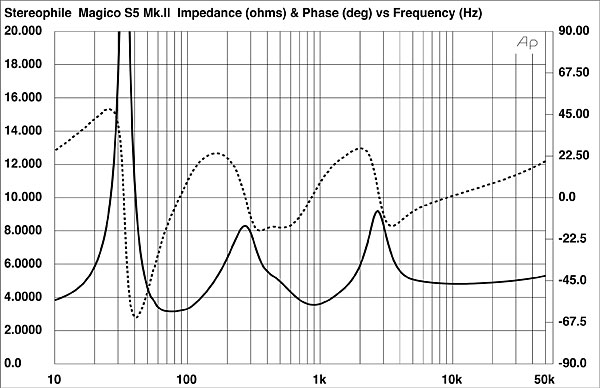
That said, my estimate of the Magico's voltage sensitivity was approximately 87.5dB/2.83V/m, close to the specified 88dB. Fig.1 shows how the S5 Mk.II's impedance magnitude and electrical phase angle vary with frequency. The impedance does drop to minima of 3.15 ohms at 78Hz and 3.55 ohms at 900Hz, and there is a current-hungry combination of 4.3 ohms and –49° at 51Hz. Magico specifies the S5 Mk.II as a 4 ohm load, which appears to be correct. The impedance traces are free from the small discontinuities that would imply the existence of panel resonances. Nevertheless, I found two high-Q vibrational modes, at 436 and 744Hz, on the sidewalls level with the midrange unit. These modes were at a low level, though they were audible when I listened to the enclosure walls with a stethoscope. Tapping the cabinet walls revealed a slight formant structure correlating with these modes, but the enclosure was otherwise inert.

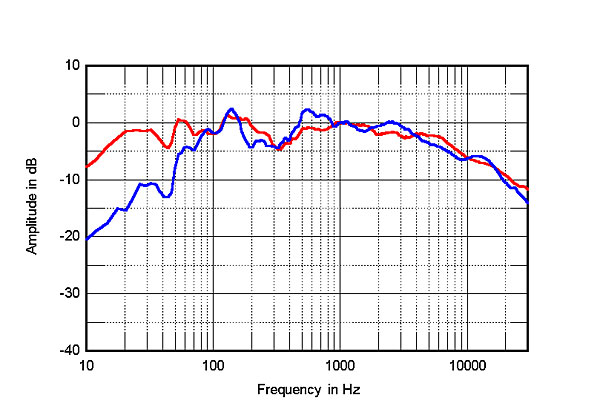 To provide a visual reference, the blue trace is that of the Crystal Arabesque Minissimo Diamonds in my room; I found the Crystal speaker's balance slightly midrange-forward, which you can see here as the small peak in the upper midrange compared with the Magico. Both speakers have a dip in the midrange, due to interference from the closest boundaries, but the S5 Mk.II's in-room balance is impressively even up to the low treble, above which its output gently and smoothly slopes down, primarily due to the increased absorptivity of the room's furnishings in this region. The Minissimo Diamond being a minimonitor, its response rolls off below 90Hz, while the sealed-box Magico both extends down to 20Hz and doesn't excite the lowest-frequency modes in my room to the extent that reflex-loaded full-range speakers do (footnote 1).
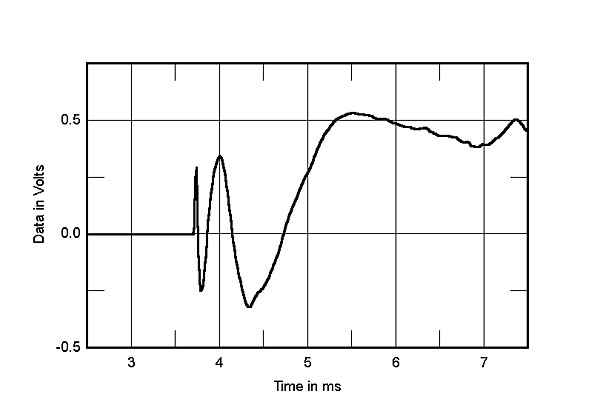
Turning to the time domain, the step response in fig.6, taken on the tweeter axis, reveals that all four of the S5 Mk.II's drive-units are connected in positive acoustic polarity, with the tweeter's output leading that of the midrange unit, which in turn leads that of the woofers. More important, the decay of the tweeter's step blends smoothly with the start of the midrange unit's step, and the decay of that step blends smoothly with the start of the woofers' step. You can see, just past the 7ms marker, that the decay of the woofers' step is disturbed by a reflection from the nearest boundary, in this case the floor. The presence of this reflection meant that I had to aggressively window the time-domain data when I calculated the cumulative spectral-decay or waterfall plot (fig.7), as indicated by the dotted area in this graph. But other than a low-level ridge of delayed energy at the cursor position of 5.7kHz, the S5 Mk.II's initial decay is very clean.
To provide a visual reference, the blue trace is that of the Crystal Arabesque Minissimo Diamonds in my room; I found the Crystal speaker's balance slightly midrange-forward, which you can see here as the small peak in the upper midrange compared with the Magico. Both speakers have a dip in the midrange, due to interference from the closest boundaries, but the S5 Mk.II's in-room balance is impressively even up to the low treble, above which its output gently and smoothly slopes down, primarily due to the increased absorptivity of the room's furnishings in this region. The Minissimo Diamond being a minimonitor, its response rolls off below 90Hz, while the sealed-box Magico both extends down to 20Hz and doesn't excite the lowest-frequency modes in my room to the extent that reflex-loaded full-range speakers do (footnote 1).
Turning to the time domain, the step response in fig.6, taken on the tweeter axis, reveals that all four of the S5 Mk.II's drive-units are connected in positive acoustic polarity, with the tweeter's output leading that of the midrange unit, which in turn leads that of the woofers. More important, the decay of the tweeter's step blends smoothly with the start of the midrange unit's step, and the decay of that step blends smoothly with the start of the woofers' step. You can see, just past the 7ms marker, that the decay of the woofers' step is disturbed by a reflection from the nearest boundary, in this case the floor. The presence of this reflection meant that I had to aggressively window the time-domain data when I calculated the cumulative spectral-decay or waterfall plot (fig.7), as indicated by the dotted area in this graph. But other than a low-level ridge of delayed energy at the cursor position of 5.7kHz, the S5 Mk.II's initial decay is very clean.

Footnote 1: See, for example, fig.7 here.
Fig.1 Magico S5 Mk.II, electrical impedance (solid) and phase (dashed) (5 ohms/vertical div.).
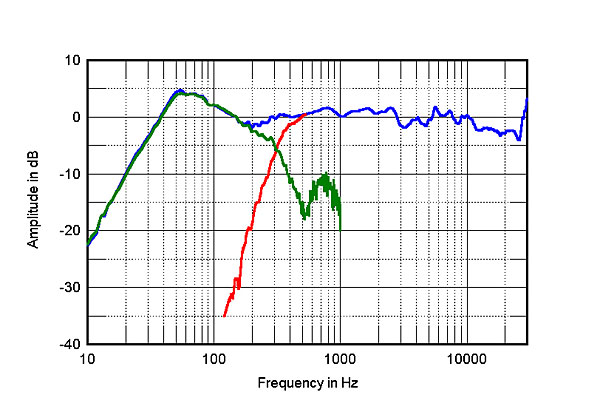
The impedance traces suggest that the sealed enclosure is tuned to 34Hz. The two woofers behave identically, and their summed output is shown as the green trace in fig.2. The crossover to the midrange unit (red trace) appears to be set at 300Hz, and the broad peak in the midbass will be almost entirely due to the nearfield measurement technique, which assumes a 2pi (half-spherical) acoustic environment for the drivers. This peak aside, the –6dB frequency is just below 30Hz, which means that with the slow, 12dB/octave rolloff below the tuning frequency that is typical of a sealed enclosure, and the typical amount of boundary reinforcement or "room gain," the S5 Mk.II's output will extend to 20Hz. The Magico's upper-frequency farfield output, averaged across a 30° horizontal window centered on the tweeter axis (fig.3, blue trace above 300Hz), is impressively even overall, though with slight depressions in the presence region and in the top octave before the ultrasonic peak, due to the tweeter's primary dome resonance. Note, however, that this resonance lies above the 30kHz limit of this graph.
Fig.2 Magico S5 Mk.II, anechoic response on tweeter axis at 50", averaged across 30° horizontal window and corrected for microphone response, with nearfield responses of midrange unit (red) and woofers (green), plotted in the ratios of the square roots of the radiating areas, and the complex sum of the nearfield midrange and woofer responses plotted below 300Hz.
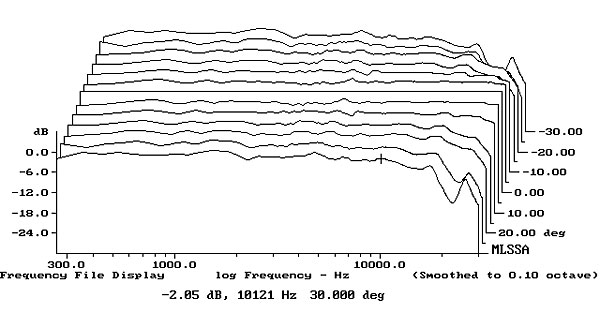
Fig.3 Magico S5 Mk.II, lateral response family at 50", normalized to response on tweeter axis, from back to front: differences in response 30–5° off axis, reference response, differences in response 5–30° off axis.
Because of the practical limitations of my listening room, I was able to plot the S5 Mk.II's horizontal dispersion out to only 30° to the sides. The result, with the off-axis traces normalized to the tweeter-axis response, is shown in fig.3: the speaker's off-axis behavior is smooth and even, with the beginnings of a top-octave rolloff evident more than 20° to the side. In the vertical plane, with again the off-axis traces normalized to the response on the tweeter axis (which is 42" from the floor), the Magico's balance doesn't change significantly over a ±10° window (fig.4). Only when you get to 15° above the tweeter does a suckout at the upper crossover frequency begin to be seen, suggesting a sensible crossover configuration.
Fig.4 Magico S5 Mk.II, vertical response family at 50", normalized to response on tweeter axis, from back to front: differences in response 15–5° above axis, reference response, differences in response 5–10° below axis.
The red trace in fig.5 shows the spatially averaged response of the pair of S5 Mk.IIs in my listening room. To create such graphs, I average 20 1/6-octave–smoothed spectra, individually taken for the left and right speakers using SMUGSoftware's FuzzMeasure 3.0 program and a 96kHz sample rate, in a rectangular grid 36" wide by 18" high and centered on the positions of my ears. This mostly eliminates the room acoustic's effects.
Fig.5 Magico S5 Mk.II, spatially averaged, 1/6-octave response in JA's listening room (red); and of Crystal Arabesque Minissimo Diamond (blue).
Fig.6 Magico S5 Mk.II, step response on tweeter axis at 50" (5ms time window, 30kHz bandwidth).
Fig.7 Magico S5 Mk.II, cumulative spectral-decay plot on tweeter axis at 50" (0.15ms risetime).
There can be no question: My measurements of Magico's S5 Mk.II reveal it to be a superbly well-engineered loudspeaker.—John Atkinson
Footnote 1: See, for example, fig.7 here.















