Sidebar 4: Measurements
I tested the Marantz Model 30 with my Audio Precision SYS2722 system (see the January 2008 "As We See It"). I looked first at its behavior via its line inputs, mostly with the volume control set to its maximum of "0.0," then at lower settings. (The volume control operates in accurate 0.5dB steps.) As the Model 30's power inlet lacks a ground connection, I connected a wire from the analyzer ground to the ground terminal on the amplifier's rear panel, to minimize power supply noise, which would otherwise be a problem with the phono input. Because the Model 30 features class-D output stages based on Hypex modules, all the measurements other than the frequency-response tests were taken with Audio Precision's AUX-0025 passive low-pass filter, which eliminates the ultrasonic noise that might otherwise drive my analyzer's input into slew-rate limiting. Without the filter, 271mV of ultrasonic noise was present at the amplifier output terminals.
The maximum gain at the loudspeaker outputs was 42dB. For the input labeled Power Amplifier, which bypasses the preamplifier stage, the gain measured 28.8dB. At the preamplifier and headphone outputs, the maximum gain measured 17.33dB and 33.33dB, respectively. The Model 30 preserved absolute polarity (ie, was noninverting) at all of its outputs.
The Model 30's line input impedance is specified at 13k ohms; I measured 16.5k ohms at 20Hz and 1kHz, dropping to a sufficiently high 14.6k ohms at 20kHz. The Power Amplifier input impedance was 17.3k ohms at low and middle frequencies, dropping to 15.7k ohms at the top of the audioband. The preamplifier output impedance was an appropriately low 21 ohms across the band; the headphone output impedance was a moderately high 84 ohms, meaning that low-impedance headphones will not be driven optimally by the Model 30.
The amplifier's output impedance was very low, at 0.01 ohms from 20Hz to 20kHz. The modulation of the amplifier's frequency response, due to the Ohm's law interaction between this source impedance and the impedance of our standard simulated loudspeaker, was therefore minimal (fig.1, gray trace). The small-signal bandwidth with the volume control set to its maximum is limited by the output stage's low-pass filter, which gives a response that is down by 0.5dB at 20kHz and 3dB at 60kHz into resistive loads (blue, red, cyan, magenta, and green traces). Channel matching was excellent and maintained at lower settings of the volume control. The response at the headphone jack was flat in the audioband: –0.25dB at 10Hz and 70kHz. A small amount of critically damped overshoot can be seen with the amplifier's reproduction of a 10kHz squarewave (fig.2).


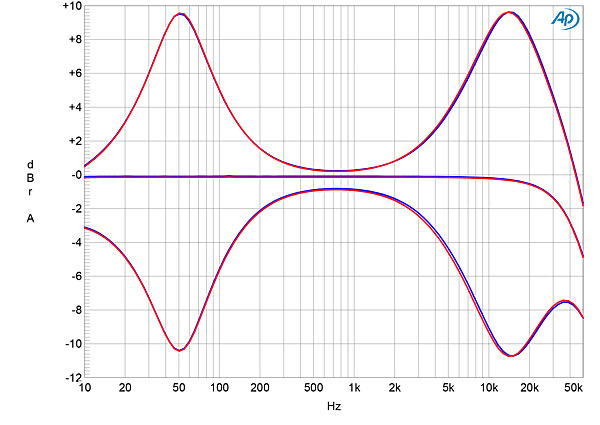
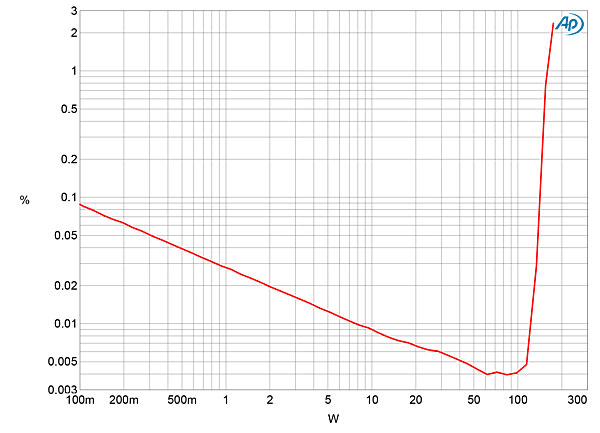
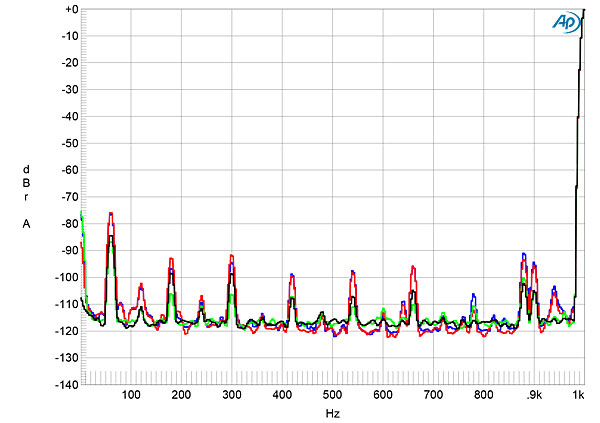 Fig.5 plots the percentage of THD+noise in the Model 30's speaker output into 8 ohms. The THD+N continues to drop below 60W due to the fixed level of noise becoming a decreasing percentage of the signal level; distortion is therefore below the noise floor at moderate powers. Though the Model 30's maximum power is specified as 100W into 8 ohms (20dBW), using our definition of clipping, which is when the output's percentage of THD+noise reaches 1%, the amplifier clipped at 165Wpc into 8 ohms (22.2dBW), as can be seen in fig.5. The Marantz also exceeded its specified power of 200W into 4 ohms (20dBW), clipping at 240W into that load (20.8dBW, fig.6). (Both graphs were taken with both channels driven.)


 Because the Model 30's Mute button silences the preamplifier output as well as the loudspeaker output, I primarily tested the Marantz's phono input from the headphone output so that I wouldn't damage the power amplifier section with high-level input signals. (Inserting a headphone plug into the ¼" headphone jack mutes the speaker output.)
The Model 30's phono input offers a moving-magnet mode and three moving-coil modes, labeled MC Low, MC Mid, and MC High. It preserved absolute polarity at all outputs in all modes. The MM input impedance was 34k ohms at 20Hz, 38k ohms at 1kHz, and 30.5k ohms at 20kHz. In MC Low mode, the input impedance was 33 ohms from 20Hz to 20kHz. MC Mid offered 101 ohms and MC High 390 ohms, both values consistent across the audioband. With the volume control set to its maximum, MM mode offered 58.7dB of gain at the preamplifier output, 70dB at the headphone output, and a high 83.5dB at the loudspeaker output. In the three MC modes, the maximum gain at the preamplifier output was 89.9dB, 92.5dB, and 93.7dB, though these are affected by the interaction between the low input impedance and the Audio Precision's 20 ohm source impedance.
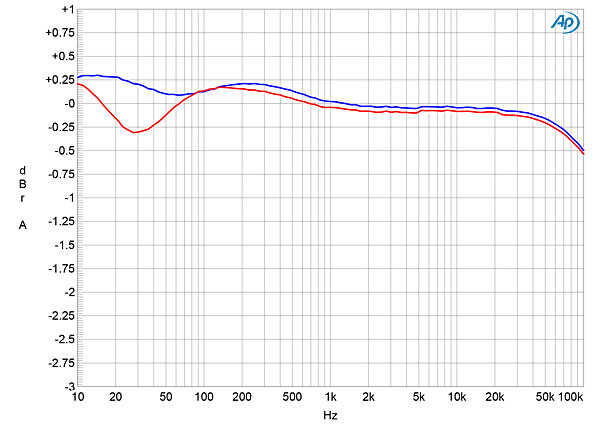
The Model 30's RIAA correction offered very low error (fig.11), with a slight (0.24dB) boost in the lower midrange. It was well-matched between the channels, except in the bass, where the right channel (red trace) had a little less output than the left (blue). Channel separation via the phono input was good, at >60dB in both directions.
Because the Model 30's Mute button silences the preamplifier output as well as the loudspeaker output, I primarily tested the Marantz's phono input from the headphone output so that I wouldn't damage the power amplifier section with high-level input signals. (Inserting a headphone plug into the ¼" headphone jack mutes the speaker output.)
The Model 30's phono input offers a moving-magnet mode and three moving-coil modes, labeled MC Low, MC Mid, and MC High. It preserved absolute polarity at all outputs in all modes. The MM input impedance was 34k ohms at 20Hz, 38k ohms at 1kHz, and 30.5k ohms at 20kHz. In MC Low mode, the input impedance was 33 ohms from 20Hz to 20kHz. MC Mid offered 101 ohms and MC High 390 ohms, both values consistent across the audioband. With the volume control set to its maximum, MM mode offered 58.7dB of gain at the preamplifier output, 70dB at the headphone output, and a high 83.5dB at the loudspeaker output. In the three MC modes, the maximum gain at the preamplifier output was 89.9dB, 92.5dB, and 93.7dB, though these are affected by the interaction between the low input impedance and the Audio Precision's 20 ohm source impedance.
The Model 30's RIAA correction offered very low error (fig.11), with a slight (0.24dB) boost in the lower midrange. It was well-matched between the channels, except in the bass, where the right channel (red trace) had a little less output than the left (blue). Channel separation via the phono input was good, at >60dB in both directions.

 My only criticism concerns the small gray-on-black lettering on both the remote control and the front panel, which I found difficult to read.—John Atkinson
Fig.1 Marantz Model 30, frequency response at 2.83V into: simulated loudspeaker load (gray), 8 ohms (left channel blue, right red), 4 ohms (left cyan, right magenta), 2 ohms (green) (1dB/vertical div.).
Fig.02 Marantz Model 30, small-signal 10kHz squarewave into 8 ohms.
Fig.3 shows the effects of the treble and bass controls, set to their maximum and minimum positions, compared with the response with the controls bypassed. The boost or cut at low and high frequencies is just below ±10dB. Channel separation via the line inputs (not shown) was okay, at >70dB in both directions below 2kHz, decreasing to 50dB at 20kHz.
Fig.3 Marantz Model 30, frequency response at 2.83V into 8 ohms with treble and bass controls set to their maximum and minimum and switched out of circuit (left channel blue, right red, 2dB/vertical div.).
The level of the Marantz's noise floor depended on the volume control setting. With the Audio Precision's output floating but a separate grounding wire connecting the amplifier's chassis to that of the analyzer and the control set to "0.0," supply-related spuriae at 60Hz and its odd harmonics were visible in the amplifier's low-frequency output spectrum (fig.4, blue and red traces), but were lowered by 10dB when the control was set to "–12.0" (fig.4, green and gray traces). The wideband, unweighted S/N ratio, taken with the Audio Precision filter, the input shorted to ground, and the volume control set to its maximum, was 65.7dB, left, and 67.2dB, right ref. 2.83V output into 8 ohms. Switching an A-weighting filter into circuit improved the ratio to 88.5dB.
Fig.4 Marantz Model 30, spectrum of 1kHz sinewave, DC–1kHz, at 1W into 8 ohms with volume control set to "0.0" (left channel blue, right red) and "–12.0" (left green, right gray, linear frequency scale).
Fig.5 Marantz Model 30, distortion (%) vs 1kHz continuous output power into 8 ohms.
Fig.6 Marantz Model 30, distortion (%) vs 1kHz continuous output power into 4 ohms.
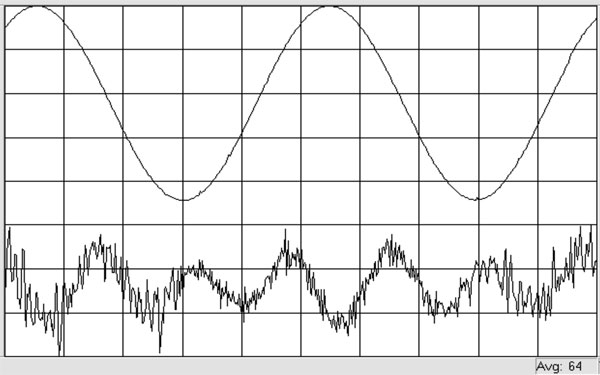
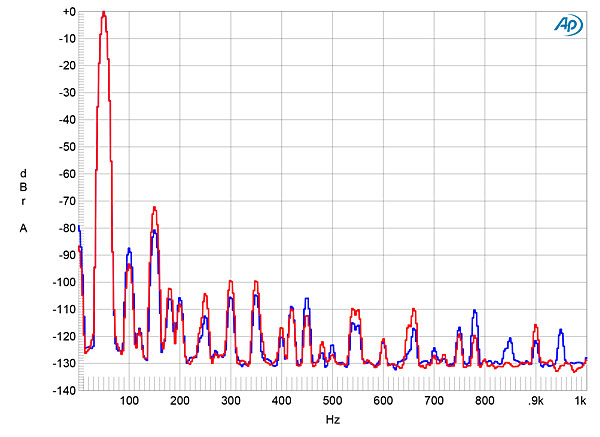
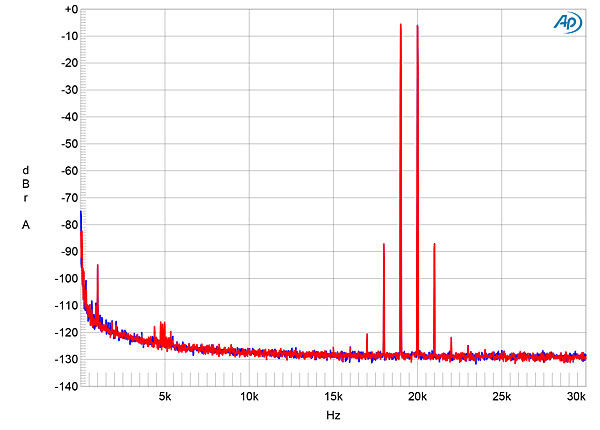
I measured how the Model 30's distortion changed with frequency at 15.5V output, which is equivalent to 30W into 8 ohms, 60W into 4 ohms, and 120W into 2 ohms. The THD+N percentage was very low below 10kHz into both 8 ohms (fig.7, blue and red traces) and 4 ohms (cyan, magenta traces). However, it did rise in the top audio octave into 2 ohms (gray trace). The distortion is predominantly the relatively innocuous third harmonic (fig.8), with the second and higher harmonics much lower in level (fig.9). Intermodulation distortion was also very low (fig.10).
Fig.7 Marantz Model 30, THD+N (%) vs frequency at 15.5V into: 8 ohms (left blue, right red), 4 ohms (left cyan, right magenta), and 2 ohms (gray).
Fig.8 Marantz Model 30, 1kHz waveform at 20W into 8 ohms, 0.016% THD+N (top); distortion and noise waveform with fundamental notched out (bottom, not to scale).
Fig.9 Marantz Model 30, spectrum of 50Hz sinewave, DC–1kHz, at 60W into 4 ohms (left channel blue, right red, linear frequency scale).
Fig.10 Marantz Model 30, HF intermodulation spectrum, DC–30kHz, 19+20kHz at 30W peak into 8 ohms (linear frequency scale).
Fig.11 Marantz Model 30, phono input, MM mode, response with RIAA correction (left channel blue, right red, 0.5dB/vertical div.)
With the volume control set to "–16.0," the phono input's noise performance in MM mode was very good, with unweighted audioband signal/noise ratios (ref. 1kHz at 5mV input signal) of 72dB (average of both channels). The ratios improved by 11dB when restricted to the audioband and to 89dB when A-weighted. The higher gains in the three MC modes reduced the S/N ratios, but not by much. Even in MC High mode, the ratios were 64dB, unweighted wideband, 68dB, audioband, and 73dB, A-weighted, all three ref. 1kHz at 500µV.
The Model 30's phono input offered excellent overload margins at low and middle frequencies, at 25dB ref. 1kHz at 5mV in MM mode and 26dB ref. 1kHz at 500µV in MC High mode. The margin was lower at the top of the audioband, at 14.3dB, MM, 19.1dB, MC Low 16.65dB, MC Mid, and 15.3dB, MC High, though this should not be any cause for concern. The phono input's distortion was very low, primarily consisting of the second harmonic, but at an input level 6dB higher than the nominal MM output level of 5mV, this lay at just –100dB (0.001%) (fig.12). Intermodulation distortion via the Model 30's phono input was similarly very low (fig.13).
Fig.12 Marantz Model 30, phono input, MM mode, spectrum of 1kHz sinewave, DC–10kHz, at 10mV input (left channel blue, right red; linear frequency scale).
Fig.13 Marantz Model 30, phono input, MM mode, HF intermodulation spectrum, DC–30kHz, 19+20kHz @ 5V into 100k ohms (linear frequency scale).
Overall, the Marantz Model 30 performed very well on the test bench. It exceeded its specified power; offers low, primarily third-harmonic distortion; and includes a versatile, low-noise, low-distortion phono input.