

Because it is Stereophile policy to change out only one component at a time, I kept my usual VAC and darTZeel amplifiers. Yes, I auditioned these $7000/pair speakers ($8000/pair with stands) with monoblock amplifiers that cost around $170,000/pair (see Associated Equipment).
We Get Requests
I own several versions of Sonny Rollins's Way Out West, including an original Stereo Records pressing (Stereo Records S7017) and the recent one from The Electric Recording Company, but the one I played is the 24/192 Qobuz version. To my surprise, the Duos reproduced the full weight, textural density, and "juiciness" of Rollins's hard-left-channel horn down to the deepest honks, surrounded by the subtle room sound that extended well toward center stage. The horn's harder edges were somewhat softened.
 Over on the right channel, Ray Brown's bass and Shelly Manne's drums fared well but not as well. The opening drumstick hit on "I'm an Old Cowhand" was slightly softer than expected, as the kit was generally, but only slightly, and a little soft is preferable to bright and etchy. Ray Brown's bass was remarkably taut, well-controlled, and muscular with but a slight bit of softening of attack.
Despite the robust bass produced by this small speaker, decay was fast, clean, and close to overhang-free. My notes simply said "remarkable." The overall picture was so effective because the top, bottom, and middle were well-integrated and shared an overall character—performance you'd expect from a skilled speaker designer.
A great test of midrange clarity is Charlie Byrd at the Village Vanguard (Riverside RS 9452), recorded on January 15, 1961, a few months before Bill Evans's famous Vanguard set engineered by David Jones. Analog Planet contributor Joseph Washek, who wrote a fascinating piece about Jones's New Orleans recording adventures, thinks Jones engineered this Byrd album a few days before he left for New Orleans, although there's no proof other than the similarly superb, transparent, and subtle recorded sound.
Over on the right channel, Ray Brown's bass and Shelly Manne's drums fared well but not as well. The opening drumstick hit on "I'm an Old Cowhand" was slightly softer than expected, as the kit was generally, but only slightly, and a little soft is preferable to bright and etchy. Ray Brown's bass was remarkably taut, well-controlled, and muscular with but a slight bit of softening of attack.
Despite the robust bass produced by this small speaker, decay was fast, clean, and close to overhang-free. My notes simply said "remarkable." The overall picture was so effective because the top, bottom, and middle were well-integrated and shared an overall character—performance you'd expect from a skilled speaker designer.
A great test of midrange clarity is Charlie Byrd at the Village Vanguard (Riverside RS 9452), recorded on January 15, 1961, a few months before Bill Evans's famous Vanguard set engineered by David Jones. Analog Planet contributor Joseph Washek, who wrote a fascinating piece about Jones's New Orleans recording adventures, thinks Jones engineered this Byrd album a few days before he left for New Orleans, although there's no proof other than the similarly superb, transparent, and subtle recorded sound.
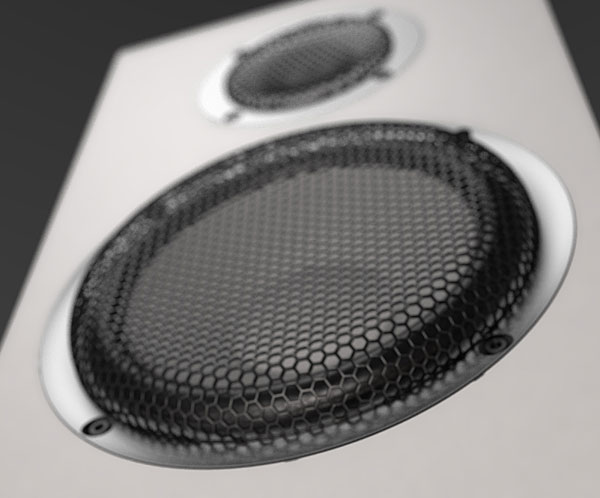 Keter Betts on bass and Buddy Deppenschmidt on drums back Byrd. The same pair are on the classic Jazz Sambawith Stan Getz, recorded a year later, but this set is more quiet and introspective, like the Bill Evans Vanguard session. Most of the action is in the midrange, and everyone plays softly. The interplay between Byrd and Betts is subtle. With this recording, with these speakers, you can hear way into the stage and catch all the subtle gestures and delicate attack of Byrd's fingers on the strings. Even with the volume turned way down, the instrument remained in 3D focus, and transients were rendered cleanly. Betts's playing is equally low key, yet nothing's lost to midbass slop, and the string attack is clean. None of this gets lost in the box. The cabinet does not make itself known.
I have to return to this speaker's surprising bottom end: I was offered a WAV file of the soundtrack to The Last Porno Show, performed by Morricone Youth. Ennio Morricone had just died (July 6), so I figured a group with that name might make for an interesting tie-in. The band, which has been around since 1999, has an interesting story, but this soundtrack is basic, built around a single theme. It sounds like a young composer just figuring things out, paying homage to the master. The recording was good, however, and the subterranean bass on track 6—a short cut called "Discovering Dad" (doing what I didn't want to know)—positively startled. Nothing I'd played since installing the speakers contained such unrelenting deep-bass energy. Each deep, identical quarter-note shook the room. I repeated the track and cranked it up to try to get the speaker to lose its composure, but it didn't budge. That was a lot of deep, quality bass from a very small speaker!
I didn't measure the frequency response, but the sensation of low-frequency generosity was there, and that's what matters. And when I played the Analogue Productions reissue of Johnny Hartman's Once in Every Life (APJ105), the baritone singer's lower registers were free and clear of lower midbass bloat. Hartman's vocals floated freely between the speakers, never getting caught in a box. The timbral and textural balance of Joe Wilder's flugelhorn rang true, and like Hartman's voice, Billy Taylor's piano never descended into murk. Victor Gaskin's bass lines were tuneful, muscular, and had far more authority and cleaner attack than any speaker this size should produce.
How does Oscar sound on Oscar Peterson, I mean. I played "You Look Good to Me," from the double-45rpm Analog Productions reissue of We Get Requests (Verve V6-8606), at comfortably high SPLs. If I'd sat you down blindfolded, I doubt you'd guess you were listening to a small two-way standmount (two of them, technically). As on the Rollins LP, Ray Brown supplies bass, but here the great Ed Thigpen is on drums.
The track begins with a short introduction: Oscar's piano center stage, a bit of finger-cymbal percussion on the left, and then Ray Brown's arco bass sweep, which should go deep and produce, at one point, a shuddery, visceral swell that's felt as much as it's heard. The tune then follows, with the trio in full swing. I'll borrow a Dudley-ism here and write that these little speakers played the tune, with Brown's bass sweep rising to a deeply felt swell and then, once the tune gets underway, well-articulated finger plucks that are not at all shy on bottom. Peterson's piano sits, well-focused, well forward and center-stage, with clean attack, neither "tinkly" nor softened nor in any way inhibited by the lower/midbass congestion that's so often the trade-off for bass extension (or the illusion of it) in small two-way loudspeakers.
Keter Betts on bass and Buddy Deppenschmidt on drums back Byrd. The same pair are on the classic Jazz Sambawith Stan Getz, recorded a year later, but this set is more quiet and introspective, like the Bill Evans Vanguard session. Most of the action is in the midrange, and everyone plays softly. The interplay between Byrd and Betts is subtle. With this recording, with these speakers, you can hear way into the stage and catch all the subtle gestures and delicate attack of Byrd's fingers on the strings. Even with the volume turned way down, the instrument remained in 3D focus, and transients were rendered cleanly. Betts's playing is equally low key, yet nothing's lost to midbass slop, and the string attack is clean. None of this gets lost in the box. The cabinet does not make itself known.
I have to return to this speaker's surprising bottom end: I was offered a WAV file of the soundtrack to The Last Porno Show, performed by Morricone Youth. Ennio Morricone had just died (July 6), so I figured a group with that name might make for an interesting tie-in. The band, which has been around since 1999, has an interesting story, but this soundtrack is basic, built around a single theme. It sounds like a young composer just figuring things out, paying homage to the master. The recording was good, however, and the subterranean bass on track 6—a short cut called "Discovering Dad" (doing what I didn't want to know)—positively startled. Nothing I'd played since installing the speakers contained such unrelenting deep-bass energy. Each deep, identical quarter-note shook the room. I repeated the track and cranked it up to try to get the speaker to lose its composure, but it didn't budge. That was a lot of deep, quality bass from a very small speaker!
I didn't measure the frequency response, but the sensation of low-frequency generosity was there, and that's what matters. And when I played the Analogue Productions reissue of Johnny Hartman's Once in Every Life (APJ105), the baritone singer's lower registers were free and clear of lower midbass bloat. Hartman's vocals floated freely between the speakers, never getting caught in a box. The timbral and textural balance of Joe Wilder's flugelhorn rang true, and like Hartman's voice, Billy Taylor's piano never descended into murk. Victor Gaskin's bass lines were tuneful, muscular, and had far more authority and cleaner attack than any speaker this size should produce.
How does Oscar sound on Oscar Peterson, I mean. I played "You Look Good to Me," from the double-45rpm Analog Productions reissue of We Get Requests (Verve V6-8606), at comfortably high SPLs. If I'd sat you down blindfolded, I doubt you'd guess you were listening to a small two-way standmount (two of them, technically). As on the Rollins LP, Ray Brown supplies bass, but here the great Ed Thigpen is on drums.
The track begins with a short introduction: Oscar's piano center stage, a bit of finger-cymbal percussion on the left, and then Ray Brown's arco bass sweep, which should go deep and produce, at one point, a shuddery, visceral swell that's felt as much as it's heard. The tune then follows, with the trio in full swing. I'll borrow a Dudley-ism here and write that these little speakers played the tune, with Brown's bass sweep rising to a deeply felt swell and then, once the tune gets underway, well-articulated finger plucks that are not at all shy on bottom. Peterson's piano sits, well-focused, well forward and center-stage, with clean attack, neither "tinkly" nor softened nor in any way inhibited by the lower/midbass congestion that's so often the trade-off for bass extension (or the illusion of it) in small two-way loudspeakers.
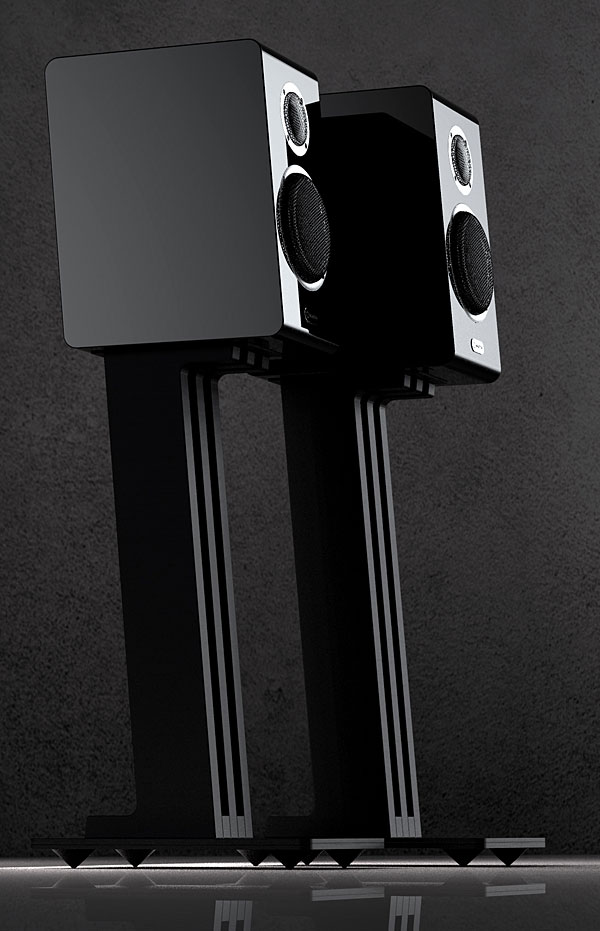 Norah Jones has a new, daring "breakup" album out, Pick Me Up Off the Floor (Blue Note B003179801), with spare backing on most tracks. All the backing instruments are placed, dreamily, well behind the singer rather than upfront and hitting hard. The production on most tracks is airy and midrange-rich. On this recording, too, this speaker demonstrated its low-midbass coloration and freedom from boxy resonances, at low and high SPLs.
I Hear a Symphony
Norah Jones has a new, daring "breakup" album out, Pick Me Up Off the Floor (Blue Note B003179801), with spare backing on most tracks. All the backing instruments are placed, dreamily, well behind the singer rather than upfront and hitting hard. The production on most tracks is airy and midrange-rich. On this recording, too, this speaker demonstrated its low-midbass coloration and freedom from boxy resonances, at low and high SPLs.
I Hear a Symphony
To test the Duo's abilities on large orchestral works, I played the Eroica—Symphony No.3—from the outstanding box-set reissue of Bernstein and the Vienna Philharmonic's Beethoven symphony cycle (DG 479 8721), produced from live recordings and released in 1980. I shouldn't have been surprised by the midband's airy transparency or the speaker's ability to freely float the first movement's sweeping strings and effortlessly project the woodwinds within the forest of instruments—but surprised I was. Yes, the double basses and timpani lacked full weight, but there was enough weight to provide a satisfying foundation. The hall's reverberant field and decay were also presented well, adding up to an enjoyable presentation that should satisfy any classical music lover, on a well-under-$10,000 speaker budget. Conclusion
Marten's Oscar Duo is a smooth-sounding speaker. Its timbral balance is on the warmer, sweeter side of the musical street but not too warm or sweet. You have to listen for quite some time, and to a great deal of music, before the speaker 'fesses up its timbral personality, so well-crafted is the design.
As expected from any small speaker, the Oscar Duo's biggest shortcoming was its macrodynamic performance. It can't scale the dynamic heights, but its microdynamic performance—its ability to present small, low-level dynamic shifts—was very good, surprisingly so for a speaker box that isn't made from some heroic, exotic material. Given its size, its ability to produce large-scale dynamic contrasts without strain or stress and without sounding boxy, at moderately high SPLs, was impressive. The Duo's spatial presentation also impressed. The pair produced a generously sized stage—wide, tall, and deep—within which were presented solid images, proportionately sized and well-focused. Lights out, the Duos disappeared, producing a space-filling picture that I wouldn't have thought possible from such small boxes. The picture remained stable regardless of SPLs.
The speaker's two most impressive qualities were its confounding bass performance—its ability to present the illusion of genuine low-frequency extension (I'm looking forward to the measurements) without clogging up the lower midrange and doing damage to acoustic guitars and voices.
Speaking of which, the Electric Recording Company's mono-fold-down reissue of Love's Forever Changes (ERC 057M) arrived yesterday, and while I'm not sure why ERC chose to take the stereo tape and produce a mono folddown—there never was a dedicated mono mix—I played the record last night, and it was the first time in decades of playing it that I really felt I was hearing Arthur Lee's voice in the studio. The all-tube mastering is mostly responsible for that, but a boxy-sounding small speaker could easily destroy the illusion. The Oscar Duo isn't a boxy-sounding speaker. It delivered the goods.
I wasn't looking forward to mothballing my big speakers for more than a month to listen to these or any small, two-way speakers, but I enjoyed every listen and never felt shortchanged. Designer Leif Olofsson has threaded the needle, producing a small speaker that can produce prodigious bass (or at least bass that sounds prodigious) with composure at relatively high SPLs, without muddying up the midrange.
I own several versions of Sonny Rollins's Way Out West, including an original Stereo Records pressing (Stereo Records S7017) and the recent one from The Electric Recording Company, but the one I played is the 24/192 Qobuz version. To my surprise, the Duos reproduced the full weight, textural density, and "juiciness" of Rollins's hard-left-channel horn down to the deepest honks, surrounded by the subtle room sound that extended well toward center stage. The horn's harder edges were somewhat softened.
Over on the right channel, Ray Brown's bass and Shelly Manne's drums fared well but not as well. The opening drumstick hit on "I'm an Old Cowhand" was slightly softer than expected, as the kit was generally, but only slightly, and a little soft is preferable to bright and etchy. Ray Brown's bass was remarkably taut, well-controlled, and muscular with but a slight bit of softening of attack.
Despite the robust bass produced by this small speaker, decay was fast, clean, and close to overhang-free. My notes simply said "remarkable." The overall picture was so effective because the top, bottom, and middle were well-integrated and shared an overall character—performance you'd expect from a skilled speaker designer.
A great test of midrange clarity is Charlie Byrd at the Village Vanguard (Riverside RS 9452), recorded on January 15, 1961, a few months before Bill Evans's famous Vanguard set engineered by David Jones. Analog Planet contributor Joseph Washek, who wrote a fascinating piece about Jones's New Orleans recording adventures, thinks Jones engineered this Byrd album a few days before he left for New Orleans, although there's no proof other than the similarly superb, transparent, and subtle recorded sound.
Keter Betts on bass and Buddy Deppenschmidt on drums back Byrd. The same pair are on the classic Jazz Sambawith Stan Getz, recorded a year later, but this set is more quiet and introspective, like the Bill Evans Vanguard session. Most of the action is in the midrange, and everyone plays softly. The interplay between Byrd and Betts is subtle. With this recording, with these speakers, you can hear way into the stage and catch all the subtle gestures and delicate attack of Byrd's fingers on the strings. Even with the volume turned way down, the instrument remained in 3D focus, and transients were rendered cleanly. Betts's playing is equally low key, yet nothing's lost to midbass slop, and the string attack is clean. None of this gets lost in the box. The cabinet does not make itself known.
I have to return to this speaker's surprising bottom end: I was offered a WAV file of the soundtrack to The Last Porno Show, performed by Morricone Youth. Ennio Morricone had just died (July 6), so I figured a group with that name might make for an interesting tie-in. The band, which has been around since 1999, has an interesting story, but this soundtrack is basic, built around a single theme. It sounds like a young composer just figuring things out, paying homage to the master. The recording was good, however, and the subterranean bass on track 6—a short cut called "Discovering Dad" (doing what I didn't want to know)—positively startled. Nothing I'd played since installing the speakers contained such unrelenting deep-bass energy. Each deep, identical quarter-note shook the room. I repeated the track and cranked it up to try to get the speaker to lose its composure, but it didn't budge. That was a lot of deep, quality bass from a very small speaker!
I didn't measure the frequency response, but the sensation of low-frequency generosity was there, and that's what matters. And when I played the Analogue Productions reissue of Johnny Hartman's Once in Every Life (APJ105), the baritone singer's lower registers were free and clear of lower midbass bloat. Hartman's vocals floated freely between the speakers, never getting caught in a box. The timbral and textural balance of Joe Wilder's flugelhorn rang true, and like Hartman's voice, Billy Taylor's piano never descended into murk. Victor Gaskin's bass lines were tuneful, muscular, and had far more authority and cleaner attack than any speaker this size should produce.
Norah Jones has a new, daring "breakup" album out, Pick Me Up Off the Floor (Blue Note B003179801), with spare backing on most tracks. All the backing instruments are placed, dreamily, well behind the singer rather than upfront and hitting hard. The production on most tracks is airy and midrange-rich. On this recording, too, this speaker demonstrated its low-midbass coloration and freedom from boxy resonances, at low and high SPLs.
To test the Duo's abilities on large orchestral works, I played the Eroica—Symphony No.3—from the outstanding box-set reissue of Bernstein and the Vienna Philharmonic's Beethoven symphony cycle (DG 479 8721), produced from live recordings and released in 1980. I shouldn't have been surprised by the midband's airy transparency or the speaker's ability to freely float the first movement's sweeping strings and effortlessly project the woodwinds within the forest of instruments—but surprised I was. Yes, the double basses and timpani lacked full weight, but there was enough weight to provide a satisfying foundation. The hall's reverberant field and decay were also presented well, adding up to an enjoyable presentation that should satisfy any classical music lover, on a well-under-$10,000 speaker budget. Conclusion
Marten's Oscar Duo is a smooth-sounding speaker. Its timbral balance is on the warmer, sweeter side of the musical street but not too warm or sweet. You have to listen for quite some time, and to a great deal of music, before the speaker 'fesses up its timbral personality, so well-crafted is the design.















