

Sidebar 3: Using the MartinLogan Dynamo 800X with an External Crossover
I used a JL Audio CR-1 external electronic crossover because its high-pass filter could be used to protect the electrostatic panels of my Quad ESL-989 speakers from deep-bass pulses. To do this, I connected the line-level output of my Bryston BP-173 preamplifier to the input of a JLA CR-1 with balanced interconnects. Additional balanced interconnects were run from the CR-1's high-pass outputs to the Mark Levinson No.534 power amplifier I used to drive the Quads.
The CR-1's high-pass filter was set to 70Hz/24dB/octave, and its low-pass filter to 150Hz/24dB/octave so it wouldn't interfere with the sub. Then the 800X's built-in low-pass filter was set to 35Hz/24dB/octave.
I played Lyle Lovett singing "Friend of the Devil," from Deadicated: A Tribute to the Grateful Dead (CD, Arista DCD-8669). The bass seemed overblown, with weak pitch definition, and the sounds of the ML subs and the Quads didn't blend well.
I used the Fast Fourier Transform (FFT) module of Studio Six's AudioTools to measure the in-room response with uncorrelated pink noise. I averaged five room responses across a 2' horizontal window at the level of my ears when I'm sitting in my listening chair. The in-room response revealed a stubborn –10dB null centered at around 60Hz. Changing the subs' phase or modifying their built-in "subsonic" filter between 20 and 30Hz didn't fix the problem. I then set both the 800Xes' low-pass filter and the Quads' high-pass filter to 80Hz, based on a recommendation for a starting crossover frequency for subwoofers given me by Revel's Kevin Voecks when he and I set up Revel's Ultima Rhythm2 subwoofer in my old room ($10,000).
VoilÖ! The midbass suckout disappeared, bass extension and soundstage depth increased, and the blend of subs and Quads was smoother. (To protect my Quads, I used this setting for any listening session involving bass-drum passages.) Fig.1 shows the in-room response of the Quad ESL-989s run full-range with the high-pass filter bypassed, fig.2 that of the 800Xes with their low-pass filter bypassed. Then I turned on the subwoofers crossover filters to measure the system's in-room response (fig.3).—Larry Greenhill
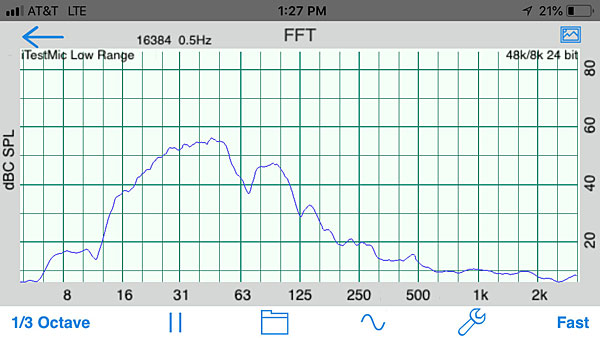


Fig.1 MartinLogan Dynamo 800X, full-range in-room response, 8Hz–2kHz (5dB/vertical div.).
Fig.2 Quad ESL-989, full-range in-room response, 8Hz–2kHz (5dB/vertical div).
Fig.3 In-room response of Quad ESL-989 and MartinLogan Dynamo 800X (using JLA CR-1 high-pass and 800X low-pass filters), 8Hz–2kHz (5dB/vertical div.).















