

Sidebar 3: Measurements
I examined the Meridian Prime's electrical performance with my Audio Precision SYS2722 system (see www.ap.com and the January 2008 "As We See It"). The Prime was powered by its optional Prime Power Supply for all measurements, and I tested its USB input with my MacBook Pro running on battery power. Apple's USB Prober utility reported the Product String as "Meridian Prime Headphone Amp" and confirmed that the Prime operated in the preferred isochronous asynchronous mode. The Prime correctly handled data with sample rates ranging from 44.1 to 192kHz, including 88.2 and 176.4kHz. The Prime doesn't decode DSD files, however.
The maximum output level at 1kHz from the RCA jacks was 2.68V, 2.5dB higher than the CD Standard's 2V, sourced from a uniform 47 ohms across the audioband. The maximum headphone output was very similar, but the output impedance from the ¼" jacks was 1 ohm. All outputs preserved absolute polarity (ie, were non-inverting). The Prime's impulse response with USB data is shown in fig.1. The lack of ringing reveals the Meridian's reconstruction filter to be a minimum-phase type, and the spectrum of the Prime's output while it decoded 44.1kHz-sampled data representing white noise at –4dBFS (fig.2, magenta and red traces) shows that the filter has a complete null at 22.05kHz (green vertical line), revealing that it is Meridian's well-regarded "apodizing" filter. The cyan and blue traces are the spectrum of a full-scale tone at 19.1kHz; the aliasing product at 25kHz is suppressed by 100dB, and the second and third harmonics are both low in level, at –93dB (0.002%) and –70dB (0.03%), respectively. With both signals in this graph, however, some low-level spurious ultrasonic tones are visible.

 Plotting the Prime's USB frequency response with sample rates of 44.1, 96, and 192kHz (fig.3) revealed that the response followed the same gentle rolloff above the audioband with each sample rate; although not shown in this graph, there is then a sharp drop-off just below half of each rate.


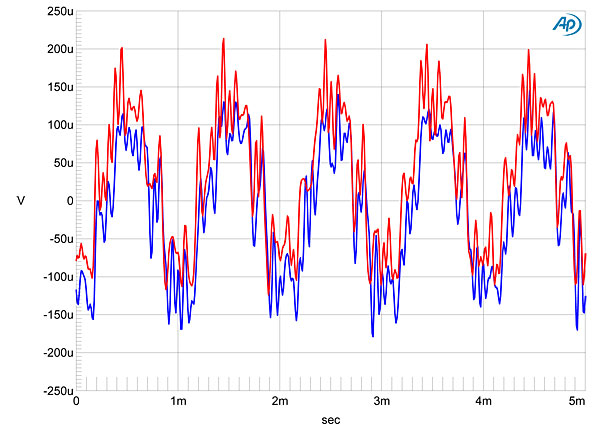
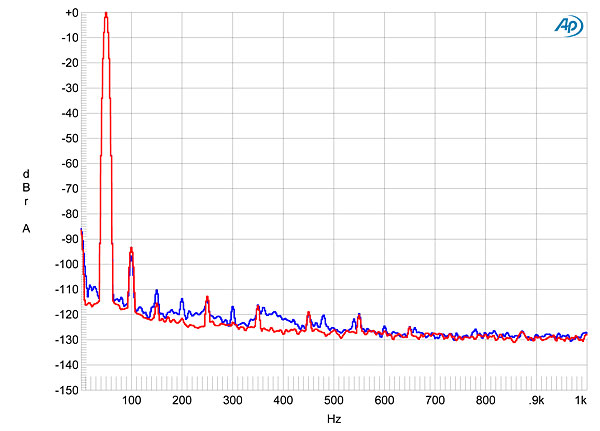


 Fig.13 plots the THD+noise percentage in the Prime's RCA output against output voltage into 100k ohms. The downward slope below 4V is due to any distortion lying below the noise. (A constant level of noise increases as a percentage as the signal level falls.) Defining clipping as the level where the THD+N reaches 1%, the Prime's RCA outputs clip at 4.7V into this load, more than enough to drive a power amplifier into overload. Reducing the load to 600 ohms reduced the clipping level to 4V, but with only a small increase in THD, due to the introduction of some second harmonic, while the headphone output clipped at 3.1V onto 30 ohms (fig.14). Intermodulation distortion via the analog inputs was also extremely low (fig.15).


Footnote 1: Subsequent to the publication of the October issue, Meridian let me know that these stemmed from my early-production sample of the Prime Power Supply, which passes the USB datastream to the Prime. After I receive a replacement Prime Power Supply, I will publish a Follow-Up.—John Atkinson
Fig.1 Meridian Prime, USB input, impulse response at 44.1kHz (4ms time window).
Fig.2 Meridian Prime, USB input, wideband spectrum of white noise at –4dBFS (left channel blue, right magenta) and 19.1kHz tone at 0dBFS (left cyan, right red), with data sampled at 44.1kHz (20dB/vertical div.).
Fig.3 Meridian Prime, USB input, frequency response at –12dBFS into 100k ohms with data sampled at: 44.1kHz (left channel blue, right red), 96kHz (left cyan, right magenta), 192kHz (left blue, right red) (1dB/vertical div.).
When I tested the Meridian's resolution with the legacy technique of sweeping a 1/3-octave bandpass filter from 20kHz down to 20Hz while the DAC decoded dithered data representing a 1kHz tone at –90 and –120dBFS, all that can be seen with 16-bit data (fig.4, top pair of traces) is the spectrum of the dither noise. However, the peak doesn't quite reach the –90dBFS line, suggesting a slight amount of linearity error. With 24-bit data, the noise floor dropped by 9dB, which implies intrinsic resolution of between 17 and 18 bits. However, peaks appear at 3 and 8kHz, suggesting, perhaps, that the Prime is truncating the LSB with 24-bit data. And, disturbingly, the level of a 24-bit, 1kHz tone at –120dBFS was exaggerated by more than 12dB (fig.4, bottom pair of traces).
Fig.4 Meridian Prime, USB input, 1?3-octave spectrum with noise and spuriae of dithered 1kHz tone at –90dBFS with 16-bit data (top) and 24-bit data (middle), and at –120dBFS with 24-bit data (bottom) (right channel dashed).
Repeating the analysis with 16- and 24-bit data using an FFT technique (fig.5) gave a clearer look into what is happening. With 16-bit data (cyan and magenta traces), a strong amount of second harmonic is present that is absent with 24-bit data (blue, red). The energy taken from the fundamental by this second harmonic results in the negative linearity error seen in fig.6. The second harmonic is absent with 24-bit data, but now the third, fifth, seventh, and ninth harmonics appear, which is what happens when the 24th bit is truncated. There is also a peculiar tone present at 8kHz with both 16- and 24-bit data. The Prime doesn't correctly preserve the waveform of an undithered tone at exactly –90.31dBFS (fig.7), in which just three clearly defined voltages should be visible.
Fig.5 Meridian Prime, USB input, spectrum with noise and spuriae of dithered 1kHz tone at –90dBFS with: 16-bit data (left channel cyan, right magenta), 24-bit data (left blue, right red) (20dB/vertical div.).
Fig.6 Meridian Prime, USB input, left-channel linearity error with 16-bit data, dBr vs dBFS (2dB/vertical div.).
Fig.7 Meridian Prime, USB input, waveform of undithered 1kHz sinewave at –90.31dBFS, 16-bit data (left channel blue, right red).
The Prime produces very low levels of harmonic distortion with USB data: with a full-scale signal, the second harmonic is the highest in level, at just –93dB (0.002%) (fig.8). Intermodulation distortion was also very low (fig.9). When the Prime was fed 16-bit Miller-Dunn J-Test data via USB, the odd-order harmonics of the low-frequency squarewave were very close to the correct level (fig.10, green line), though that spurious tone at 8kHz can be seen. With 24-bit J-Test data (fig.11), the odd-order harmonics are absent, as expected, but in both fig.11 and fig.10, the central spectral spike representing the tone at one-fourth the sample rate has a significant amount of spreading at its base. This will be due to random, low-frequency jitter.
Fig.8 Meridian Prime, USB input, spectrum of 50Hz sinewave, DC–1kHz, at 0dBFS into 100k ohms (left channel blue, right red; linear frequency scale).
Fig.9 Meridian Prime, USB input, HF intermodulation spectrum, DC–30kHz, 19+20kHz at 0dBFS into 100k ohms (left channel blue, right red; linear frequency scale).
Fig.10 Meridian Prime, USB input, high-resolution jitter spectrum of analog output signal, 11.025kHz at –6dBFS, sampled at 44.1kHz with LSB toggled at 229Hz: 16-bit data via USB from MacBook Pro (left channel blue, right red). Center frequency of trace, 11.025kHz; frequency range, ±3.5kHz.
Fig.11 Meridian Prime, USB input, high-resolution jitter spectrum of analog output signal, 11.025kHz at –6dBFS, sampled at 44.1kHz with LSB toggled at 229Hz: 24-bit data via USB from MacBook Pro (left channel blue, right red). Center frequency of trace, 11.025kHz; frequency range, ±3.5kHz.
Turning to the Prime's single-ended analog inputs, these offer a modest maximum gain—2.35dB at the RCA jacks, 2.33dB at the headphone jacks—and an input impedance of 26k ohms across the audioband. The analog frequency response is wide (fig.12), with an upper –3dB point at 180kHz and excellent channel matching. This graph was taken with the volume control set to –6dB; with the volume control at its maximum, the –3dB point dropped to a still high 120kHz. Channel separation (not shown) varied from 104dB in both directions at 100Hz to 63dB at 20kHz. Background noise was extremely low, and with the Prime sitting atop its power supply, the only supply component present was 60Hz, at a roots-of-the-universe –117dB!
Fig.12 Meridian Prime, analog input, headphone output into 100k ohms, volume control at –6dB (left channel blue, right red; 1dB/vertical div.).
Fig.13 Meridian Prime, analog input, RCA output, distortion (%) vs 1kHz output voltage into 100k ohms.
Fig.14 Meridian Prime, analog input, headphone output, distortion (%) vs 1kHz output voltage into 30 ohms.
Fig.15 Meridian Prime, analog input, headphone output, HF intermodulation spectrum, DC–30kHz, 19+20kHz at 0dBFS into 600 ohms (left channel blue, right red; linear frequency scale).
Given the excellent measured performance of earlier Meridian digital products, it's odd that the Prime doesn't seem to correctly handle 24-bit data (footnote 1). But it does offer that seductive-sounding apodizing reconstruction filter, and its analog stages appear to be well engineered.—John Atkinson
Footnote 1: Subsequent to the publication of the October issue, Meridian let me know that these stemmed from my early-production sample of the Prime Power Supply, which passes the USB datastream to the Prime. After I receive a replacement Prime Power Supply, I will publish a Follow-Up.—John Atkinson















