

Sidebar 3: Measurements
I measured the Meridian Ultra DAC with my Audio Precision SYS2722 system (see the January 2008 As We See It"). As well as the Audio Precision's optical and electrical digital outputs, I used Pure Music 3.0 to play WAV and AIFF test-tone files sourced via USB from my MacBook Pro running on battery power. Apple's USB Prober utility identified the Ultra DAC as "Meridian USB input" from "Meridian" and confirmed that its USB port operated in the optimal isochronous asynchronous mode. Apple's AudioMIDI utility revealed that, via USB, the Meridian accepted 16- and 24-bit integer data sampled at all rates from 44.1 to 384kHz. Its optical and AES/EBU inputs locked to datastreams with sample rates of up to 192kHz.
In Variable mode, the maximum output level at 1kHz with the volume control set to "87" was 6.54V from the balanced outputs, 3.23V from the unbalanced outputs. (Although the volume control goes up to "99," the Meridian clips with full-scale data at settings higher than "87.") With the Ultra DAC set to Fixed output mode, the maximum output level was 4.85V from the balanced outputs; ie, 2.6dB lower than with the volume control set to "87." All subsequent measurements were taken in Variable mode with the volume control set to "87" or "86."
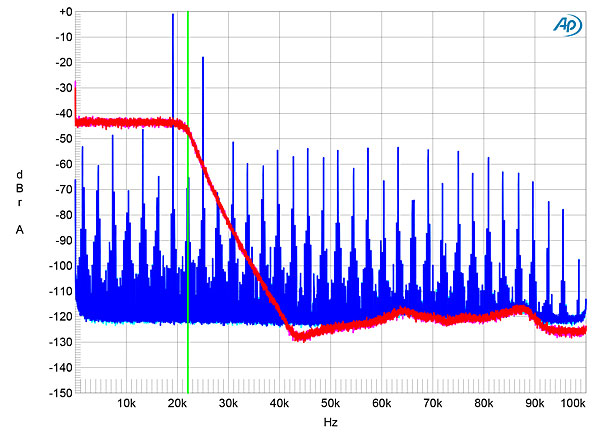
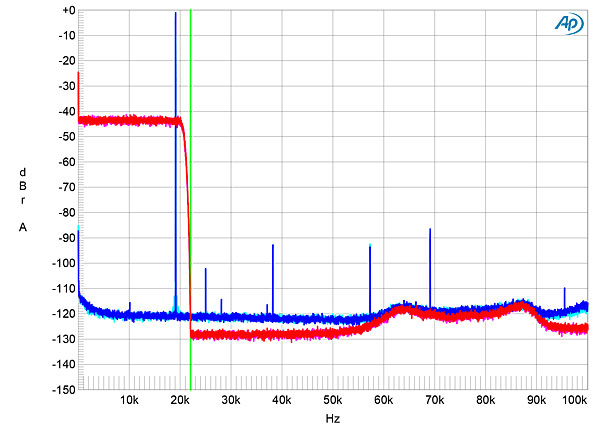
Both the balanced and unbalanced outputs preserved absolute polarity (ie, were non-inverting), the XLR jacks being wired with pin 2 hot. The unbalanced output impedance was a very low 47 ohms from 20Hz to 20kHz; the balanced impedance was twice that, as expected. With the reconstruction filter set to Long, the impulse response with data sampled at 44.1kHz (fig.1) revealed it to be a minimum-phase type, with all the ringing following the single sample at 0dBFS. The Medium filter is also a minimum-phase type, but with less ringing (not shown), while the Short filter, as its name suggests, had even less ringing (fig.2). Tested with 44.1kHz-sampled white noise, the Short filter had a gentle rolloff above the Nyquist frequency (half the sample rate), this shown by the vertical green line in fig.3; but with a full-scale 19.1kHz tone (cyan and blue traces), many aliasing products are visible. Reducing the level of this tone by 3dB gave a much cleaner-looking spectrum (fig.4)—this filter, which resembles that used by other MQA-compatible processors (footnote 1), is "leaky," but relies on the fact that musical signals with full-scale content above 15kHz or so are rare. The Ultra DAC's Long and Medium filters rolled off very sharply above 20kHz (fig.5, magenta and red traces), with maximum attenuation reached at the Nyquist frequency, confirming that these filters are Meridian's "apodizing" types.






Footnote 1: See fig.6 in my measurements of the Mytek HiFi Brooklyn.
Fig.1 Meridian Ultra DAC, Long filter, impulse response (one sample at 0dBFS, 44.1kHz sampling, 4ms time window).
Fig.2 Meridian Ultra DAC, Short filter, impulse response (one sample at 0dBFS, 44.1kHz sampling, 4ms time window).
Fig.3 Meridian Ultra DAC, Short filter, wideband spectrum of white noise at –4dBFS (left channel red, right magenta) and 19.1kHz tone at 0dBFS (left blue, right cyan), with data sampled at 44.1kHz (20dB/vertical div.).
Fig.4 Meridian Ultra DAC, Short filter, wideband spectrum of white noise at –4dBFS (left channel red, right magenta) and 19.1kHz tone at –3dBFS (left blue, right cyan), with data sampled at 44.1kHz (20dB/vertical div.).
Fig.5 Meridian Ultra DAC, Medium filter, wideband spectrum of white noise at –4dBFS (left channel red, right magenta) and 19.1kHz tone at 0dBFS (left blue, right cyan), with data sampled at 44.1kHz (20dB/vertical div.).
Fig.6 shows a conventional examination of the Ultra DAC's frequency response with the Long reconstruction filter. The behavior with 44.1- and 96kHz-sampled data is different from that with 192- and 384kHz-sampled data, with a very slight peak evident before the usual steep rolloff. Peculiarly, the 384kHz response (blue and red traces) is not as extended as that with 192kHz data (cyan, magenta). The Short filter (fig.7) behaved similarly at all three of the sample rates shown in this graph, with a gentle rolloff above each Nyquist frequency.
Fig.6 Meridian Ultra DAC, Long filter, frequency response at –12dBFS into 100k ohms with data sampled at: 44.1kHz (left channel blue, right red), 96kHz (left green, right gray), 192kHz (left cyan, right magenta), 384kHz (left blue, right red) (1dB/vertical div.).
Fig.7 Meridian Ultra DAC, Short filter, frequency response at –12dBFS into 100k ohms with data sampled at: 44.1kHz (left channel green, right gray), 96kHz (left cyan, right magenta), 192kHz (left blue, right red) (1dB/vertical div.).
Channel separation (not shown) was superb, at >120dB in both directions below 2kHz. Although the Meridian's noise floor was very clean, with no sign of supply-related spuriae (fig.8), a very low-level tone was present at 500Hz, half the frequency of the signal used to generate this graph. Changing the bit depth of the data from 16 to 24 with a dithered tone at –90dBFS dropped the noise floor by 17dB (fig.9), implying resolution of 19 bits or so. With an undithered tone at –90.31dBFS (fig.10), the three DC voltage levels are well defined and the Long filter's asymmetrical ringing can be seen on the leading edges of the waveform. With undithered 24-bit data at –90.31dBFS, the Meridian output a well-formed sinewave (fig.11).
Fig.8 Meridian Ultra DAC, spectrum with noise and spuriae of dithered 24-bit, 1kHz tone at: 0dBFS (left channel blue, right red), –60dBFS (left green, right gray) (20dB/vertical div.).
Fig.9 Meridian Ultra DAC, spectrum with noise and spuriae of dithered 1kHz tone at –90dBFS with: 16-bit data (left channel cyan, right magenta), 24-bit data (left blue, right red) (20dB/vertical div.).
Fig.10 Meridian Ultra DAC, Long filter, waveform of undithered 1kHz sinewave at –90.31dBFS, 16-bit data (left channel blue, right red).
Fig.11 Meridian Ultra DAC, Long filter, waveform of undithered 1kHz sinewave at –90.31dBFS, 24-bit data (left channel blue, right red).
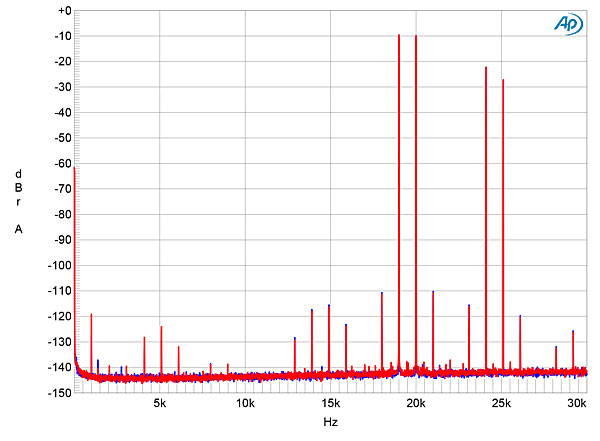
Harmonic distortion was very low, the second and third harmonics accompanying a full-scale 50Hz tone at or below –110dB (0.0003%, fig.12). When I tested the Ultra DAC with an equal mix of 19 and 20kHz tones, intermodulation distortion was also very low (fig.13). This graph was taken with the Long filter; tested with the same signal, the Short filter produced a picket fence of aliasing tones. As I had for fig.5, I reduced the level of the signal by 3dB to reveal that, while the level of intermodulation distortion was as low as it had been with the Long filter, the Short filter didn't provide much attenuation of the aliased images at 24.1 and 25.1kHz (fig.14).
Fig.12 Meridian Ultra DAC, volume control set to "86," spectrum of 50Hz sinewave, DC–1kHz, at 0dBFS into 100k ohms (left channel blue, right red; linear frequency scale).
Fig.13 Meridian Ultra DAC, Long filter, volume control set to "86," HF intermodulation spectrum, DC–30kHz, 19+20kHz at 0dBFS into 100k ohms, 44.1kHz data (left channel blue, right red; linear frequency scale).
Fig.14 Meridian Ultra DAC, Short filter, volume control set to "86," HF intermodulation spectrum, DC–30kHz, 19+20kHz at –3dBFS into 100k ohms, 44.1kHz data (left channel blue, right red; linear frequency scale).
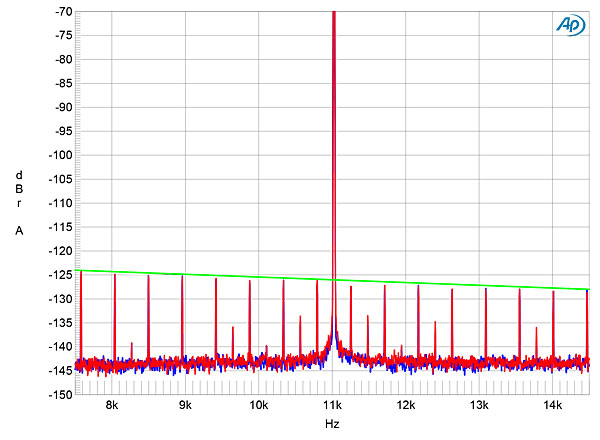
With 16-bit J-Test data sourced via AES/EBU, the Ultra DAC did well at rejecting word-clock jitter (fig.15), all the odd-order harmonics of the low-frequency LSB-level squarewave lying at the correct level. However, some non–data-related sidebands are visible; repeating this test with 24-bit data indicated that these were spaced at 458Hz intervals (fig.16). However, it is fair to point out that these sidebands all lay at or below –135dB, and are therefore inaudible.—John Atkinson
Fig.15 Meridian Ultra DAC, high-resolution jitter spectrum of analog output signal, 11.025kHz at –6dBFS, sampled at 44.1kHz with LSB toggled at 229Hz: 16-bit AES/EBU data (left channel blue, right red). Center frequency of trace, 11.025kHz; frequency range, ±3.5kHz.
Fig.16 Meridian Ultra DAC, high-resolution jitter spectrum of analog output signal, 11.025kHz at –6dBFS, sampled at 44.1kHz with LSB toggled at 229Hz: 24-bit AES/EBU data (left channel blue, right red). Center frequency of trace, 11.025kHz; frequency range, ±3.5kHz.
Footnote 1: See fig.6 in my measurements of the Mytek HiFi Brooklyn.















