

Sidebar 2: Measurements
Looking at fig.1, the way in which the R300's impedance changes with frequency, the speaker appears to be a kind load, never dropping below 8 ohms. In conjunction with its reasonably high sensitivity—I measured 89.5dB/W/m for the 1kHz 1/3-octave—the R300 should mate well with inexpensive, low-powered amplification.

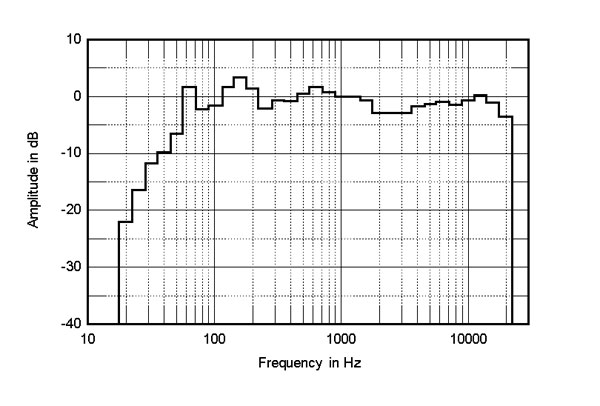
Fig.1 Monitor Audio R300/MD, electrical impedance (2 ohms/vertical div.).
Measured in the nearfield, the microphone almost touching the dustcap, the bass extension was only moderate, at –6dB at 62Hz, though as can be seen from the in-room response, fig.2, the rate of roll-off is quite moderate. Though braced, the cabinet is not as inert as I would have thought desirable, exhibiting several strong rear- and side-panel resonant modes between 260Hz and 295Hz. There was also a very strong side-panel resonance apparent at 363Hz which, in conjunction with the fact that too much energy in the 125–200Hz and 630Hz regions can be seen in the spatially averaged in-room response (fig.2), might correlate with the subjective feeling of slight confusion and coloration in the lower midrange.
Fig.2 Monitor Audio R300/MD, spatially averaged, 1/3-octave response in JA's room.
The tweeter seems well-behaved in this graph, though its level might be 1dB or so too low in absolute terms. The slight rise in its response in-room might be thought to be due to the tweeter's dispersion pattern being quite wide; however, it is most prominent on-axis or just below, suggesting that there really is a little too much energy between 8kHz and 16kHz compared with the octaves either side of that region.—John Atkinson















